
In January 2026, Rackspace announced it was raising the price of its hosted email product from $2.99 per mailbox per month to $10.00 per mailbox per month, effective March 1. That is a 234% increase on a product that had quietly underpinned many small IT resellers' and agencies' email portfolios for years. The Register reported on the backlash in January 2026 after customers flooded forums with complaints. Resellers on the Rackspace partner program were notified roughly six weeks before the change took effect. Some saw monthly contracts jump from around $2,400 to $5,100 or more, with no mechanism to hold the previous rate.
This article walks through exactly what happened, what it means for your reseller economics, and how to move clients to a stable platform without disrupting a single inbox.
Table of Contents
- What Changed in March 2026
- How the Hike Hits Resellers Specifically
- The Margin Math at 50 Mailboxes
- Switching Platforms Without Disrupting Clients
- The Client Conversation
- Frequently Asked Questions
Key Takeaways
| Point | Details |
|---|---|
| Rackspace raised retail email prices 234% | From $2.99 to $10.00 per mailbox per month, effective March 1, 2026, with roughly six weeks' notice to partners. |
| At $10/mailbox, Rackspace now costs more than Google Workspace | Google Workspace Business Starter is $7.00/user/month on an annual plan and includes Docs, Sheets and Meet. Rackspace Email is email only, at $10.00. |
| Reseller margins inverted overnight | The wholesale rate moved with the retail rate. Resellers who had been billing clients at $4 to $5 per mailbox now face a wholesale input that leaves no viable spread at those prices. |
| White-label hosting stays at $1.39/mailbox wholesale | 15 GB included, no contract, no mailbox minimum. You set the client price; the spread is yours every month. |
| IMAP migration preserves everything | Folders, message dates and attachments all copy over from Rackspace. Nothing starts empty. The client's email address does not change. |
What Changed in March 2026
Rackspace Email had been priced at $2.99 per mailbox per month for direct customers, with discounted wholesale rates for authorized resellers through the Rackspace email reseller program. On March 1, 2026, that retail price became $10.00 per mailbox per month. The increase applied across the board: new mailboxes and, critically, existing reseller contracts that had been renewed or repriced under the new schedule.
The optional add-ons layer on top of the base price. Rackspace Email Plus adds $2.00 per mailbox per month for additional archiving and recovery features. The Rackspace Archiving add-on adds another $6.00 per mailbox per month. A fully loaded Email Plus mailbox with Archiving now runs $18.00 per mailbox per month at retail. For comparison, Google Workspace Business Standard, which includes 2 TB pooled storage, Docs, Sheets, Slides, Meet and full-featured calendar, costs $14.00/user/month on an annual commitment.
The reseller program itself was not shut down. Rackspace's email reseller program still allows partners to buy at wholesale, set their own retail price, and handle billing independently. The problem is that the wholesale rate moved with the retail rate. This is the standard pattern when a vendor reprices: the discount percentage may stay roughly the same, but the absolute input cost climbs to a level that makes existing resale pricing unworkable.
How the Hike Hits Resellers Specifically
Before March 2026, a typical reseller setup looked like this: buy Rackspace Email at a wholesale rate below the $2.99 retail, bill clients at $4.00 to $5.00 per mailbox, and keep the difference as recurring margin. That spread was narrow but predictable, and it worked cleanly alongside other hosting services billed through WHMCS or Blesta.
After the hike, the same client bill of $4.50 per mailbox represents a guaranteed loss at any reasonable wholesale rate. To maintain even a thin margin at the new input cost, a reseller would need to charge clients somewhere above $10.00 per mailbox. At that price, Rackspace-resold email costs more than Google Workspace Business Starter ($7.00/user/month annual), which also includes the entire Google productivity suite. That is a nearly impossible pitch: "Your email is going up to over $10 per mailbox, and you get fewer features than Google Workspace at $7."
The clients who notice the pricing inconsistency are exactly the ones most likely to leave. There are only three available responses: absorb the loss on the email line, pass on an uncompetitive price and hope clients do not comparison-shop, or switch platforms before the next billing cycle.
The Margin Math at 50 Mailboxes
Take a 50-mailbox client, a realistic size for a small business account. The table below uses Rackspace's published retail prices as the reference point, since Rackspace does not publish partner wholesale rates publicly. Actual reseller input costs sit below retail, but the direction and magnitude of the change are the same at any discount level: a price that tripled at retail tripled at wholesale too.
| Rackspace retail, pre-March 2026 | Rackspace retail, post-March 2026 | White-label hosting | |
|---|---|---|---|
| Input cost (50 mailboxes) | $149.50/mo (50 x $2.99) | $500.00/mo (50 x $10.00) | $69.50/mo (50 x $1.39) |
| Client bill at $5/mailbox | $250.00/mo | $250.00/mo (now a loss at retail) | $250.00/mo |
| Gross margin (vs retail input) | $100.50/mo | -$250.00/mo | $180.50/mo |
| Annualized | $1,206/year | -$3,000/year | $2,166/year |
The white-label column uses Atriomail's published wholesale price of $1.39 per mailbox per month, 15 GB included. The $5.00 client bill is illustrative: most resellers in mid-market SMB land somewhere between $4 and $8 depending on local competition, and the wholesale rate stays $1.39 regardless. At $5, the client pays significantly less than Rackspace's new $10 retail, which makes the conversation with clients straightforward: they save money and you earn more margin than the old Rackspace arrangement ever produced.
For resellers already surveying hosted email alternatives for their portfolio, the Rackspace price hike removes any ambiguity: at $10/mailbox for a product with no productivity suite attached, Rackspace is no longer cost-competitive for clients who have any awareness of what Google Workspace charges.
Switching Platforms Without Disrupting Clients
The practical concern most resellers raise is what actually happens to the client during a migration. The answer: very little, if you sequence it correctly.
Step 1: Provision the new mailboxes before touching DNS
Create the client's mailboxes on the new platform first. This takes minutes through the admin panel. At this stage the client is still live on Rackspace and receiving mail normally; nothing has changed for them yet.
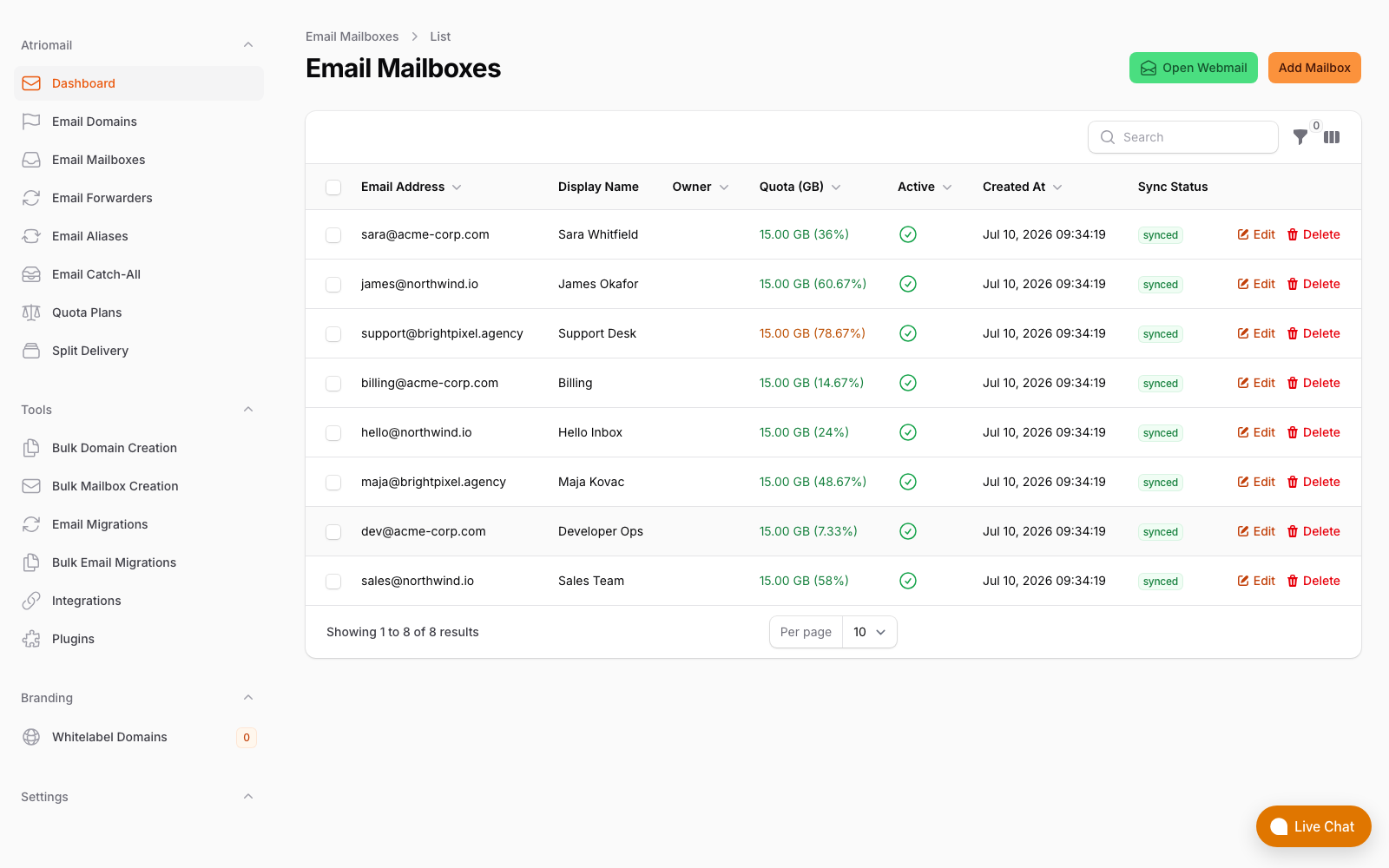
The mailbox list in the Atriomail admin panel, where you provision and monitor all client accounts before and after migration.
Step 2: Run the IMAP copy while the client stays live
The built-in IMAP migration connects to each client's Rackspace mailboxes, copies all messages, folders and attachment history to the new mailboxes, and preserves original message dates. The client never sees this step; they are still receiving and sending mail on Rackspace during the copy. A typical small business mailbox of 2 to 5 GB migrates in under an hour. Larger archives take proportionally longer but run in the background with no client-facing disruption.
This sequence is the standard pattern for any IMAP-to-IMAP move: copy first, cut over after. The result is that there is never a window where the client has an empty mailbox. The full approach is covered in the guide to migrating email without downtime or headaches.
Step 3: Update DNS to complete the cutover
Once the IMAP copy is complete, you update the client's MX records to point at the new mail servers. SPF, DKIM and DMARC records publish automatically across the 15 supported DNS providers, so deliverability does not regress on day one the way a hand-configured cutover can. The MX propagation window is typically under an hour; mail sent during that window is queued by the sending server and delivered once propagation completes. No mail is lost.
No need to move all clients at once
There is no minimum account count and no requirement to migrate your entire book in one operation. Most resellers pilot with one or two accounts, confirm deliverability and client experience hold up, and work through the rest of the portfolio at their own pace. A client's upcoming contract renewal is a natural trigger: migrate and reprice in the same billing conversation.
Once clients are on the new platform, the mailbox line goes on the same WHMCS or Blesta invoice they already receive, at whatever price you have set. The mechanics of automating email billing in WHMCS and Blesta are identical regardless of which mail platform sits behind the scenes; the changeover is invisible at the invoice level.
The Client Conversation
Clients care about three things when their email platform changes: their address stays the same, their old mail is still there, and the price makes sense. All three are true when you migrate them correctly.
The honest framing: "The email infrastructure I was using for you changed its pricing significantly earlier this year, so I have moved to a better-priced provider. Your address is exactly the same, your full email history has been copied over, and your monthly rate is staying at [current price]." Most clients want to confirm their email still works and move on. The migration itself is invisible to them.
Clients who ask more questions often already know that their Rackspace mailbox felt dated or that pricing had been opaque. A clean migration is frequently an opportunity to reset the relationship: one invoice, your branding, your support line, and a price that reflects what the service is actually worth rather than whatever Rackspace decided to charge in 2026.
The structural issue behind the Rackspace price hike is the same one covered in the Namecheap outage analysis: building a client portfolio on infrastructure you do not control means absorbing vendor decisions, including pricing decisions, with no advance notice and no leverage. Moving to a platform where you are the biller, you set the price, and you manage the client relationship is the structural fix, not just a response to one price hike.
For context on why resellers systematically underestimate the margin difference between resale and white-label ownership, the Google Workspace margin comparison covers the same math from a different angle: the reseller who set up a client on Google Workspace but is not a formal Google partner also earns $0 recurring, a different version of the same problem.
Frequently Asked Questions
Will migrating change my clients' email addresses?
No. Email addresses are tied to the domain, not to Rackspace's infrastructure. You move the mailboxes; the address stays the same. Clients continue using name@theirdomain.com without any change on their end.
What happens to mail that arrives during the DNS cutover?
Mail sent while MX records are propagating is queued by the sending server and delivered once propagation completes. This is standard SMTP behavior; no mail is lost. Propagation typically takes well under an hour for most DNS providers.
Can I negotiate with Rackspace instead of migrating?
Rackspace's partner program wholesale rates moved with the March 2026 retail increase. Some resellers with older volume contracts may have different terms for the remainder of their contract term, but Rackspace has not published any mechanism for locking in pre-March 2026 pricing for new or renewed mailboxes. Check your renewal date: once a fixed-term contract lapses, new pricing applies.
How long does migrating one client domain actually take?
Setup takes minutes. IMAP copy time depends on total mailbox size: a typical small business domain with 5 to 10 mailboxes averaging 2 GB each migrates in one to two hours. You run the copy while the client is still live on Rackspace, then cut over DNS only after the copy completes. The client starts on the new platform with a full inbox and no downtime window.
Recommended
- Email Hosting Alternatives for Hosting Providers: A Comparison, Atriomail
- Master the Art of Email Migration Without Downtime or Headaches, Atriomail
- Automate Email Billing in WHMCS and Blesta, Atriomail
- The Namecheap Outage: What Resellers Should Build Differently, Atriomail
- White-Label Email vs. Reselling Google Workspace: The Margin Math, Atriomail
- Atriomail Pricing and Reseller Margin Calculator, Atriomail
Latest from the blog
- How to Set Up BIMI So a Client's Logo Shows Up in Gmail and Yahoo · Oct 12, 2026
- DreamHost Email vs Atriomail: What "Unlimited" Doesn't Cover for Resellers · Oct 10, 2026
- A Client's Email Account Was Compromised: Why a Password Reset Alone Doesn't Fix It · Oct 9, 2026
- Aliases, Forwarders and Catch-Alls in Atriomail: The One Rule That Decides When They Work · Oct 8, 2026
- How to Move a Client's DMARC Policy to p=reject Without Breaking Their Mail · Oct 7, 2026