
Plesk comes with email built in. Postfix handles outgoing mail, Dovecot handles IMAP and POP3, and SpamAssassin does spam filtering. For hosting resellers who already pay for a Plesk Web Host license to manage client domains, those mailboxes look free.
After Plesk's January 2026 licensing changes, that calculation has shifted. The Web Host tier now runs approximately $60 per month per server, the company eliminated annual rate locking in the same move, and the underlying deliverability and billing limitations that existed before are still there. This post works through each of them and compares the picture against dedicated white-label email hosting at $1.39 per mailbox per month.
Table of Contents
- What Plesk's Email Stack Actually Is
- The 2026 Licensing Change That Changed the Math
- DKIM, SPF, and DMARC: The External DNS Complication
- Shared IP Deliverability Risk
- WHMCS Billing: What Metric Billing Can and Cannot Do
- The Margin Math
- When Plesk Email Is the Right Answer
- Moving Clients Off Plesk Mail
- FAQ
Key Takeaways
| Point | Details |
|---|---|
| Plesk email costs $0 per mailbox but not $0 to operate | The Web Host license runs approximately $60 per server per month post-January 2026, plus server infrastructure costs, regardless of how many mailboxes you provision. |
| DKIM, SPF, and DMARC auto-configure only when Plesk manages DNS | For domains using external DNS providers (Cloudflare, Route 53, registrar DNS), all three authentication records must be added manually per domain, every time. |
| Email is bundled in hosting: hard to bill as its own line item | Plesk's WHMCS integration can track mailbox usage within subscriptions, but it does not support selling standalone email-only products to clients without a hosting account. |
| Dedicated white-label hosting puts the margin on your invoice | At $5 per mailbox retail, 50 mailboxes returns $180.50 per month in gross margin vs. $0 from bundled Plesk email. |
What Plesk's Email Stack Actually Is
Plesk Obsidian is a web hosting control panel that runs on Linux or Windows servers. The email stack built into it uses Postfix for outbound delivery, Dovecot for IMAP, POP3, and local delivery, and SpamAssassin for spam filtering. Plesk layers its own configuration interface on top: per-domain mail settings, a webmail interface (Horde or Roundcube), per-domain DKIM key generation, and a server-level spam filter dashboard.
The structural difference from a dedicated email platform is that Plesk email lives inside a hosting control panel. Every mailbox belongs to a hosting subscription. There is no concept of a standalone email-only account in the standard Plesk model: if a client needs email, they also hold a Plesk hosting subscription with disk quota, web space, and FTP access allocated alongside it.
This is different from how white-label email hosting is structured, where the mailbox is the product, billed per seat, regardless of whether the client has any web hosting account at all.
The 2026 Licensing Change That Changed the Math
Plesk licenses are per server, not per account. You pay one monthly fee for the entire server, and that covers every domain and subscription running on it. The tier you need depends on how many domains you host:
| Edition | Domain cap | Monthly price (post-Jan 2026) |
|---|---|---|
| Web Admin | 10 domains | ~$16/month |
| Web Pro | 30 domains | ~$29/month |
| Web Host | Unlimited | ~$60/month (VPS) |
For a hosting reseller managing more than 30 client domains, Web Host is the only tier that does not impose a hard cap on growth. Effective January 2026, Plesk announced an average price increase of approximately 26% across all tiers and simultaneously eliminated annual billing in favor of monthly-only subscriptions. Before the change, resellers could lock in a rate for twelve months. That option is gone: pricing now adjusts annually, billed monthly with no ability to hedge against the next increase.
Combined with server costs (a VPS adequate for running Plesk across 20 to 50 client domains runs roughly $20 to $40 per month on most infrastructure providers), the real monthly floor for a Plesk reseller's email infrastructure lands between $80 and $100 per month before a single mailbox is provisioned. That overhead is fixed: it exists whether you are serving five clients or fifty.
DKIM, SPF, and DMARC: The External DNS Complication
This is where Plesk diverges meaningfully from what most resellers expect.
When Plesk manages a domain's DNS using its own built-in PowerDNS or BIND, the control panel automatically generates a DKIM key pair and publishes the DNS record when you enable DKIM for that domain. It also adds an SPF record and, for new domains, sets a default DMARC quarantine policy automatically. On paper, that covers the full authentication stack without manual work.
The problem is that many clients do not use Plesk as their DNS authority. If a client's domain is managed through Cloudflare (the scenario covered in detail in Cloudflare Email Routing vs. White-Label Email Hosting), AWS Route 53, their domain registrar, or any other external provider, Plesk cannot write records to that DNS zone. The Plesk documentation is explicit on this point: domains using an external DNS server cannot have DKIM enabled automatically. Plesk displays the required TXT record values, and the reseller must log in to the external provider and add them by hand.
SPF and DMARC face exactly the same limitation when DNS is external. For every client domain not using Plesk's DNS server, all three authentication records become a manual, per-domain operation. A reseller managing 30 client domains across three registrars and Cloudflare faces 30 separate manual tasks, each one a support overhead that grows every time a new client onboards or changes their DNS provider.
Dedicated email platforms handle this differently. They publish authentication records through their own DNS integrations for each domain you add, regardless of where the client's authoritative DNS lives. The configuration is set once per integration; from there, adding a new domain means the platform handles the record publishing automatically across all connected DNS providers. You can see how that connects to billing workflow in Automate Email Billing in WHMCS and Blesta.
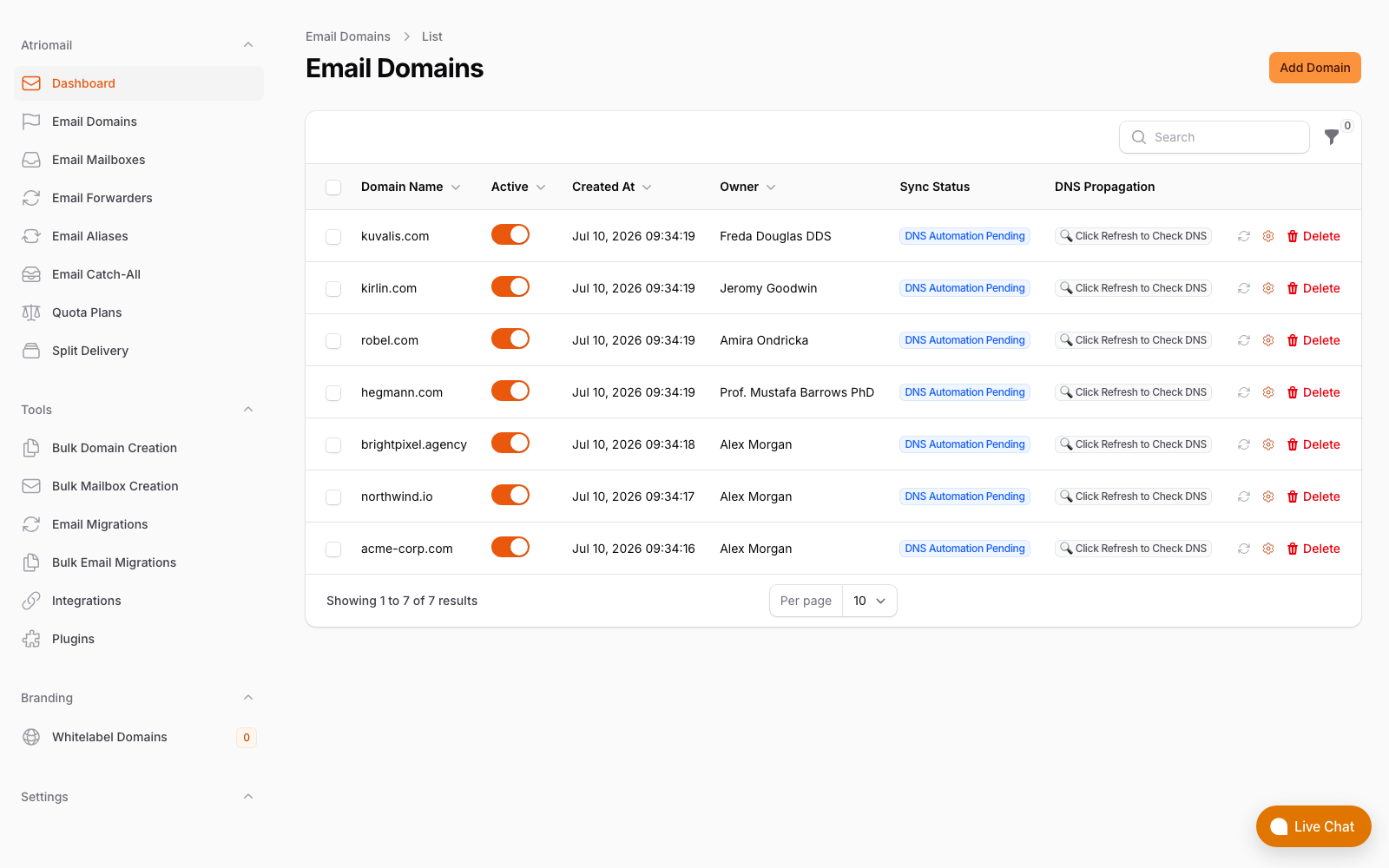
DNS authentication records published automatically per domain in the Atriomail panel, regardless of where the domain's authoritative DNS is hosted.
Shared IP Deliverability Risk
Like cPanel's email stack, Plesk routes all outgoing mail through the server's IP address or IP pool. On a shared hosting server, every client domain sends from the same IP. One account compromised into a botnet, one client running a badly configured newsletter blast, one domain missing authentication records that gets spoofed and starts generating bounces: all of these events affect every other client on the same server.
Plesk's own support documentation acknowledges this directly. When a server IP gets listed on Spamhaus, Barracuda, or other DNS block lists, every domain using that IP is affected until delisting is complete. Plesk's recommended mitigation for persistent deliverability problems on shared infrastructure is routing outbound mail through a third-party SMTP relay such as SendGrid, Mailgun, or Amazon SES. That recommendation adds cost and configuration overhead, and it applies to all clients simultaneously: if you want one client's mail routed through a relay, you typically route all of them, or run separate relay rules per domain.
For a reseller managing 20 to 50 client domains on one Plesk server, this is the same correlated failure problem that the self-hosted vs. white-label comparison covers in depth: when all clients share an IP or IP pool, one client's problem becomes everyone's deliverability event.
WHMCS Billing: What Metric Billing Can and Cannot Do
WHMCS added metric billing support for Plesk in version 8.5, which allows you to track usage of specific resources within a hosting subscription and bill for overages. Mailboxes are one of the trackable resources: you can set an included quantity in the base plan and charge a per-unit fee when clients exceed that limit.
This sounds like per-mailbox billing, but the mechanics matter. Metric billing in WHMCS for Plesk operates at the hosting subscription level. A client purchases a hosting plan; within that plan, mailboxes are counted. If usage exceeds the included threshold, WHMCS adds a charge to the next invoice. The client is still buying "hosting" with email as one component, not "email" as the standalone product.
What this model does not support is selling email-only plans to clients who hold no Plesk hosting subscription. A client who hosts their website somewhere else, needs only business email on their domain, and wants to pay you a flat monthly per-mailbox fee cannot be cleanly provisioned and automatically invoiced through the standard Plesk WHMCS module. You can create minimal hosting subscriptions used only for email, but those subscriptions still allocate disk quota and appear in the client interface as hosting accounts rather than email accounts.
White-label email hosting is designed around exactly the opposite structure: the mailbox is the unit of sale. Provisioning, billing, and support all center on the mailbox, and the client's web hosting choice has no bearing on whether you can onboard them. For the workflow detail, see Automate Email Billing in WHMCS and Blesta.
The Margin Math
Take a reseller with 50 client mailboxes spread across 10 client domains. Running those mailboxes on Plesk requires both a server and a license:
| Plesk reseller | White-label email hosting | |
|---|---|---|
| Infrastructure cost | VPS ~$30/month + Plesk Web Host ~$60/month = $90/month | None (wholesale only, no server to run) |
| What you pay wholesale | $90/month flat, regardless of mailbox count | 50 x $1.39 = $69.50/month |
| What the client pays | Bundled in hosting plan; no separate email invoice line | $5.00/mailbox = $250/month on your invoice |
| Your recurring email margin | $0/month (email is not separately billed) | $250 - $69.50 = $180.50/month |
| Annualized | $0 | ~$2,166/year |
The $90/month infrastructure figure is a conservative floor, not an average. It does not include admin time for server patching, spam-filter tuning, blacklist monitoring, or the SMTP relay cost that Plesk recommends for shared-server deliverability. Even ignoring admin overhead entirely, a Plesk reseller who wants to capture email as a separate revenue line needs to break it out of the hosting invoice and price it explicitly, which the standard WHMCS module does not do for standalone email plans.
Atriomail's wholesale price is $1.39 per mailbox per month, 15 GB included, with extra storage at $0.60 per additional 5 GB block. Domains, aliases, forwarders, and IMAP migration are free. There is no contract and no minimum mailbox count.
When Plesk Email Is the Right Answer
There are genuine scenarios where Plesk's built-in email works well and the overhead is easy to absorb:
- You already run a Plesk Web Host server for client websites, and email is a convenience add-on rather than a product line you bill separately. The license cost is already baked into hosting margins you are already charging.
- All your client domains use Plesk's built-in DNS, so DKIM, SPF, and DMARC are auto-configured without any per-domain manual work. If every client uses Plesk DNS, the automation story is actually reasonable.
- You have fewer than 10 to 15 client domains and the per-server license cost is a small fraction of the hosting revenue those accounts generate.
- Clients need basic webmail access alongside a Plesk-hosted site and have no deliverability-sensitive use case (no newsletters, no transactional triggers, no business-critical outbound volume).
Outside those scenarios, especially for resellers who want to sell email to clients independent of web hosting, the per-server license model and email-bundled-in-hosting structure work against building a scalable email product line.
Moving Clients Off Plesk Mail
For resellers who decide to move client mailboxes to a dedicated platform, the migration is IMAP to IMAP. Existing mail, folder structure, and message dates are preserved by running an IMAP migration job from the destination platform. Dedicated email hosting platforms with built-in migration can pull from any IMAP source, including Dovecot running behind a Plesk server, without requiring SSH access to the server itself.
DNS cutover is the second step: update each domain's MX records from the Plesk server's IP to the new platform's inbound mail servers. If the domain uses Plesk DNS, the MX record lives in Plesk's zone editor. If it uses Cloudflare or another external provider, the same DNS dashboard where you were manually managing DKIM records is where you make the MX update.
Timing matters: run IMAP migration before DNS cutover and let both servers accept mail in parallel during a short window to avoid bounce risk from in-flight messages. Most migrations for clients with 5 to 20 mailboxes complete within a few hours.
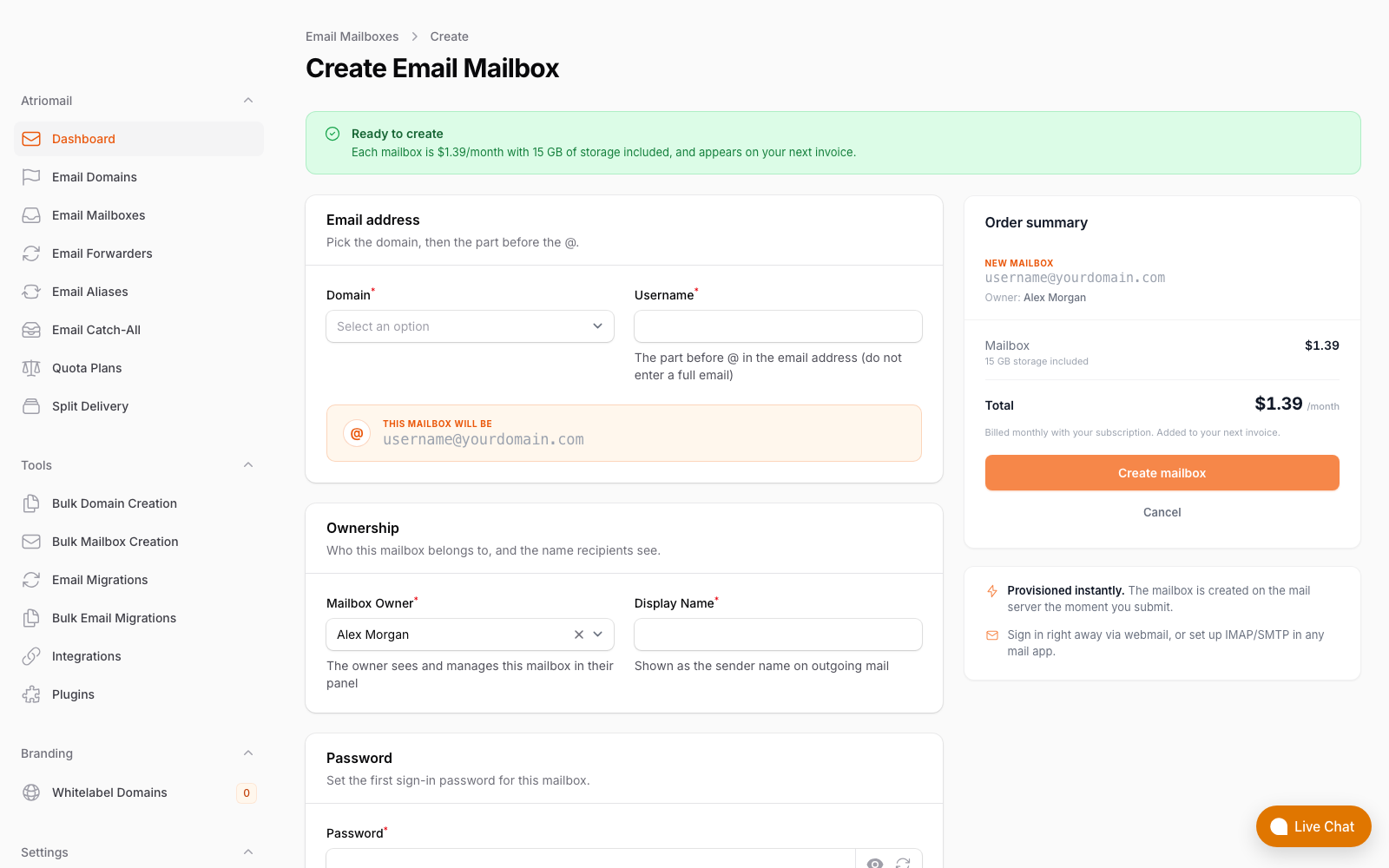
Provisioning a new mailbox in the Atriomail panel, the same flow whether migrating from Plesk or starting a new account from scratch.
Frequently Asked Questions
More detail on migration, billing, and setup in the full FAQ.
Does Plesk support DMARC?
Yes. Plesk includes DMARC configuration in its mail server settings. For new domains managed by Plesk DNS, it sets a default quarantine policy automatically. For domains using external DNS, the DMARC TXT record must be added manually to the external provider. Plesk displays the record value but cannot push it to an external zone.
Can I sell email-only plans through Plesk without a hosting subscription?
Not cleanly with the standard Plesk model. Email in Plesk is provisioned as part of a hosting subscription. You can create minimal subscriptions used primarily for email, but they still allocate disk and web space and appear as hosting accounts in the client interface. WHMCS metric billing can track and charge for mailbox overages within subscriptions, but the base product being sold is always hosting, not email.
What WHMCS version supports metric billing for Plesk?
WHMCS 8.5 and later support metric billing for Plesk servers, including mailbox count as a trackable resource. This allows you to define an included mailbox quantity within a hosting plan and add per-unit charges when clients exceed that threshold on their next billing cycle.
How does the January 2026 pricing change affect annual plan holders?
Plesk eliminated annual plan billing effective January 2026. Resellers previously on annual plans were moved to monthly billing at the new rates. The ability to lock in a price for twelve months no longer exists, which means licensing costs now adjust with each annual price revision and cannot be smoothed out with a prepaid annual commitment.
Recommended
- cPanel Email vs. White-Label Email Hosting: The Real Cost for Hosting Resellers, Atriomail
- Self-Hosted Email Server vs. White-Label Hosting: What MSPs Get Wrong About the Math, Atriomail
- Automate Email Billing in WHMCS and Blesta: Best Practices for Resellers and MSPs, Atriomail
- Cloudflare Email Routing vs. White-Label Email Hosting: What MSPs Need to Know, Atriomail
- What Is White-Label Email? Atriomail
- Pricing and the Reseller Margin Calculator, Atriomail
Latest from the blog
- How to Read an Email Bounce Message: What the SMTP Code Is Actually Telling You · Oct 14, 2026
- SiteGround Email for Agencies: Why "Included" Doesn't Mean You Can Bill for It · Oct 13, 2026
- How to Set Up BIMI So a Client's Logo Shows Up in Gmail and Yahoo · Oct 12, 2026
- DreamHost Email vs Atriomail: What "Unlimited" Doesn't Cover for Resellers · Oct 10, 2026
- A Client's Email Account Was Compromised: Why a Password Reset Alone Doesn't Fix It · Oct 9, 2026