
DirectAdmin is the third major hosting control panel, behind cPanel and Plesk, and it has a loyal following among hosting resellers who want a capable, affordable alternative to both. The Standard license at $29/month includes unlimited accounts and domains, which looks appealing compared to cPanel's per-account pricing model. Email, powered by Exim and Dovecot, ships with every DirectAdmin installation at no extra cost.
The problem shows up when you try to turn that bundled email into a standalone revenue line. DirectAdmin's account model is designed for hosting packages, not for per-mailbox email subscriptions. DMARC authentication requires a manual DNS record on every domain. Every client on your server shares the same outbound IP pool. And the WHMCS native DirectAdmin module provisions hosting accounts, not email-only products. This piece works through each of those constraints, with real numbers, so you can decide which clients belong on DirectAdmin's built-in email and which need a dedicated platform.
Table of Contents
- How DirectAdmin Email Works for Resellers
- What DirectAdmin Costs in 2026
- The DNS Authentication Gap
- The WHMCS Billing Problem
- Shared IP Deliverability Risk
- The Margin Math for Email-Only Clients
- When DirectAdmin Email Is the Right Call
- Where Atriomail Fits
- Frequently Asked Questions
Key Takeaways
| Point | Details |
|---|---|
| DirectAdmin Standard is $29/month flat | Unlimited accounts and domains on one server. No per-account fees, unlike cPanel. Lite is $15/month for up to 10 accounts and 50 domains. |
| DKIM is semi-automatic, DMARC is always manual | DirectAdmin auto-generates DKIM keys when configured and adds the record to its own DNS zone. DMARC requires a manual TXT record in DNS Management per domain, every time. |
| No standalone email product in WHMCS | The native DirectAdmin WHMCS module provisions full hosting packages (web, email, databases). You cannot bill email-only subscriptions per mailbox through standard DirectAdmin provisioning. |
| Every client shares the same outbound IP | One compromised or high-volume sender on the server risks the shared IP reputation for every other domain you host. |
| Separation is the fix for all four problems | Moving email onto a dedicated white-label platform gives per-mailbox billing, automated DMARC, dedicated IP pools, and native WHMCS/Blesta email modules. |
How DirectAdmin Email Works for Resellers
DirectAdmin uses a three-tier account hierarchy: Admin (you, the server owner), Reseller (clients who manage their own sub-clients), and User (end clients with individual hosting accounts). When a User account is created, it gets a bundle: web hosting, MySQL databases, FTP access, and email all in the same package. Email accounts, forwarders, autoresponders, and webmail access via Roundcube are provisioned through the User account's own panel.
This structure works cleanly for traditional web hosting resellers. One client needs a website plus business email on their domain: create one User account, set the limits (storage, mailboxes, databases), and the client manages everything in their own panel. The challenge arrives the moment a client's email needs diverge from that bundled model.
Two scenarios break the pattern. First, a client who hosts their website elsewhere and only wants email: to serve them through DirectAdmin, you have to give them a full hosting account anyway, which complicates billing and wastes resources. Second, a client who grows beyond what a shared server can reliably deliver: the email keeps competing with Apache or Nginx for memory and the Exim queue backs up under load. For resellers aiming to build a dedicated email service alongside their hosting business, the bundling is the constraint that matters most.
What DirectAdmin Costs in 2026
DirectAdmin publishes three retail license tiers:
| License | Price | Accounts | Domains |
|---|---|---|---|
| Personal PLUS | $5/month | 2 | 20 |
| Lite | $15/month | 10 | 50 |
| Standard | $29/month | Unlimited | Unlimited |
Bulk discounts start at four Standard licenses: 15% off at four, scaling to 40% off at 35 or more. For a reseller running a single server, the Standard license at $29/month is the right tier. Add a VPS or dedicated server at $15 to $40/month depending on specs, and the infrastructure baseline sits at roughly $44 to $69/month before any additional software (SpamAssassin, ClamAV, Roundcube updates, backup storage). That compares reasonably with a cPanel setup at equivalent scale, though cPanel's per-account pricing climbs faster as client count grows.
The license cost is flat and straightforward. What it does not buy you is a way to bill email as a line item separate from hosting, and that is where the DirectAdmin cost model starts to diverge from what a reseller building an email business actually needs.
The DNS Authentication Gap
Reliable email delivery in 2026 requires three DNS records on every domain: SPF (declares which servers are authorized to send), DKIM (a cryptographic signature attached to outgoing messages), and DMARC (the policy record that tells receiving servers what to do when SPF or DKIM fail). Missing or misconfigured records are the leading cause of messages landing in spam rather than the inbox, which becomes a support ticket.
DirectAdmin's handling of these records is partially automated, partially manual, and depends heavily on whether you are also managing the client's DNS:
- DKIM: DirectAdmin auto-generates a DKIM key pair when the feature is enabled (the
dkim=1configuration flag), and adds the public key TXT record to the domain's local DNS zone automatically. This works well when DirectAdmin is also the nameserver for the domain. When a client points their domain to Cloudflare, Route 53, or a registrar's DNS, the record has to be extracted and added manually to the external zone. - DMARC: DirectAdmin does not create a DMARC record automatically at any point. According to the DirectAdmin community forums, DMARC has been a long-requested feature for automatic configuration and remains a manual step: you add a
_dmarcTXT record through the domain's DNS Management interface each time a new domain is activated. - SPF: DirectAdmin adds an SPF record to the local zone for new domains, but does not push it to external DNS providers automatically.
In practice, for a reseller with 30 active client domains, that means 30 manual DMARC records: one to create per new domain, one to update whenever a client adds a third-party mail sender. The deliverability impact is real: without a DMARC record, receiving servers have no policy to enforce, which is increasingly treated as a trust signal by Gmail and Microsoft 365 mail filters. Google and Yahoo's 2024 bulk sender requirements made DMARC mandatory for high-volume senders, and the bar for "high-volume" keeps moving.
This is the same structural limitation found in Plesk's built-in email when Plesk is not managing DNS: the server can generate the right records, but getting them into an external zone is a manual step for every domain.
The WHMCS Billing Problem
WHMCS is the billing and automation platform that most hosting resellers and MSPs use to provision services and invoice clients. DirectAdmin integrates with WHMCS through a native module that lets you automate account creation: a client signs up for a hosting plan, WHMCS creates a DirectAdmin User account with the specified resource limits (disk, bandwidth, email accounts, databases), and the client gets login credentials automatically.
That automation works well for bundled hosting packages. It does not extend to per-mailbox email billing. The DirectAdmin WHMCS module provisions accounts with email accounts as a resource limit inside a hosting package: you can cap a plan at five mailboxes or fifty, but you cannot bill a client $5 per mailbox per month and have WHMCS automatically adjust the invoice when they add a sixth mailbox. That kind of per-mailbox billing automation requires a platform built specifically for email, not one where email is a feature inside a hosting account.
The practical consequence: resellers who want to sell email as a standalone, usage-based product through WHMCS have to choose between custom-coding their own DirectAdmin integration or using a third-party module such as ModulesGarden's DirectAdmin Extended. Neither path changes the underlying reality that DirectAdmin's architecture treats mailboxes as a feature of a hosting account, not as independently billable units.
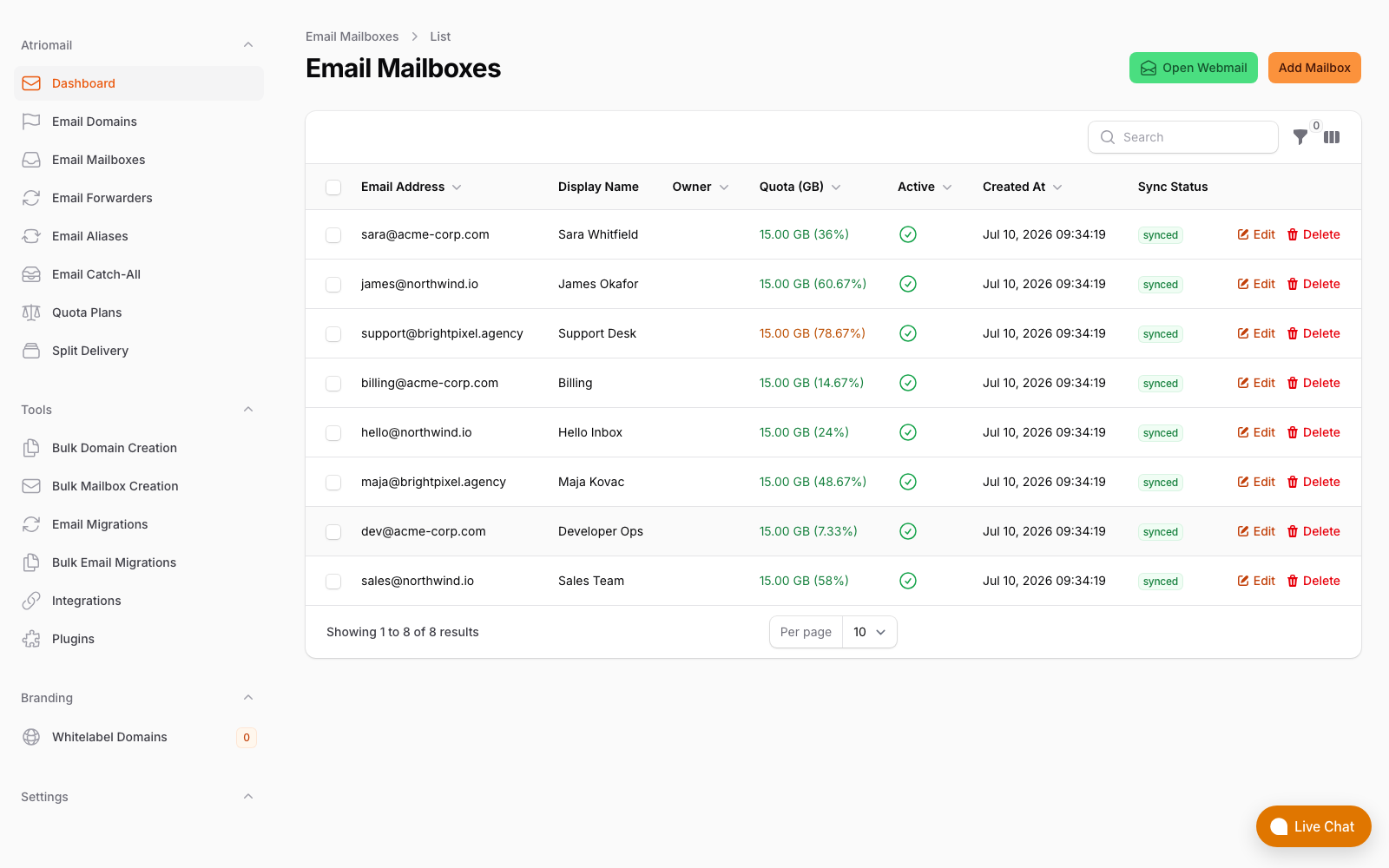
A dedicated white-label platform tracks every mailbox individually, which is what per-mailbox billing in WHMCS or Blesta actually requires.
Shared IP Deliverability Risk
All mail sent from a DirectAdmin server leaves through the server's outbound IP address (or a small pool of IPs if you have configured multiple). Every domain on the server shares that reputation. A single client who sends a promotional blast without proper list hygiene, or a compromised mailbox that sends spam before it is caught, can get the shared IP added to a blocklist. When that happens, mail from every domain on the server is affected until the IP is delisted.
For a reseller hosting 20 client domains, this is a correlated failure: one client's problem becomes every client's problem simultaneously. The same failure mode applies to shared hosting email in general, whether the platform is DirectAdmin, cPanel, or Plesk. The difference is that email-specific platforms maintain dedicated IP pools with reputation systems designed around email sending patterns, and they typically have automated IP warming and rotation that shared hosting stacks do not.
Blocklist events are time-consuming to resolve. You file a delisting request, wait for review (24 to 72 hours on many lists), and explain to affected clients why their mail was rejected in the meantime. On a busy reseller book of 50 or more email clients, this risk compounds: the more domains you add to the same IP pool, the higher the probability that one of them triggers a problem.
The Margin Math for Email-Only Clients
Take a realistic scenario: a new client wants professional email for their 50-person team, but their website is already on a managed WordPress host they are happy with. They need email, not web hosting. Here is what each path looks like:
| DirectAdmin (hosting bundle required) | White-label email hosting | |
|---|---|---|
| What you provision | Full hosting account with unused web/database resources | 50 mailboxes, no web hosting required |
| What you pay wholesale | No marginal cost (already paying $29/mo for the server) | 50 x $1.39 = $69.50/month |
| What you can bill | A hosting plan price (e.g. $10/month), not per-mailbox | Whatever you set per mailbox, e.g. $5.00 x 50 = $250/month |
| Your recurring margin | $10/month (if the client accepts a hosting plan for email-only) | $250 - $69.50 = $180.50/month |
| Annualized | ~$120/year | ~$2,166/year |
The DirectAdmin path is not worthless: if this client also needs web hosting, bundling email into a single account at a single price is efficient. But email-only clients are common, and their email needs grow over time. A client who starts at 10 mailboxes and grows to 50 produces meaningful recurring revenue on a per-mailbox model, and that revenue is invisible if they are on a fixed-price hosting plan that does not scale with mailbox count.
The Atriomail wholesale price is $1.39 per mailbox per month with 15 GB included and no contract. The spread between that wholesale cost and whatever you charge clients is margin you control. There is no minimum mailbox count to start, so piloting with one or two email-only clients before migrating the full book is straightforward.
When DirectAdmin Email Is the Right Call
DirectAdmin's built-in email genuinely suits a subset of reseller scenarios. Being honest about that matters more than overselling the alternative:
- Every email client is also a web hosting client. If your book is 100% bundled: same client, same domain, website plus email in one account, the DirectAdmin model is efficient. There is no unbundling needed and no per-mailbox billing complexity.
- All clients use DirectAdmin-managed DNS. When DirectAdmin controls the nameservers, DKIM automation works as designed and SPF records populate automatically. The manual step for DMARC remains, but it is one record to add per domain rather than coordinating with Cloudflare or a registrar for every authentication record.
- Your client count is small and relatively stable. Under 10 active domains on a Lite license ($15/month), the shared-IP risk is lower and the manual DMARC overhead is manageable. At that scale, the infrastructure cost per domain is also low enough that the economics are reasonable even for bundled hosting.
- You are not trying to build email as a separate revenue category. If email is a convenience add-on to hosting, not a distinct service line with its own pricing, WHMCS product, and margin target, DirectAdmin is a reasonable choice.
The decision point is whether you want to sell email to clients who do not need web hosting, price it per mailbox with automatic WHMCS billing that scales as clients grow, and avoid the deliverability risk of a shared IP pool. If yes to any of those, a dedicated white-label platform handles all three in a way that DirectAdmin's architecture cannot.
Where Atriomail Fits
The section above makes the case for keeping email on DirectAdmin where the book is fully bundled. Where it is not, each of the four problems this article documented has a direct answer.
DMARC stops being manual: SPF, DKIM and DMARC are all published automatically per domain across 19 supported DNS providers and panels, rather than DKIM landing in the local zone while DMARC waits for someone to remember it. Email-only billing becomes possible: the WHMCS and Blesta modules provision and invoice per mailbox, so you can sell email to a client who does not buy hosting from you, which standard DirectAdmin provisioning cannot express. And the shared outbound IP problem is what moving off the box solves in the first place, since one client's sending behaviour stops sitting on the same reputation as every other domain on your server.
At $1.39 per mailbox per month with 15 GB included, that also turns email from a bundled cost inside a $29 per month server into a line item with its own margin. See the pricing page.
Frequently Asked Questions
Can I sell email-only packages through DirectAdmin?
Not cleanly. DirectAdmin requires every email account to belong to a User account, which is a full hosting account with web, database, and email resources bundled together. You can create a minimal hosting account with storage capped low and no web hosting configured, but WHMCS will still invoice it as a hosting plan rather than a per-mailbox subscription. There is no native DirectAdmin product type for standalone email with per-mailbox billing.
Does DirectAdmin set up DMARC automatically?
No. DKIM automation exists (the server generates the key pair and adds the record to its local DNS zone when enabled), but DMARC has no equivalent automatic step. Each domain requires a manual _dmarc TXT record added through the DNS Management interface. If the client uses external DNS, that record also has to be added on their DNS provider's side.
What happens when a client uses Cloudflare for DNS?
DirectAdmin's automatic DKIM record only populates the local zone it manages. When a client's domain resolves via Cloudflare, Route 53, or any external provider, DKIM, SPF and DMARC records all need to be added manually on the external provider. A dedicated email platform that integrates with 15 DNS providers publishes those records automatically on domain activation, which is what automated DNS validation actually means in practice.
Is DirectAdmin better than cPanel for email resellers?
The email architecture is similar: both use Exim and Dovecot, both have the same shared-IP problem, and both bundle email inside hosting accounts rather than selling it as a standalone product. DirectAdmin's licensing is simpler (flat per-server, no per-account fees), which makes cost predictable as you scale. But the core email limitations are the same. Both cPanel and DirectAdmin are web hosting platforms first. If per-mailbox email revenue is the goal, neither platform's native email is the right tool.
Recommended
- cPanel Email vs. White-Label Email Hosting: The Real Cost for Hosting Resellers, Atriomail
- Plesk Email vs. White-Label Email Hosting: The Reseller's Real Cost, Atriomail
- Automate Email Billing in WHMCS and Blesta: Best Practices for Resellers, Atriomail
- Automated DNS Validation: Higher Deliverability, Fewer Tickets, Atriomail
- What Is White-Label Email? Atriomail
- Pricing and the Reseller Margin Calculator, Atriomail
Latest from the blog
- How to Read an Email Bounce Message: What the SMTP Code Is Actually Telling You · Oct 14, 2026
- SiteGround Email for Agencies: Why "Included" Doesn't Mean You Can Bill for It · Oct 13, 2026
- How to Set Up BIMI So a Client's Logo Shows Up in Gmail and Yahoo · Oct 12, 2026
- DreamHost Email vs Atriomail: What "Unlimited" Doesn't Cover for Resellers · Oct 10, 2026
- A Client's Email Account Was Compromised: Why a Password Reset Alone Doesn't Fix It · Oct 9, 2026