
If you are a small MSP or hosting agency deciding how to sell professional email, Zoho Mail is worth looking at carefully. Unlike Google Workspace, where most small agencies never hold a formal reseller agreement and earn zero recurring margin on a client's subscription, Zoho runs a documented partner program with a real commission structure. That difference matters. But a formal program is not the same as a good fit for every business model, and the comparison with white-label email hosting reveals some structural trade-offs that are easy to miss before you commit.
This is the full picture.
Table of Contents
- How the Zoho Mail Reseller Program Works
- How White-Label Email Hosting Works
- The Brand Question: What Your Client Actually Sees
- Storage Math and Value Per Dollar
- The Free-Tier Problem
- Client Ownership and the Middleman Risk
- Which Setup Fits Your Business
- Where Atriomail Fits
- Frequently Asked Questions
Key Takeaways
| Point | Details |
|---|---|
| Zoho has a formal reseller program | Unlike Google Workspace for most small agencies, Zoho lets partners earn a commission on every seat they sell. Exact rates are set in the partner agreement and are not published on the public site. |
| You still sell Zoho's brand | Clients log into Zoho's webmail interface, agree to Zoho's terms, and can go directly to Zoho if they choose. A custom webmail subdomain is available, but the interface remains Zoho's. |
| White-label gives you pricing control | At $1.39/mailbox/month wholesale, you set the retail price. At $4/mailbox your margin is $2.61 per mailbox per month. At $5, it is $3.61. Zoho's published retail price sets the practical ceiling on what you can charge above it. |
| Storage gap at comparable prices | Zoho Mail Lite at $1/user/month (annual) includes 5 GB. Atriomail at $1.39/mailbox/month includes 15 GB. That is three times the storage per mailbox at the entry level. |
| Zoho's free plan competes against you | Zoho's free tier covers up to 5 users on one custom domain, permanently. Any client with 5 or fewer mailboxes can bypass you entirely and go straight to Zoho for nothing. |
How the Zoho Mail Reseller Program Works
Zoho runs a formal Value-Added Reseller (VAR) program for Zoho Mail and Zoho Workplace. Approved partners can provision and manage subscriptions for clients through the partner portal, set their own retail price, and keep a margin. The billing runs in one of two modes: either the partner pays Zoho at a discounted wholesale rate and invoices the client independently, or the client's card is charged at retail and Zoho pays the partner a commission on a monthly cycle.
Zoho does not publish specific commission rates on its public website. The rates are disclosed only after you apply and are accepted into the program. Third-party reviews have cited commission ranges in the ballpark of 10 to 20 percent depending on program tier and volume, but Zoho's official position is to disclose those terms in the partner agreement itself, not publicly. The only reliable source for your specific rate is that agreement.
Zoho also maintains a WHMCS module for Zoho Mail resellers that automates provisioning and billing inside WHMCS, a setup that mirrors how white-label billing integrations work.
Zoho Mail retail pricing in 2026 (annual billing):
| Plan | Price per user/month | Storage per user | Includes |
|---|---|---|---|
| Mail Lite | $1.00 | 5 GB | IMAP/POP, ActiveSync, webmail, mobile apps |
| Workplace Standard | $3.00 | 10 GB | Mail + Cliq, Connect, WorkDrive, Meet Lite |
| Workplace Professional | $6.00 | 100 GB | Full Zoho Workplace suite |
Those are the retail prices your clients would see. Your actual margin is the discount Zoho offers your partner tier off those numbers.
How White-Label Email Hosting Works
White-label email hosting runs on a different logic entirely. You pay a wholesale price per mailbox, set your own retail price, and keep the spread. The infrastructure, spam filtering, webmail, IMAP/POP3/SMTP access and DNS automation are managed by the hosting provider. Clients see your invoice. With a branding add-on, they also see your logo on the webmail and admin panel rather than the provider's.
Atriomail's wholesale price is $1.39 per mailbox per month, 15 GB included, with extra storage at $0.60 per additional 5 GB block. Domains, aliases, forwarders, catch-all addresses and IMAP migration are free. There is no minimum mailbox count and no contract; billing is usage-based, month to month. A reseller who charges clients $4/mailbox keeps $2.61 per mailbox per month. On 100 mailboxes that is $261/month or $3,132/year, recurring, with no ceiling tied to a vendor's published retail rate.
The difference in how margin is generated is structural. Zoho's published retail price sets a practical ceiling on what you can charge before clients start questioning the markup. With white-label email hosting, you set the price based on your market and your client relationships, not a vendor's public price list.
The Brand Question: What Your Client Actually Sees
When you resell Zoho Mail, your client logs into Zoho's webmail at mail.zoho.com or a Zoho-branded URL. The Zoho name appears on the login screen, mobile apps, support documentation and the terms of service your client accepts. Zoho does allow partners to configure a custom subdomain for webmail access, so the URL can carry your domain, but the interface itself remains Zoho's. When a client searches online for help, they find Zoho's knowledge base, Zoho's community and Zoho's support contact, not yours.
With white-label hosting, the baseline setup already puts the client's own domain on their mailbox (name@theirdomain.com), which is what they actually type and share with contacts every day. The admin panel and webmail carry the hosting provider's default branding at the base price. With a white-label branding add-on, a one-time setup fee plus a monthly subscription, those panels show your own logo, domain and colors instead. At that point, the product looks like yours.
Whether that level of brand ownership matters depends on whether you are building a service identity clients associate with you, or simply adding an email line item to their invoice. The two goals lead to different choices.
Storage Math and Value Per Dollar
At the entry price point, Zoho Mail Lite gives clients 5 GB per user at $1/user/month retail. Atriomail's wholesale price of $1.39/mailbox/month includes 15 GB. For a reseller charging $3 to $5/mailbox to clients, that means you are offering three times the storage of Zoho's base plan at a wholesale cost lower than Zoho's own Workplace Standard tier retails for.
That storage gap matters for client conversations and support volume. A 5 GB mailbox fills up in under two years for a moderately active business email user. When it does, the client either upgrades to a higher Zoho tier or opens a support issue with you. With 15 GB included by default, that problem largely disappears from your queue.
The Free-Tier Problem
Zoho operates a permanent free plan that covers up to 5 users on one custom domain, with 5 GB per user, webmail and mobile app access. This is not a time-limited trial. Clients can stay on it indefinitely.
For a Zoho reseller, that free plan is a structural problem at the small end of the client book. Any prospect with 5 or fewer employees can set up Zoho Mail on their own domain for nothing, directly through Zoho, without involving you. You cannot price-compete with free at that size. If part of your book is 1-to-5-seat clients, a 3-person accounting firm or a 4-person law office, Zoho reselling structurally excludes you from monetizing that segment.
White-label email hosting has no consumer-facing free tier. There is no public sign-up a client can use to bypass you and get the same product for free. The $1.39 per mailbox wholesale price is low enough that even single-user accounts are worth serving, and the economics hold across the entire size range of clients typical for an MSP or hosting agency book.
Client Ownership and the Middleman Risk
Reselling Zoho makes you a billing intermediary for Zoho customers. If a client decides to move to a direct Zoho account, the transition requires almost no effort on their part: the mailbox data lives in Zoho's infrastructure, and switching to direct billing does not require a data migration. Their email, contacts and calendar stay exactly where they are. You stop earning the commission; the client stays on Zoho with no disruption.
With white-label hosting, a client who wants to leave uses IMAP migration to move mailboxes to a new provider. That is a real process requiring coordination. It is not designed to be difficult, and both Atriomail and any receiving host provide tools to make the transition straightforward, but it naturally keeps you in the conversation in a way that Zoho reselling does not.
As a frame of reference, the Google Workspace comparison showed that most small agencies earn zero recurring margin on Workspace seats they configure for clients. Zoho reselling solves the margin problem. It does not solve the brand problem or the client ownership problem. Both of those require white-label hosting.
Which Setup Fits Your Business
Zoho reselling is a reasonable choice when:
- Your clients already run other Zoho products (Zoho CRM, Zoho Desk, Zoho Books) and adding Mail keeps everything inside one vendor ecosystem for them.
- You want a commission structure without taking on billing risk or managing infrastructure-level relationships.
- Your client base runs mostly 6 or more seats, which keeps the free-tier problem out of play.
White-label email hosting is the better fit when:
- You want to own the pricing decision on every client account without a vendor's public retail rate working as a ceiling.
- You already invoice clients through WHMCS, Blesta or DirectAdmin and want email on the same consolidated invoice as your other services.
- You are building a service identity under your own name rather than co-branding with a third party's platform.
- Your clients need more than 5 GB without paying for a mid-tier upgrade.
- You serve small clients in the 1-to-5-seat range where Zoho's own free plan would undercut any price you could offer.
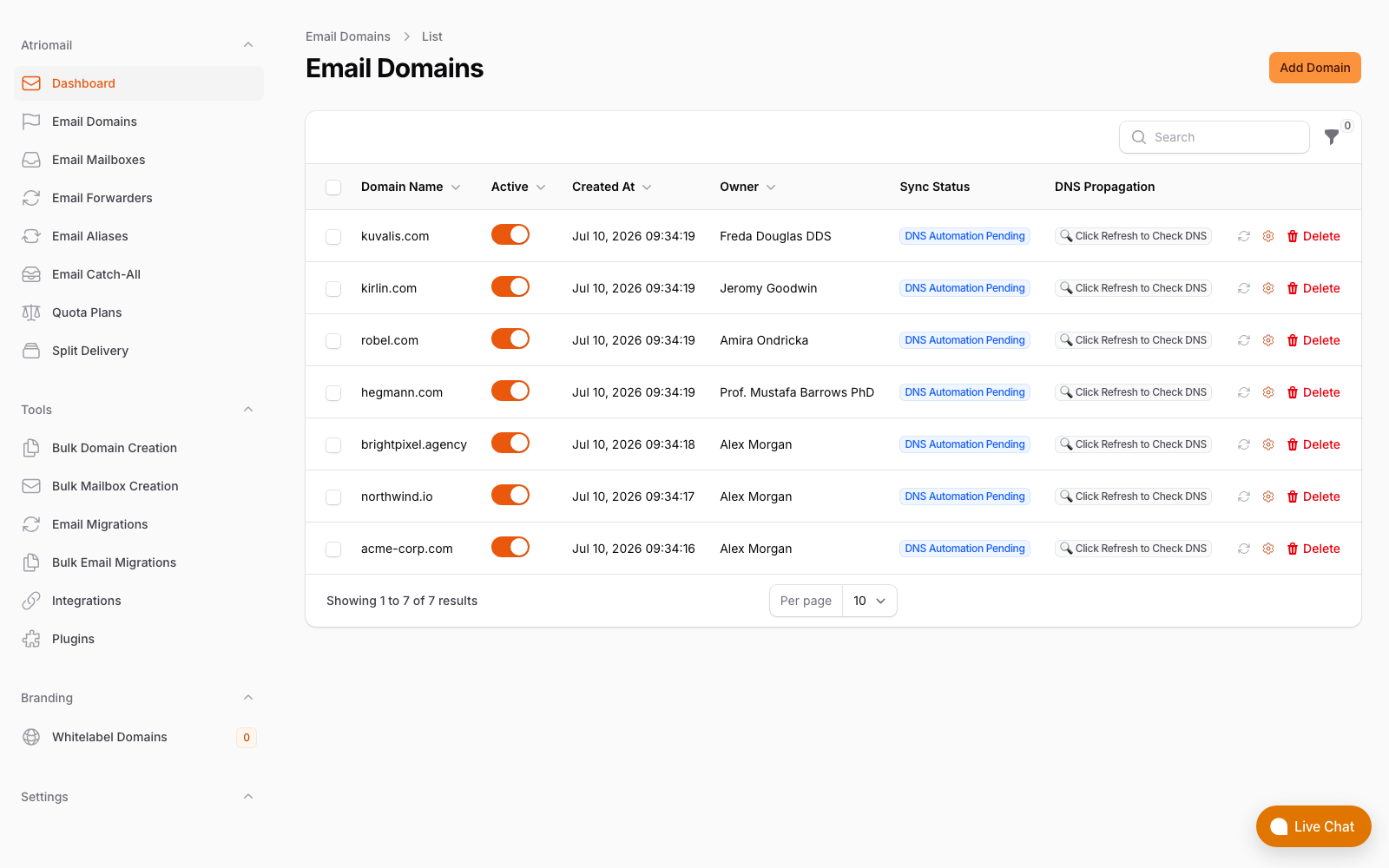
The domains panel showing DNS authentication status. SPF, DKIM and DMARC records publish automatically across 15 supported DNS providers when a domain is added, with no manual record entry required.
Most agencies that are building a durable email service line, rather than adding email as a convenience add-on, gravitate toward white-label hosting for those reasons. The pricing control and brand ownership compound over time in ways that a commission-based resale arrangement cannot replicate.
Where Atriomail Fits
Zoho's programme is real, which makes this a sharper comparison than most. The question is what you are selling: a commission on Zoho's product, or a product of your own.
On the commission path the client logs into Zoho's webmail, accepts Zoho's terms and can deal with Zoho directly, and the commission rate is set in a partner agreement that is not published. On the wholesale path you buy at $1.39 per mailbox per month, set your own retail, and the client relationship stays yours. At $4 per mailbox that is $2.61 per mailbox per month of margin, at $5 it is $3.61, and Zoho's published retail price no longer caps what you can charge.
Storage is the other direct comparison: Zoho Mail Lite at $1 per user per month on annual billing includes 5 GB, against 15 GB included here at $1.39, with more at $0.60 per 5 GB block. Clients already running Zoho CRM, Desk or Books have a genuine reason to stay inside that ecosystem. See the pricing page.
Frequently Asked Questions
More answers on migration, provisioning and setup in the full FAQ.
Does Zoho have a WHMCS module?
Yes. Zoho publishes a WHMCS module for Mail resellers through their partner portal. It automates provisioning and billing for Zoho Mail subscriptions inside WHMCS. Atriomail also has a native WHMCS module and a Blesta module for the same purpose on the white-label side.
Can I fully white-label Zoho Mail?
Partially. Zoho lets resellers configure a custom subdomain so clients reach webmail at a URL you control. The webmail interface, mobile applications and underlying Zoho terms remain unchanged. Full white-labeling, where your own logo and brand name appear throughout the product, is not part of the standard Zoho reseller program.
What happens to clients if I leave the Zoho reseller program?
The client's Zoho account and all email data remain in Zoho's infrastructure. Billing typically migrates to a direct Zoho plan. The client keeps their email history without any data migration required. You stop receiving the commission from that point forward.
How does DNS automation work with white-label email?
When you add a domain in the Atriomail panel, SPF, DKIM and DMARC records publish automatically across 15 supported DNS providers. No manual record entry is required. This removes the most common source of deliverability problems during new client onboarding and eliminates a category of support tickets that DNS-manual setups regularly generate.
Recommended
- What Is White-Label Email? Atriomail
- White-Label Email vs. Reselling Google Workspace: The Margin Math, Atriomail
- Pricing and the Reseller Margin Calculator, Atriomail
- Automate Email Billing in WHMCS and Blesta, Atriomail
- Frequently Asked Questions, Atriomail
Latest from the blog
- How to Set Up BIMI So a Client's Logo Shows Up in Gmail and Yahoo · Oct 12, 2026
- DreamHost Email vs Atriomail: What "Unlimited" Doesn't Cover for Resellers · Oct 10, 2026
- A Client's Email Account Was Compromised: Why a Password Reset Alone Doesn't Fix It · Oct 9, 2026
- Aliases, Forwarders and Catch-Alls in Atriomail: The One Rule That Decides When They Work · Oct 8, 2026
- How to Move a Client's DMARC Policy to p=reject Without Breaking Their Mail · Oct 7, 2026