
Fastmail earns a level of respect among IT professionals that few email providers match. It is independently owned (by Australian software company 1 Percent), ad-free, privacy-respecting, and built on open standards including JMAP, the modern protocol it helped define. Many hosting resellers and MSPs have recommended Fastmail to clients over the years and rightly so, for the right clients.
But "recommending Fastmail" and "building a scalable email business with Fastmail" are two very different things. This post looks at what Fastmail's partner and reseller programs actually offer, where the friction points are for a 1-15 person hosting reseller or MSP, and how the margin math compares to a white-label email hosting model at the wholesale level.
Table of Contents
- What Fastmail Is
- Fastmail Business Pricing
- The Partner Program: Three Paths
- What Resellers Actually Get (and What They Don't)
- The Margin Math
- When Fastmail Is the Right Call
- The White-Label Alternative for the Rest of the Book
- FAQ
Key Takeaways
| Point | Details |
|---|---|
| Fastmail has a reseller program | Resellers can create and manage accounts for client organizations, and can have clients billed directly to the reseller rather than to Fastmail. But wholesale pricing is not published; you contact partnerships@fastmailteam.com to find out what you pay. |
| Retail starts at $3/user/month (annual billing) | Fastmail Business Basic at $3/user/month annual or $4/user/month monthly, with 6 GB per user. Standard is $5/user/month annual or $6/user/month monthly, 60 GB. Professional is $9/user/month annual or $10/user/month monthly, 150 GB. |
| No WHMCS or Blesta module, no public provisioning API | Fastmail offers a JMAP API for email access, but not a REST API for account provisioning. There is no native module for WHMCS or Blesta. Resellers manage accounts through Fastmail's admin interface, not through their billing platform. |
| Most agencies earn $0 recurring from Fastmail recommendations | The common agency path is to recommend Fastmail, set it up for the client, and have the client bill Fastmail directly. The agency earns a one-time setup fee and nothing recurring on the mailbox line item. |
| White-label email hosting is a different model entirely | At $1.39/mailbox/month wholesale, you set your own retail price and keep the spread. On 50 mailboxes billed at $5, that is $180.50/month in recurring margin that Fastmail recommendation structurally cannot produce. |
What Fastmail Is
Fastmail has been providing email hosting since 1999, which in internet terms makes it ancient. The company is headquartered in Melbourne, Australia, and has never been acquired by Google, Microsoft or any advertising platform. That independence is deliberate: Fastmail's business model is subscription revenue from users and businesses, not data.
Technically, Fastmail is notable for its work on open email standards. It was a primary author of JMAP (JSON Meta Application Protocol), the modern API for email, calendars and contacts that the IETF standardized in 2019 as RFC 8621. JMAP is faster and more bandwidth-efficient than the IMAP protocol most email clients still rely on. Fastmail also operates a privacy-respecting masked email feature, integrated with 1Password and Bitwarden.
For clients who care about data sovereignty, open standards, and a provider with no advertising business to serve, Fastmail is a legitimate and well-built choice. Understanding what reseller email hosting can and cannot do with that choice is a separate question.
Fastmail Business Pricing
Fastmail publishes its business pricing openly. There are three tiers, all billed per user:
| Plan | Monthly billing | Annual billing | Storage per user |
|---|---|---|---|
| Business Basic | $4/user/month | $3/user/month | 6 GB |
| Business Standard | $6/user/month | $5/user/month | 60 GB |
| Business Professional | $10/user/month | $9/user/month | 150 GB |
Annual billing shaves roughly 16-17% off the monthly rate at each tier. There is no published minimum user count for the business plans, and no setup fee. Every plan includes custom domain support, calendar and contacts syncing, and 24/7 support from staff based in Philadelphia, Melbourne and Tallinn.
The Business Standard plan is the most common recommendation for small business clients: 60 GB per user is generous for typical mailbox usage, and $5/user/month annual is competitive compared to Google Workspace Business Starter at $7/user/month or Microsoft 365 Business Basic at $6/user/month.
The Partner Program: Three Paths
Fastmail's partner page describes three ways to work with them:
Affiliate program. Standard referral model: you register, promote Fastmail through your channels, and receive monthly payouts when a referral signs up. Commission rates are not published on the page. The client relationship and the billing relationship are both between the client and Fastmail.
Reseller program. Designed for IT managers and support professionals. Resellers can create and manage accounts for the organizations they support, and crucially, can choose to have those accounts billed directly to the reseller rather than to each client. This lets you bundle Fastmail email into an overall monthly package you invoice the client for.
Value-added reseller and co-branding. Fastmail mentions VAR options including the ability to create sub-businesses and co-branding arrangements. Details require direct contact with the partnerships team at partnerships@fastmailteam.com.
The reseller billing model is meaningful: it means a hosting reseller or MSP could, in principle, pay Fastmail for a pool of seats and invoice clients at a markup. The critical gap is that wholesale pricing for that arrangement is not published anywhere on Fastmail's site.
What Resellers Actually Get (and What They Don't)
Most small hosting resellers and MSPs fall into the affiliate or informal recommendation path, not the formal reseller program. The result: they set up Fastmail for a client, the client registers with their own Fastmail account, and Fastmail bills the client directly. The agency earns a setup fee once and nothing on the mailbox line item going forward. This is the same structural problem as setting up Google Workspace for a client without a formal partner agreement, a situation covered in more detail in the Google Workspace margin math comparison.
For resellers who do engage the formal reseller program, there are several gaps worth noting before building a workflow around it:
No published wholesale price. You can only find out what Fastmail charges resellers by contacting them. That makes margin planning speculative until you have an active agreement. Compare this to a white-label email hosting model where the wholesale price is published on a public pricing page and does not require a negotiated agreement to start.
No WHMCS or Blesta module. Fastmail does not have a native module for either WHMCS or Blesta. If your billing runs through either platform (the most common setup for resellers automating email billing), there is no automatic provisioning: you create accounts manually in Fastmail's admin interface and add the line item to invoices by hand. At five clients that is manageable; at fifty it becomes a recurring administrative burden.
No public provisioning API. Fastmail has a robust JMAP API for accessing email, calendars and contacts, but JMAP is designed for email clients, not for account management. There is no publicly documented REST API for creating accounts, setting storage quotas, or deprovisioning users programmatically. Automation at the account-management level requires a custom integration built against undocumented internals, which is not a realistic investment for a 1-15 person shop.
Brand presentation depends on the arrangement. Fastmail mentions co-branding options for VARs, but the default reseller experience presents Fastmail's own login and branding to end users. A client logging into webmail sees Fastmail, not your agency's name. For resellers where the connection between brand and client trust matters, this is worth considering before committing the book.
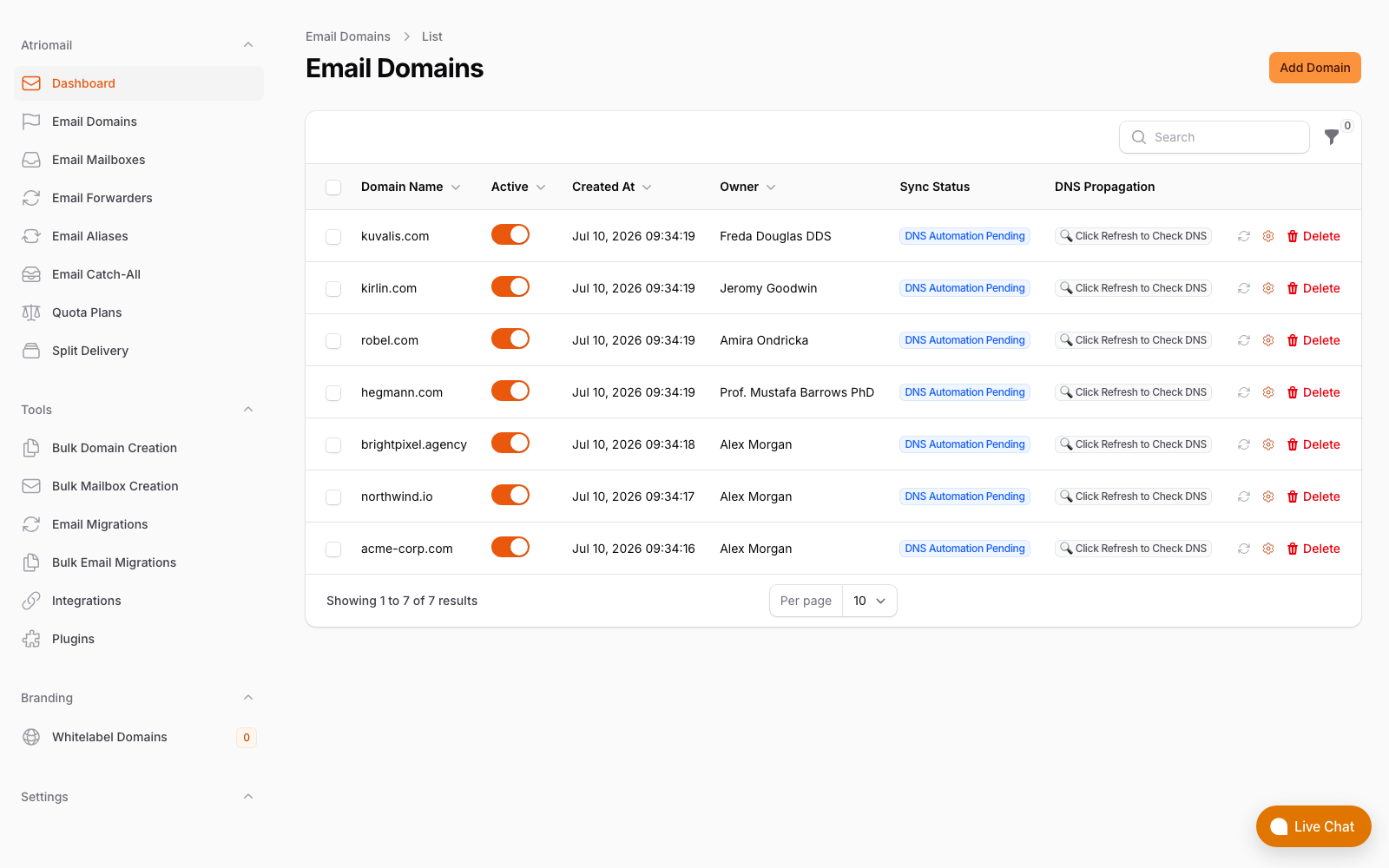
Domain and DNS management in a white-label panel, where the admin interface carries your brand rather than a third-party provider's.
The Margin Math
Take the most common reseller scenario: a client needs 50 mailboxes for a small business. You recommend Fastmail Business Standard and set it up for them. What does each path actually yield per month?
| Fastmail recommendation (client direct) | White-label email hosting | |
|---|---|---|
| What you pay wholesale | Nothing; you don't hold the account | 50 × $1.39 = $69.50/month |
| What the client pays | $5.00/user/month directly to Fastmail (annual billing) | Whatever you set, e.g. $5.00/mailbox = $250/month to you |
| Your recurring margin | $0/month | $250 − $69.50 = $180.50/month |
| Annualized | $0 | ~$2,166/year |
The white-label scenario bills the client at the same per-mailbox price as Fastmail Business Standard annual, so the client's invoice is unchanged. The $180.50/month difference is not a surcharge: it is margin that exists because the reseller controls the billing relationship and the wholesale cost is $1.39, not $5.00. That is the structural shift a white-label model creates that a referral or informal recommendation cannot replicate.
A reseller who formally enrolls in Fastmail's reseller program and negotiates a wholesale rate would theoretically close some of this gap, but the extent of that discount is unknown until you have an agreement in place. The lack of a published rate is a real obstacle for anyone trying to model the business before committing.
When Fastmail Is the Right Call
This comparison is not an argument against Fastmail. For specific client profiles, it genuinely is the right recommendation, and honest advice to clients is the foundation of every healthy agency relationship.
Fastmail makes strong sense when:
- Privacy is a documented requirement. Law firms, medical practices, journalists, and clients under GDPR or similar regulations often ask for a provider with no advertising business and a clear data-processing record. Fastmail publishes its data handling practices and is subject to Australian privacy law, not US surveillance orders (though it does comply with Australian legal processes).
- The client wants open-standard clients. JMAP support means clients can use any compatible email client rather than being locked into a specific app. For technical clients who run their own setup, this matters.
- The client is self-sufficient and large enough for Fastmail's own billing to be fine. A 200-seat organization that manages its own IT and has no interest in bundled hosting services is exactly who Fastmail's business plans are designed for. They do not need you to hold the billing relationship, and Fastmail's direct billing is efficient.
The challenge arises when the same recommendation gets extended to the majority of the client book: small businesses that want professional email on their domain, care little about JMAP versus IMAP, and are perfectly happy receiving one consolidated invoice from you. Those clients do not need Fastmail specifically; they need reliable, professional email. And that is where the model matters more than the provider name.
The White-Label Alternative for the Rest of the Book
For the majority of a hosting reseller's client book, the practical requirement is: email on the client's own domain, reliable delivery, 15-plus GB of storage per mailbox, and a single invoice alongside everything else the agency already bills. That requirement does not depend on JMAP, Australian data law, or any particular provider's brand.
Atriomail's wholesale price is $1.39 per mailbox per month, 15 GB included, with no contract, no mailbox minimum, and extra storage at $0.60 per 5 GB block. SPF, DKIM and DMARC publish automatically on any domain. Domains, aliases, forwarders, catch-alls and IMAP migration are all included at no extra charge.
The practical differences for a reseller:
- Published wholesale pricing. The number on the pricing page is the number you plan against. No agreement required to know what you pay.
- WHMCS and Blesta modules. Provisioning, suspension, termination and storage changes happen automatically through the billing platform the reseller already runs. As covered in automating email billing in WHMCS and Blesta, this removes the administrative overhead that grows with every client added under a manual approach.
- REST API for custom integrations. Resellers who run DirectAdmin or custom client portals can use the API for account management without depending on undocumented internals.
- White-label branding add-on. The webmail login and admin panel can carry your name and logo for $200 one-time plus $50/month. For context on when the add-on is worth adding, the math on that is covered in the guide to white-label email for agencies.
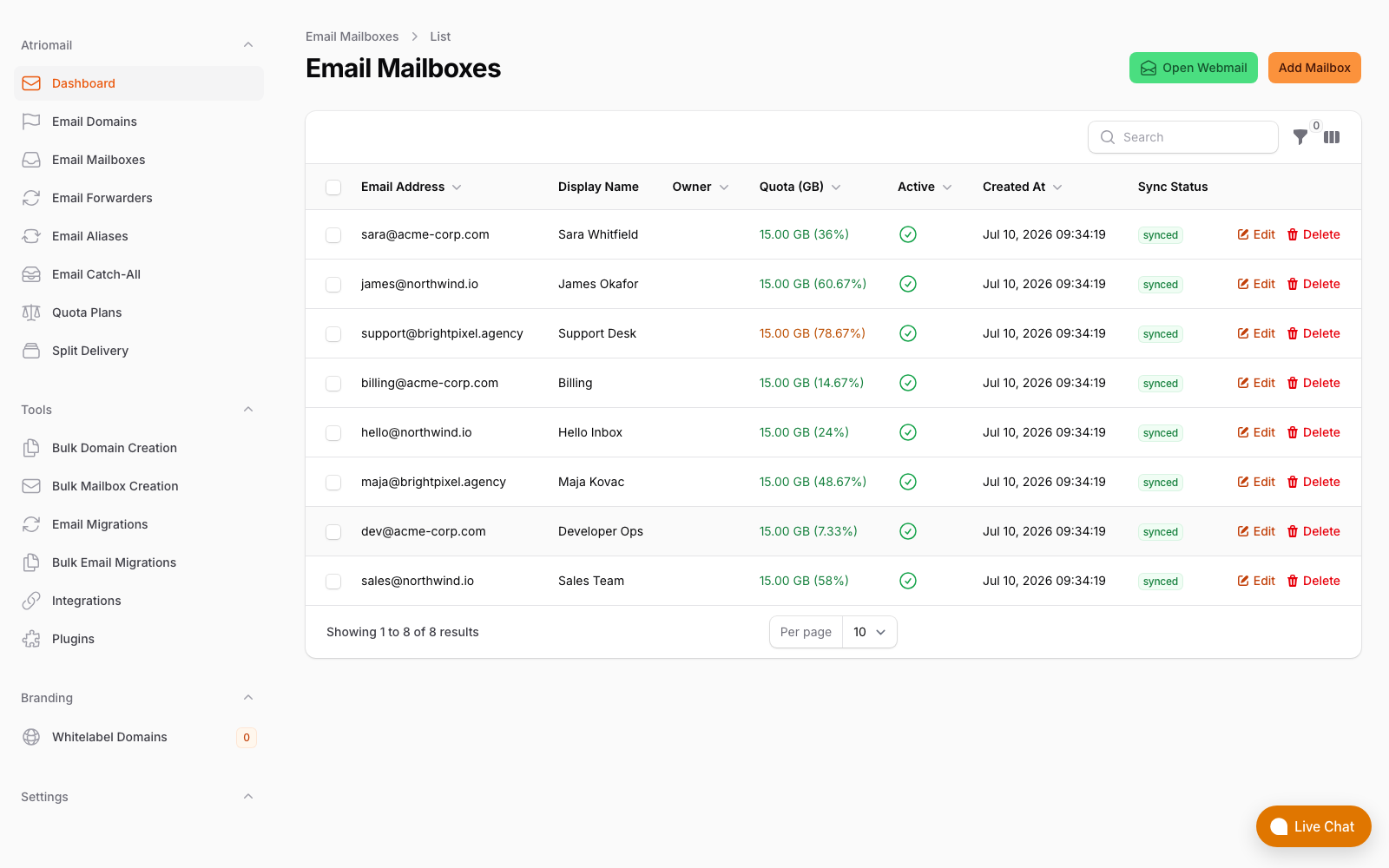
Mailbox management across a client's domain in the admin panel. WHMCS and Blesta provisioning changes reflect here automatically when modules are connected.
The point is not that Fastmail is the wrong tool, it is that Fastmail's partner model was not designed to power a multi-client billing operation in the same way a purpose-built reseller platform is. They serve different jobs. Matching the tool to the job, for each segment of the client book, is the practical question.
Frequently Asked Questions
More on billing and reseller setup in the full FAQ.
Can I white-label Fastmail under my own brand?
Fastmail mentions co-branding options for value-added resellers, but the terms require direct negotiation with their partnerships team (partnerships@fastmailteam.com). The default reseller setup presents Fastmail's own login and webmail interface to end users. A purpose-built white-label email platform provides branded login, webmail and admin interfaces as a standard feature rather than a custom arrangement.
Does Fastmail have a WHMCS or Blesta module?
No. As of August 2026, Fastmail has no native module for WHMCS or Blesta. Resellers who want to bill Fastmail accounts through their billing platform need to create accounts in Fastmail's admin interface manually and add the line item to invoices by hand. Titan Email, GoDaddy Professional Email, and several other white-label providers also lack WHMCS or Blesta modules, which is a key part of why provider-level reseller programs often create more overhead than they save for small resellers.
What does Fastmail charge resellers at wholesale?
Fastmail does not publish a wholesale reseller price. You need to contact their partnerships team to negotiate a rate. This is unlike white-label email hosting platforms that publish a single public wholesale price: $1.39/mailbox/month at Atriomail. Not knowing your cost before entering an agreement makes margin planning speculative.
Is Fastmail appropriate for all business email clients?
No, and Fastmail would likely agree. It is best suited for clients with genuine privacy or open-standards requirements, or organizations large enough to manage their own email relationship with a provider. For small businesses that want professional email on their domain as part of a broader hosted service, the client typically does not benefit from Fastmail specifically and the reseller does not benefit from recommending a service that generates no recurring revenue from the mailbox line item.
Recommended
- White-Label Email vs. Reselling Google Workspace: The Margin Math, Atriomail
- Titan Email for Hosting Resellers: What It Is, Who Can Access It, and What to Use Instead, Atriomail
- Automate Email Billing in WHMCS and Blesta, Atriomail
- What Is Reseller Email Hosting? Atriomail
- A Guide to White-Label Email for Agencies, Atriomail
- Pricing and the Reseller Margin Calculator, Atriomail
Latest from the blog
- How to Set Up BIMI So a Client's Logo Shows Up in Gmail and Yahoo · Oct 12, 2026
- DreamHost Email vs Atriomail: What "Unlimited" Doesn't Cover for Resellers · Oct 10, 2026
- A Client's Email Account Was Compromised: Why a Password Reset Alone Doesn't Fix It · Oct 9, 2026
- Aliases, Forwarders and Catch-Alls in Atriomail: The One Rule That Decides When They Work · Oct 8, 2026
- How to Move a Client's DMARC Policy to p=reject Without Breaking Their Mail · Oct 7, 2026