
When a client says "I just need professional email, not Teams, not Office," many MSPs reach for Exchange Online Plan 1. It is Microsoft's email-only subscription: $4.00/user/month on an annual commitment, no collaboration suite bundled in. That price point makes it sound like the obvious answer for a lean email-only need.
For the MSP recommending it, however, the picture looks quite different from how it appears at first glance. CSP indirect reseller margins on Exchange Online are thin, not published by Microsoft, and negotiated through a distributor. Seat counts lock under the New Commerce Experience terms until renewal. And as of October 1, 2026, Microsoft begins disabling Exchange Web Services in Exchange Online, a change that can break backup tools and third-party integrations your clients depend on right now.
This post works through what Exchange Online Plan 1 actually gives a small MSP or hosting reseller, compared to hosting mailboxes under your own brand at $1.39/mailbox wholesale.
Table of Contents
- What Is Exchange Online Plan 1?
- The Reseller's Path Through CSP
- Three Constraints That Change the Math
- What White-Label Email Hosting Gives You Instead
- The Margin Math, Side by Side
- When Exchange Online Plan 1 Is Still the Right Call
- Where Atriomail Fits
- Frequently Asked Questions
Key Takeaways
| Point | Details |
|---|---|
| Exchange Online Plan 1 retail price | $4.00/user/month on an annual commitment; $4.80/month flexible. Includes a 50 GB mailbox, Outlook on the web, and mobile access. No Outlook desktop app, no Teams, no Microsoft 365 productivity apps. |
| CSP indirect reseller margin | Not published by Microsoft. Negotiated with your distributor and typically a small percentage of the retail seat price. No white-label branding option at any Plan 1 tier. |
| NCE seat lock-in | Under New Commerce Experience rules, you can add seats during a term but cannot reduce them until renewal. A client who downsizes mid-year still bills at the original seat count. |
| EWS deprecation starts October 2026 | Microsoft begins blocking Exchange Web Services requests in Exchange Online on October 1, 2026. Backup tools, archiving apps, and integrations using EWS must migrate to Microsoft Graph before that date. |
| White-label alternative | $1.39/mailbox/month wholesale, 15 GB included, automatic SPF/DKIM/DMARC, native WHMCS and Blesta modules, and your own branding on the admin panel and webmail. |
What Is Exchange Online Plan 1?
Exchange Online Plan 1 is Microsoft's standalone business email product, sold separately from the Microsoft 365 suite. A subscription gives each user a 50 GB mailbox, Outlook on the web, iOS and Android mobile access, and support for messages up to 150 MB in size. It does not include the Outlook desktop application, Microsoft Teams, or any of the Microsoft 365 productivity apps (Word, Excel, PowerPoint).
Microsoft's published pricing for Exchange Online Plan 1 is $4.00/user/month on an annual commitment, or $4.80/user/month on a flexible month-to-month basis. The annual rate held steady through the July 2026 price adjustments that raised Microsoft 365 Business Basic from $6.00 to $7.00/user/month, which makes Plan 1 look comparatively stable by comparison.
For clients who genuinely need only business email on their own domain and have no requirement for document collaboration or video meetings, Plan 1 can appear to be the most economical way to stay on Microsoft infrastructure. That appearance is the starting point for a decision many small MSPs make without working through the reseller side of the equation.
The Reseller's Path Through CSP
To resell Exchange Online Plan 1, a small MSP typically enrols as an indirect reseller in Microsoft's Cloud Solution Provider program and purchases licenses through an authorized distributor (the indirect provider). The distributor buys from Microsoft and passes licenses down to the reseller, who assigns them to client tenants via Microsoft Partner Center.
The margin in this chain is not published by Microsoft. Indirect resellers negotiate rates with their distributor, and those rates vary by distributor, volume and incentive program participation. Industry partner discussions generally put indirect reseller margins on Microsoft 365 core licenses at a few percentage points of the retail seat price. On a $4.00/user license, a few percent translates to a small number of cents per user per month.
That margin also comes with the FY26 CSP program's administrative requirements: a $25,000 trailing twelve-month revenue threshold for incentive eligibility as an indirect reseller, mandatory multi-factor authentication across the partner tenant, and Solutions Partner designation criteria. For a shop primarily selling managed services, meeting these requirements is routine. For one that wants to earn recurring margin specifically on email, the program carries more overhead than the email revenue alone justifies.
As covered in depth in the Microsoft 365 CSP reseller vs. white-label comparison, the CSP model is designed for partners who add broad value across the Microsoft ecosystem. Exchange Online Plan 1 margin, in isolation, is not what makes CSP enrollment worthwhile.
Three Constraints That Change the Math
1. NCE seat lock-in
Under Microsoft's New Commerce Experience, subscriptions are term-based. You can add seats mid-term, but you cannot reduce the seat count until the term renews. A client who hires staff and goes from 40 to 50 seats is straightforward. A client who drops from 50 to 35 after a layoff still bills at 50 seats for the remainder of the annual term. On a 50-seat plan at $4.00/user, 15 unused seats costs $60/month for however many months remain. That is a conversation you will have with the client, and there is no easy answer inside the NCE model.
2. No native WHMCS or Blesta module
Exchange Online Plan 1 has no native integration with WHMCS or Blesta. License management happens in Microsoft Partner Center and client billing happens in your billing platform, with no automated bridge between them. The workflow that WHMCS and Blesta native email modules handle automatically, provisioning a mailbox when a client pays and suspending it when they cancel, requires a third-party connector or manual reconciliation when the underlying service is Exchange Online via CSP.
3. EWS deprecation: October 1, 2026
This one has a hard deadline. Microsoft announced in September 2023 that Exchange Web Services in Exchange Online would be blocked starting October 1, 2026, with a complete shutdown on April 1, 2027. EWS is the legacy API many backup tools, email archiving solutions, and workflow integrations use to connect to Exchange Online mailboxes.
According to Microsoft's announcement, any tenant with EWSEnabled set to Null on October 1, 2026 is automatically switched to False, which blocks all EWS requests for every application in that tenant. Tools from vendors including Veeam and Mimecast that historically used EWS for backup and archiving have published their own migration guides. If you manage clients whose backups or integrations run on EWS today, auditing and migrating those connections before October 2026 is now an active task, not a future item.
This does not mean Exchange Online Plan 1 is the wrong platform for those clients. It means managing clients on Exchange Online now includes EWS migration overhead that was not part of the picture a year ago.
What White-Label Email Hosting Gives You Instead
White-label email hosting separates the mailbox infrastructure from your operational overhead and replaces it with a direct margin line. The wholesale price at Atriomail is $1.39/mailbox/month, 15 GB included. Domains, aliases, forwarders and IMAP migration are free. SPF, DKIM and DMARC records publish automatically per domain across 15 supported DNS providers when a domain is added, which removes the per-domain DNS setup step that typically generates the most new-client support tickets.
The WHMCS and Blesta native modules handle provisioning and suspension automatically when clients update their subscriptions. As discussed in the guide on per-mailbox pricing for resellers, usage-based billing means you pay only for active mailboxes at each cycle. A client who drops from 50 to 35 users changes what you owe at the next billing date, not at an annual renewal.
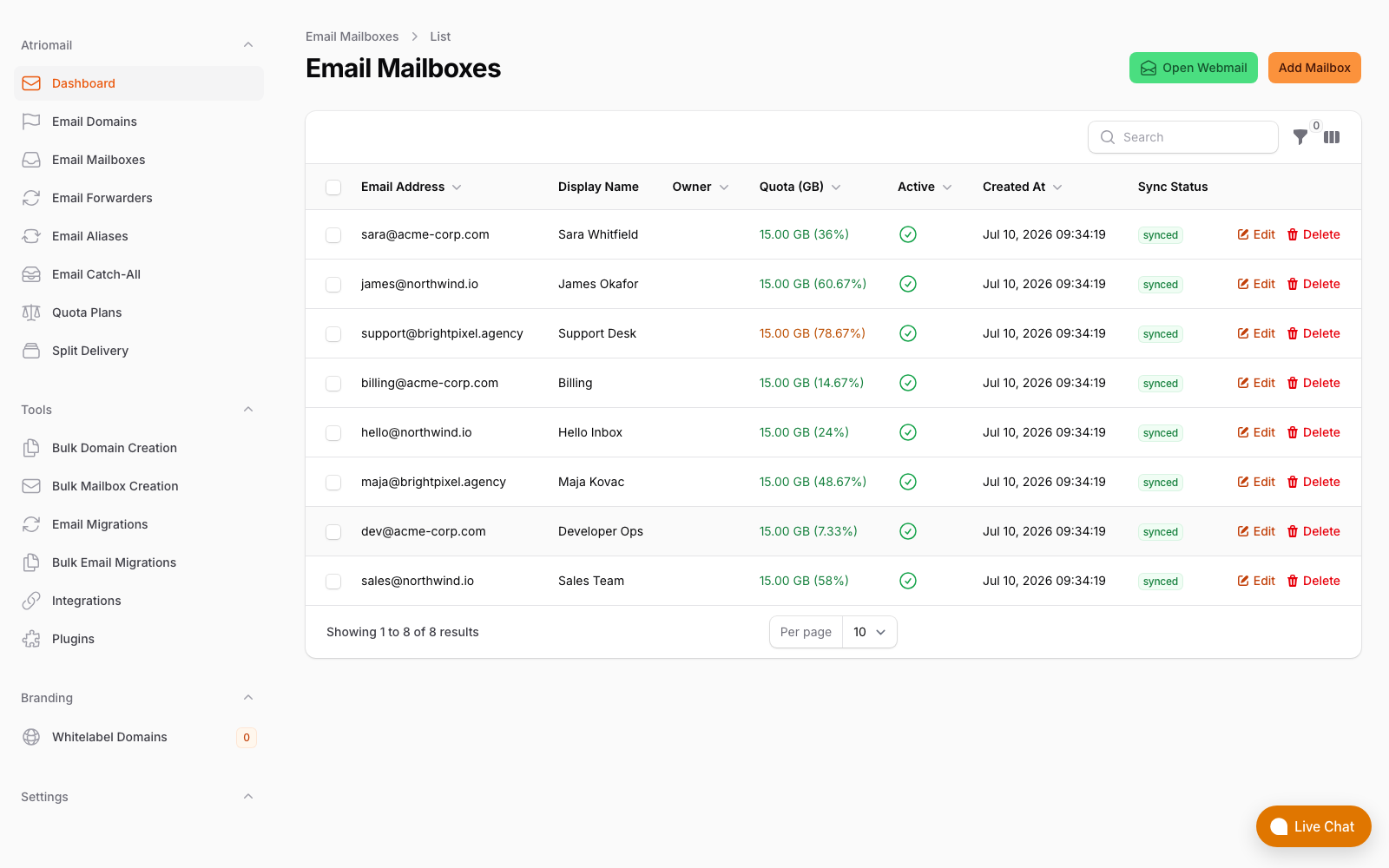
The mailbox list view in the Atriomail panel, real product screenshot. Each row is one billed mailbox; adding or removing happens immediately.
The 15 GB per-mailbox storage is a real tradeoff worth stating directly. Exchange Online Plan 1 gives 50 GB; Atriomail gives 15 GB at the base $1.39 price. For clients who accumulate years of attachment-heavy email in their primary mailbox without archiving, 15 GB requires more active storage management. For most business email users who receive and send routine correspondence, 15 GB is sufficient, and extra storage is available in 5 GB blocks at $0.60 per block per month. A 50 GB equivalent at Atriomail would cost $1.39 plus seven extra blocks at $0.60, which is $5.59/mailbox/month; at that level the comparison changes and Exchange Online Plan 1 becomes the stronger storage value. The right question is what storage pattern the specific client actually has.
The Margin Math, Side by Side
Take a client who needs 50 mailboxes on their own domain:
| Exchange Online Plan 1 via CSP indirect | White-label email hosting | |
|---|---|---|
| Retail seat price | $4.00/user/month (annual) | You set the price, e.g. $5.00/mailbox |
| Your wholesale cost | Distributor rate; not published by Microsoft | 50 × $1.39 = $69.50/month |
| Estimated margin at 50 seats | $4-$10/month (est. 2-5% of $200 retail; actual varies) | $250 − $69.50 = $180.50/month |
| Annualized | ~$48-$120 estimated | ≈ $2,166 |
| White-label branding | Not available | Add-on: $200 one-time + $50/month |
| WHMCS/Blesta native module | No | Yes |
The white-label margin assumes a $5/mailbox client price. You set that number. Even at $3.50/mailbox, the white-label margin on 50 mailboxes is $105.50/month, roughly ten times the upper estimate of the Exchange Online Plan 1 indirect margin at the same client size. The spread comes not from the resale price but from the structural difference: you own the billing relationship and the pricing on white-label hosting; on Exchange Online you earn a percentage of a price Microsoft sets.
For context on how similar math plays out with other Microsoft products, the full email hosting alternatives comparison covers a wider range of options against white-label hosting.
When Exchange Online Plan 1 Is Still the Right Call
Being honest about this comparison means saying when Exchange Online Plan 1 is the better answer:
- Existing Microsoft tenant dependency. A client already running Azure Active Directory, Intune, or other Microsoft 365 services needs Exchange Online mailboxes in the same tenant. Moving email to a third-party host breaks that integration. Stay on Exchange Online.
- Heavy storage users. Clients who have accumulated years of attachment-heavy mail in a single 50 GB mailbox are genuinely better served by that storage allowance than by a 15 GB mailbox that requires archiving strategy from day one.
- Clients who plan to add M365 within a year. If a client will likely want Teams or Microsoft 365 apps in the near term, starting on Exchange Online Plan 1 and upgrading the license when ready is simpler than migrating email platforms twice.
- You are already transacting significant M365 volume through CSP. If Exchange Online Plan 1 seats are one line item in a broader CSP book that justifies the program overhead, the thin per-seat margin is fine as part of a larger relationship. As a standalone email-revenue strategy, it is not.
For clients on Exchange Online primarily because "it's what we set them up with," and for MSPs who want to turn that email service into a real margin line, a managed migration to white-label hosting resolves both. The client's inbox on their own domain looks identical the day after the migration; what changes is which invoice it appears on and whether the recurring revenue flows to you. Migration logistics are covered in the MSP email migration playbook.
Where Atriomail Fits
Two of the constraints above have no equivalent here, and they are the two that cost a small shop real money.
NCE seat lock-in is the first. Atriomail is usage-based and billed monthly: you can add mailboxes mid-term and you can remove them mid-term, so a client who downsizes in March stops paying for those mailboxes in March rather than at renewal. There is no minimum, no contract and no cancellation fee. The second is branding. There is no white-label option at any Plan 1 tier; here it exists as a paid add-on that puts your webmail domain and logo in front of the client instead of ours.
On price, $1.39 per mailbox per month with 15 GB included sits against $4.00 per user per month on annual commitment, and because the wholesale rate is published you set retail yourself instead of working from an unpublished CSP margin. Clients tied to an existing Microsoft tenant should stay in it, for the reasons the previous section gives. See the pricing page.
Frequently Asked Questions
More on migration, billing and setup in the full FAQ.
Can I resell Exchange Online Plan 1 without joining the CSP program?
No. To purchase and assign Exchange Online Plan 1 licenses to your clients and bill them yourself, you need an indirect reseller enrollment in the Microsoft Cloud Solution Provider program and a relationship with an authorized distributor. Clients can purchase Plan 1 directly from Microsoft without you, in which case they manage the subscription themselves and you have no billing relationship with that seat.
What breaks on October 1, 2026 because of the EWS retirement?
Any application or script that connects to an Exchange Online mailbox using the Exchange Web Services API will be blocked once Microsoft sets EWSEnabled to False on the tenant, which happens automatically starting October 1, 2026 for tenants that have not opted in ahead of time. Common tools that have historically used EWS include some email backup products, archiving solutions, email signature tools, and calendar-sync applications. The Microsoft Graph API is the supported replacement. If you manage clients on Exchange Online, running an EWS usage report in Microsoft 365 admin today will show you which apps are still using the old protocol.
Does the 15 GB mailbox on white-label hosting cause problems for most clients?
For most business email users, 15 GB is adequate. Problems arise for clients who store years of large attachments without any archiving or local mail client sync, or who use their mailbox as a file repository. For those clients, extra storage blocks at $0.60 per 5 GB per month are available, or the honest answer is that Exchange Online Plan 1's 50 GB is the better fit. Knowing a client's storage pattern before recommending is worth one question during the sales conversation.
Is there a WHMCS module that bridges Exchange Online Plan 1 into client billing?
There is no native WHMCS or Blesta module for Exchange Online Plan 1 from Microsoft. Third-party modules exist (HostBill has Microsoft 365 integration, for example), but they require their own licensing and setup. White-label email hosting platforms built for resellers include WHMCS and Blesta modules as part of the base offering, so provisioning, suspension and billing all flow through the same tool your team already uses daily.
Recommended
- Microsoft 365 CSP Reseller Program vs. White-Label Email: What Small Agencies Actually Qualify For, Atriomail
- White-Label Email vs. Reselling Google Workspace: The Margin Math, Atriomail
- Automate Email Billing in WHMCS and Blesta: Best Practices for Resellers and MSPs, Atriomail
- Per-Mailbox Pricing: Why It Wins for Resellers, Atriomail
- Email Hosting Alternatives for Hosting Providers: A Comparison, Atriomail
Latest from the blog
- How to Read an Email Bounce Message: What the SMTP Code Is Actually Telling You · Oct 14, 2026
- SiteGround Email for Agencies: Why "Included" Doesn't Mean You Can Bill for It · Oct 13, 2026
- How to Set Up BIMI So a Client's Logo Shows Up in Gmail and Yahoo · Oct 12, 2026
- DreamHost Email vs Atriomail: What "Unlimited" Doesn't Cover for Resellers · Oct 10, 2026
- A Client's Email Account Was Compromised: Why a Password Reset Alone Doesn't Fix It · Oct 9, 2026