
Namecheap is one of the most widely used domain registrars among hosting resellers and MSPs. If you bill domains through WHMCS, there is a reasonable chance Namecheap's registrar API is already part of your stack. When a client on one of those domains needs professional email, the natural next question is whether Namecheap can simply supply it and keep everything under one account. The answer is more complicated than it first appears, and understanding where the seams fall saves a reseller from building a billing workflow that cannot scale.
Namecheap has three distinct email-related offerings: the domain reseller API (which handles registration and renewal, nothing else), the hosting reseller program (which bundles cPanel-style mailboxes with web hosting accounts), and Private Email (a standalone per-mailbox email product sold separately). Each of these is a different product with different capabilities, and only one of them is relevant to an MSP trying to sell professional email as a standalone service. That product is Private Email, and it went through a significant platform migration in mid-2026 that removed several features hosting resellers and their clients relied on.
Table of Contents
- Two Reseller Programs, Neither Covers Standalone Email
- Namecheap Private Email: The Product Itself
- What the 2026 Platform Migration Removed
- The Provisioning and Billing Gap
- Margin Math for 50 Mailboxes
- When Namecheap Private Email Makes Sense
- Where Atriomail Fits
- Frequently Asked Questions
Key Takeaways
| Point | Details |
|---|---|
| No email reseller program exists at Namecheap | The domain reseller API covers domain registration and renewal only. The hosting reseller program bundles cPanel-style email with hosting accounts, not Private Email subscriptions. There is no Private Email wholesale or partner tier. |
| New June 2026 Private Email plans start at $8.88/year per mailbox | The restructured Starter plan is $0.74/month per mailbox on an annual commitment, with 5 GB storage. Namecheap's pricing history includes promotional rates that increased at renewal; verify current renewal terms directly at namecheap.com before projecting long-term client costs. |
| ActiveSync is being removed in the 2026 migration | Namecheap is migrating Private Email off the Open-Xchange platform. Features being sunset include ActiveSync, Drive, Docs/Sheets/Presentations, and Unified Mail. Clients using native mobile Outlook or iOS Mail with push sync will need to reconfigure to IMAP. |
| No WHMCS or Blesta module for Private Email provisioning | Namecheap's WHMCS integrations cover domain registration and SSL. There is no module that provisions or bills Private Email mailboxes automatically. Resellers managing dozens of client domains must provision and track billing manually. |
Two Reseller Programs, Neither Covers Standalone Email
Namecheap's reseller offerings split cleanly into two programs, and it is worth understanding both before reaching for Private Email as a reseller solution.
The domain reseller API is Namecheap's original reseller channel. You fund a Namecheap account, integrate the API with WHMCS using Namecheap's documented registrar module, and your clients register and renew domains through your storefront at whatever markup you choose. This is a real reseller program with real margin. It covers domains, DNS management, and SSL certificates. Email is not in scope.
The hosting reseller program gives you a WHM-style control panel to provision cPanel hosting accounts for clients. Email comes with every hosting account: each account gets a set of cPanel mailboxes tied to the account's web hosting plan. This is the model covered in more detail in the cPanel email vs. white-label hosting comparison, and it comes with the same structural constraints: shared outbound IP pool, manual DNS configuration for DMARC, and no way to sell email as a standalone per-mailbox product separate from web hosting.
Private Email sits outside both programs. It is a consumer and small-business product sold per mailbox, per domain, through Namecheap's storefront. Namecheap does not publish a wholesale rate for it, does not offer a partner tier, and does not have a provisioning API that a reseller can call to create and delete mailboxes programmatically on behalf of clients. The MSP who wants to use Private Email for client email is not a reseller of Namecheap email; they are a retail customer buying mailboxes at retail price and absorbing the billing and provisioning overhead themselves.
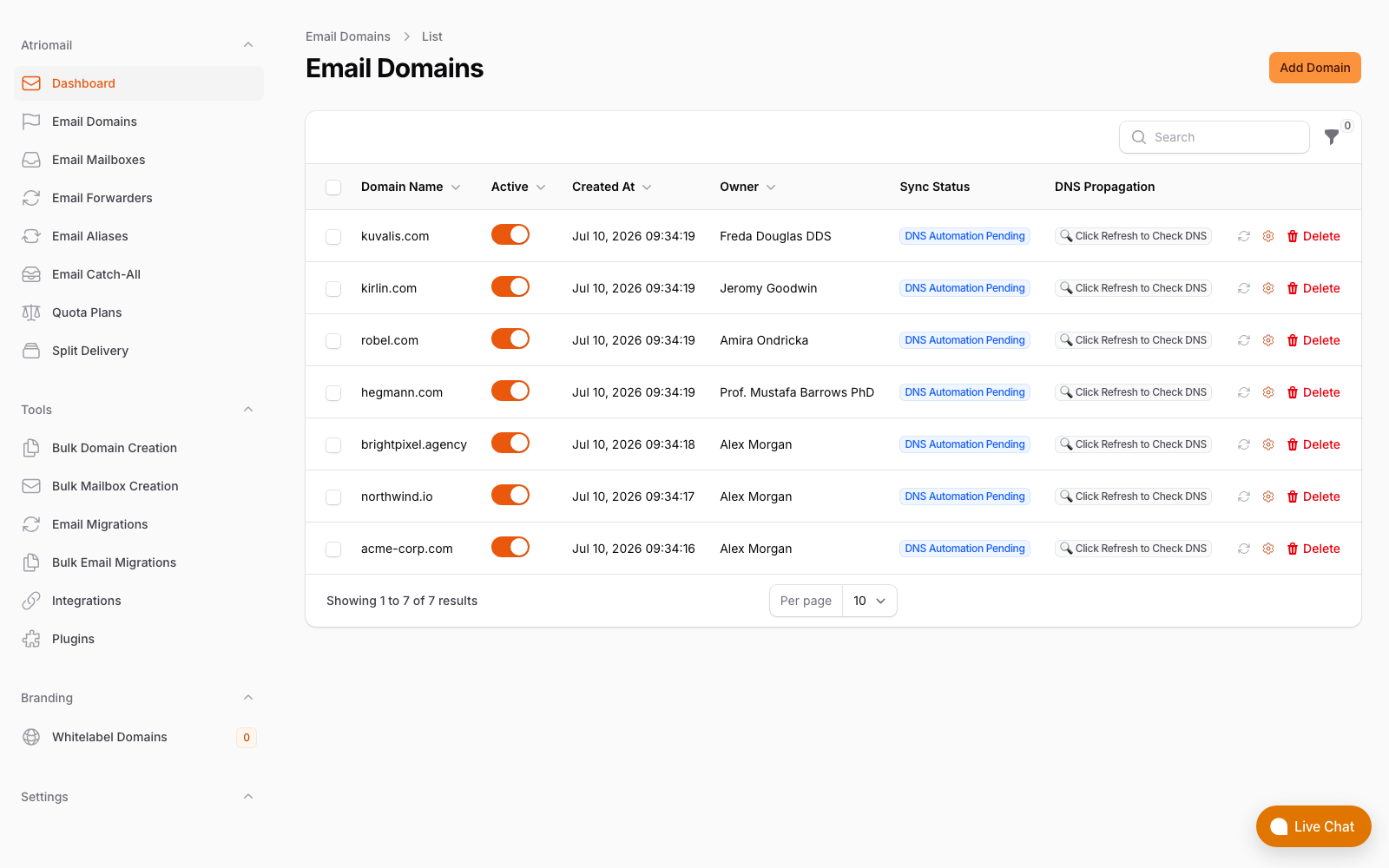
A reseller panel that actually exists for managing multiple client domains' email in one place. Namecheap's Private Email does not have an equivalent multi-domain admin view.
Namecheap Private Email: The Product Itself
As of June 2, 2026, Namecheap restructured its Private Email plans. New subscriptions opened after that date are on the updated platform with updated pricing. Existing subscribers are being migrated gradually throughout the remainder of 2026.
| Plan | Annual rate | Per-mailbox per month | Storage per mailbox |
|---|---|---|---|
| Starter | $8.88/year | $0.74 | 5 GB |
| Pro | $25.88/year | $2.16 | 20 GB |
| Ultimate | $39.88/year | $3.32 | 50 GB |
Pricing shown is annual billing. Namecheap's historical pattern with Private Email has been promotional first-year rates that increased substantially at renewal: the previous Starter plan introduced at $0.99/month renewed at $1.99/month, a doubling. The new plan structure may carry a similar renewal differential; verify directly at namecheap.com/hosting/email/ before quoting long-term client pricing based on the introductory rate.
Each plan covers one mailbox. An MSP with 50 client mailboxes across 30 domains is buying 50 separate annual subscriptions through Namecheap's storefront, each with its own renewal date. That is an administrative surface area problem before you even get to margin.
For context on how Private Email compares to what an actual wholesale email platform provides, the chart below shows per-mailbox monthly cost at the Namecheap Starter annual rate, the previous plan's renewal rate (the more operationally relevant number for long-running client accounts), and Atriomail's flat wholesale rate with three times the storage:
What the 2026 Platform Migration Removed
Namecheap built Private Email on Open-Xchange, a mature open-source collaboration platform. As of mid-2026, Namecheap is migrating to its own platform, and several Open-Xchange features are being sunset rather than rebuilt. For resellers managing client accounts, four removals matter operationally:
ActiveSync is being removed. ActiveSync is the push-sync protocol that native Outlook (iOS and Android), the iOS Mail app, and most Android mail apps use to sync email, calendar, and contacts in real time. Without it, clients must reconfigure their mobile devices to use IMAP for email (no push, polling only) and CalDAV/CardDAV separately for calendar and contacts, which most end users cannot do without help. For a reseller managing 20 to 50 client domains, that is a support ticket per migrated device.
Drive is being removed. Namecheap Private Email included a cloud file storage layer through Open-Xchange. Clients who used it to store shared documents will need an alternative before their account migrates.
Collaboration tools (Docs, Sheets, Presentations) are being removed. These were the Open-Xchange equivalents of Google Docs and Google Sheets. Clients using them for lightweight document collaboration will need to move that work elsewhere.
Unified Mail is being removed. This feature let users manage multiple email accounts from a single inbox view. Power users who relied on it will need to adapt to the new interface.
For an MSP whose clients only need a professional mailbox and IMAP access from a desktop client, the ActiveSync removal is the only item that causes immediate friction. But it is the most common friction point: nearly every smartphone user has their email app configured with push sync, and nearly none of them will accept "switch to IMAP polling" without an explanation and a support call.
For comparison, the Titan Email platform that powers Hostinger and GoDaddy email does not offer ActiveSync to end users either, so the mobile sync limitation is not unique to Namecheap. But when clients signed up for Private Email with ActiveSync working, removing it mid-subscription is a different problem from a platform that never offered it.
The Provisioning and Billing Gap
Even if the per-mailbox price and feature set worked for a reseller's needs, the operational reality is that Private Email has no provisioning path that integrates with the tools resellers actually use.
Namecheap's WHMCS integrations cover domain registration (the registrar module, open-source and documented) and SSL certificate ordering (development discontinued in 2019). There is no WHMCS module that provisions a Private Email mailbox when a client places an order, adjusts storage, suspends access when an invoice goes unpaid, or terminates the subscription at the end of a billing cycle. Everything happens manually through Namecheap's control panel, which means the reseller is the billing clerk for every client, every month.
The practical cost of manual email billing in WHMCS compounds quickly. At 20 to 30 client domains, the time spent creating invoices, chasing non-payment, and provisioning or removing mailboxes by hand typically outweighs the margin earned. At 50 domains and beyond, the overhead becomes the business.
There is also no centralized admin view across client email accounts. Each Private Email subscription lives in its own Namecheap sub-account or the reseller's main account, but there is no panel that shows all 50 clients' domains, their mailbox counts, storage usage, and delivery status in a single view. A reseller supporting a client who cannot receive email must navigate to that client's specific subscription to diagnose the problem, a per-incident friction cost that adds up across a support queue.
The DirectAdmin email comparison covers a similar structural gap: built-in or bundled email products typically lack the per-mailbox billing and centralized multi-client admin that resellers need, regardless of whether the email itself works well. Private Email is a different product from DirectAdmin's built-in email but faces the same structural problem from the reseller's perspective.
Margin Math for 50 Mailboxes
Take a book of 50 client mailboxes across 30 domains, a realistic scale for a small MSP. Here is what the financials look like under three different email models:
| Namecheap Private Email (Starter, new annual rate) | Namecheap Private Email (previous Starter renewal rate) | Atriomail (wholesale) | |
|---|---|---|---|
| Your cost per mailbox | $0.74/month | $1.99/month | $1.39/month |
| Total cost, 50 mailboxes | $37/month | $99.50/month | $69.50/month |
| Client billed at $4/mailbox | $200/month | $200/month | $200/month |
| Gross margin on email | $163/month | $100.50/month | $130.50/month |
| WHMCS/Blesta billing automation | None (manual) | None (manual) | Native module included |
| Storage per mailbox | 5 GB | 5 GB | 15 GB |
| White-label branding available | No | No | Yes (add-on) |
The Namecheap Starter at the new annual rate shows the highest gross margin on paper because the per-mailbox cost is lowest. But two things compress that number in practice. First, the renewal rate for these plans is not yet established in the market: if it follows the previous plan's pattern of doubling, the $163 gross margin becomes $100.50 within a year. Second, the absence of WHMCS automation means the reseller is spending uncompensated time on provisioning and billing operations that a dedicated platform handles in the background.
Atriomail's $130.50/month gross margin is the most predictable of the three. It does not depend on an annual rate renewing favorably, includes automated provisioning through WHMCS and Blesta so billing overhead stays near zero, and includes three times the storage per mailbox without a plan upgrade. The details on how automated billing actually works in practice are covered in the WHMCS and Blesta billing guide.
When Namecheap Private Email Makes Sense
Not every MSP use case needs a dedicated reseller email platform. Namecheap Private Email is a reasonable fit in specific circumstances:
- A single client domain with a small team. If an MSP manages one domain for a client who needs three or four mailboxes, the manual overhead is bounded. One subscription, one renewal date, no WHMCS automation needed. The lower Starter price makes sense here, and the client gets a working IMAP setup with spam filtering included.
- A domain already registered with Namecheap where email is incidental. For domains where email is a small part of a broader service (hosting, DNS management), bundling Private Email under the same account keeps things simple for a one-person shop where per-item billing is not a priority.
- Short-term or transitional use. If a client needs email while a longer-term setup is being built, Private Email with an annual commitment is a low-friction starting point that does not require negotiating a contract or setting up API credentials.
The use case where Namecheap Private Email does not work is the one this site's audience most commonly encounters: 20 to 200 client domains billed through WHMCS or Blesta, with email provisioning, renewal management, and support operating at enough volume that manual steps become the constraint. In that scenario, the reseller program structure, the WHMCS module, and the centralized admin panel matter as much as the per-mailbox price.
The August 2026 Namecheap infrastructure outage is a separate but related consideration: an MSP who moves a significant portion of client email onto any single provider's infrastructure takes on correlated failure risk. Whether Private Email or any other product, the infrastructure concentration question is worth asking before committing a book of 50-plus domains to one supplier.
For clients who need to move off Private Email to a platform that supports WHMCS billing and gives them an admin panel, the free IMAP migration covers that transition without clients losing any existing mail. The domain management guide covers how DNS record configuration works across different registrars, including Namecheap, when switching email providers.
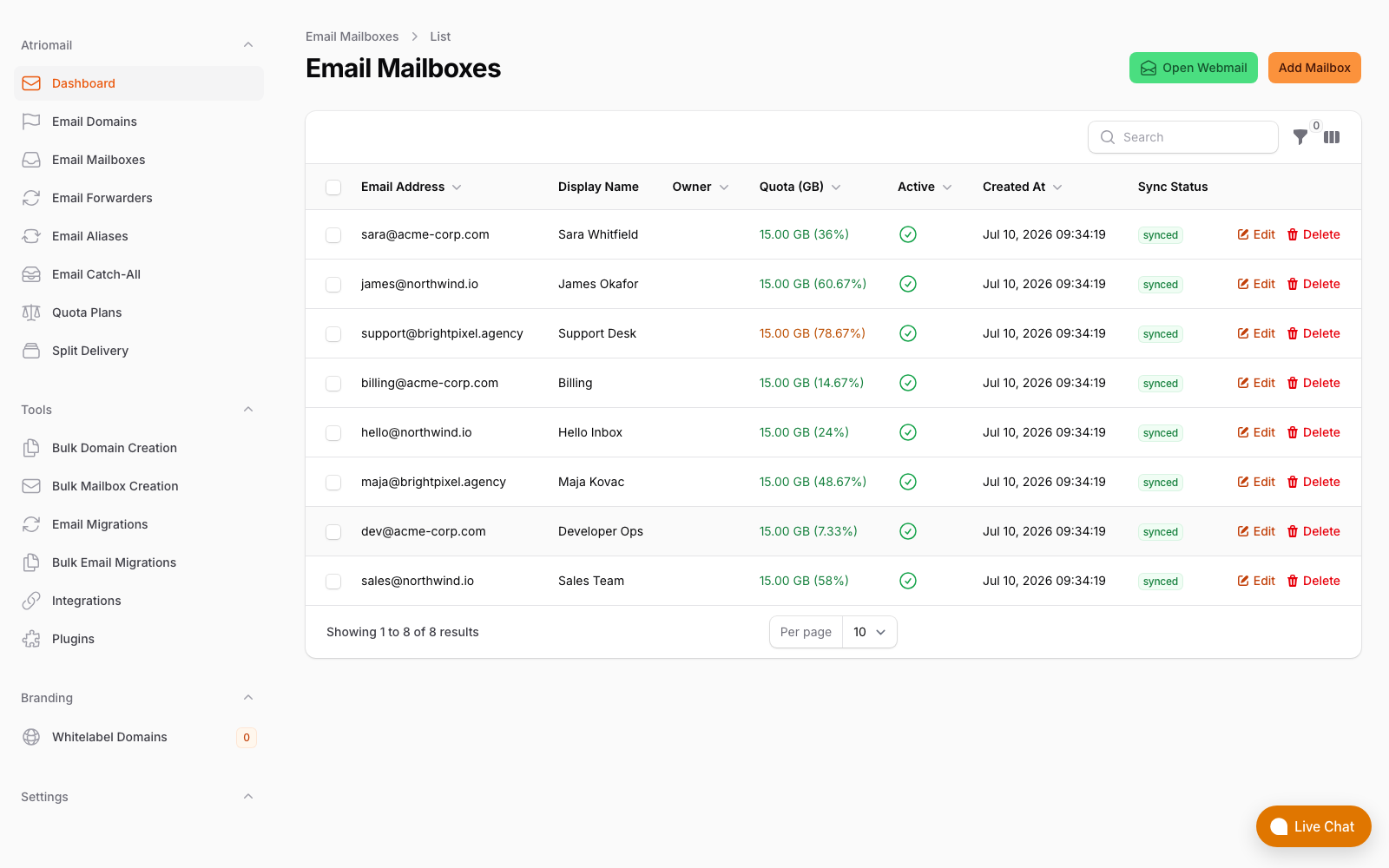
The mailbox management screen in a dedicated reseller email panel, where a reseller can see all mailboxes across a client domain in one place and manage storage, passwords, and aliases centrally.
Where Atriomail Fits
The recurring theme above is that there is nothing to resell: no wholesale tier, no partner rate, and a renewal price the client discovers after they have budgeted for the promotional one.
Atriomail is built as the wholesale layer that is missing here. You buy at $1.39 per mailbox per month with 15 GB included and set your own retail price, so the margin is the spread you choose rather than a discount someone else declines to offer. The rate is published and flat, which matters directly against the renewal trap in this comparison: there is no introductory rate to lapse, and no promotional pricing that resets underneath a client you have already quoted.
Storage is worth comparing directly, since the restructured Starter plan is 5 GB. Fifteen GB is included per mailbox here, with more at $0.60 per 5 GB block. Provisioning and per-client invoicing run through WHMCS, Blesta or the REST API. See the pricing page for current rates.
Frequently Asked Questions
Can I resell Namecheap Private Email as my own product?
There is no Namecheap program that lets you resell Private Email under your own brand at a wholesale rate. You can purchase Private Email plans from Namecheap at retail and bill your clients separately, but Namecheap sets the price you pay, provides no WHMCS module for automation, and puts no white-label branding option on the product. Your clients see Namecheap's webmail interface and Namecheap's name in support flows unless you manage the mailboxes entirely through your own account and keep Namecheap's involvement invisible.
Is Namecheap Private Email powered by Titan?
No. Namecheap built Private Email on Open-Xchange and is now migrating to its own platform. Titan powers email products from Hostinger, GoDaddy, Name.com, WordPress.com, and Namesilo, but not Namecheap. The two are separate products with different infrastructure, different feature sets, and different reseller model limitations. The core limitation is the same from a reseller perspective: neither provides a wholesale per-mailbox rate or a WHMCS module that provisions email at the domain level.
What does the ActiveSync removal mean for my clients' mobile devices?
ActiveSync is the protocol iOS Mail, native Outlook on iOS and Android, and most Android mail apps use to sync email with push delivery. Removing it means those apps will no longer be able to connect via their default protocol. Clients will need to reconfigure their devices to use IMAP for email and add CalDAV and CardDAV separately for calendar and contacts sync. IMAP uses polling rather than push, so email delivery to mobile devices will be slower. For clients whose mobile email is business-critical, this is a service degradation that often requires a support call to resolve.
How do I migrate clients off Namecheap Private Email?
IMAP-to-IMAP migration is the standard path. Since Private Email supports standard IMAP access, migrating to any IMAP-based destination preserves all existing folders and message dates. The reseller-side checklist is: provision the new mailboxes at the destination, run the IMAP migration to copy existing mail, update the domain's MX records at Namecheap (the domain registrar interface is the same one resellers already use), and verify delivery on the new platform before canceling the Private Email subscription. The migration guide covers how to frame this transition for clients so it reads as a service improvement rather than a disruption.
Recommended
- The Namecheap Outage Took Down 1.4 Million Mailboxes: What Resellers Should Build Differently
- Titan Email for Hosting Resellers: What It Is, Who Can Access It, and What to Use Instead
- Automate Email Billing in WHMCS and Blesta: Best Practices for Resellers and MSPs
- Effortless Email Migration: Impress Your Clients with Atriomail
- Pricing and the Reseller Margin Calculator, Atriomail
Latest from the blog
- How to Rotate a DKIM Key Without Breaking Mail That's Already Signed · Oct 21, 2026
- Microsoft Cut CSP Partner Margins on Exchange Online: What It Does to Your Resale Price · Oct 20, 2026
- How to Fix Forwarded Mail That's Failing SPF and Breaking DMARC · Oct 19, 2026
- What to Check Before Onboarding a 200-Mailbox Client in Atriomail · Oct 18, 2026
- Hostinger Retires cPanel Reseller Hosting: What Happens to the Client Email You Bill · Oct 17, 2026