
OpenSRS comes up in hosting reseller forums often, and the reasons are straightforward: it is a Tucows company, it has been selling wholesale domains since 1999, and its email service comes with native WHMCS and Blesta modules that provisioning-focused MSPs want to see on a spec sheet. For a hosting company already running its domain business through Tucows, adding email through the same platform makes obvious sense.
For a 1-15 person MSP that is primarily selling email, not domains, the calculus is different. The pricing is competitive at small storage sizes, but the platform has a gap that adds real operational overhead for every new client domain you onboard: there is no automated per-domain DNS configuration. This article covers what that actually means, what the pricing looks like across storage tiers, and how the margin math compares to a purpose-built email reseller platform at the same storage level.
Table of Contents
- What OpenSRS Is (and What It Is Not)
- OpenSRS Email Pricing in 2026
- What the Platform Includes
- The DNS Gap: Manual Work on Every Domain
- The Margin Math at 50 Mailboxes
- When OpenSRS Email Makes Sense
- Where Atriomail Fits
- Frequently Asked Questions
Key Takeaways
| Point | Details |
|---|---|
| OpenSRS email pricing starts at $0.50 per 5 GB mailbox per month | Storage scales at $0.50 per additional 5 GB block. A 15 GB mailbox costs $1.50/month, compared to $1.39/month at Atriomail with 15 GB included. |
| There is a $95 one-time account activation fee | The fee converts to account credits. OpenSRS uses a pre-pay credit model rather than monthly consolidated invoicing. |
| WHMCS, Blesta, HostBill and ClientExec modules are available | These cover provisioning. The modules do not automatically configure DNS records for new client domains. |
| No automated SPF/DKIM/DMARC per domain | Every new client domain requires manual DNS record setup. For a reseller managing 50 domains, this is the highest-overhead gap in the platform. |
| OpenSRS is domain-first, email-second | The email service is a natural add-on for existing Tucows domain resellers. For pure email-focused MSPs, a dedicated platform removes the manual DNS overhead entirely. |
What OpenSRS Is (and What It Is Not)
OpenSRS is a wholesale reseller platform owned by Tucows, built for hosting companies and web agencies that want to resell domains, SSL certificates, and email under their own brand. Domains are the historical core of the business. The email service was added as a complementary product to let domain resellers provision mailboxes through the same account and billing system they already use.
That origin matters for understanding the platform's strengths and its limits. OpenSRS is excellent at what a large hosting company needs: a credit-based wholesale account, API access for domain management, and a single panel that covers domains, email, and SSL. It is not primarily an email company, and its email feature set reflects that positioning.
If your business model is reselling domains and bundling email as a simple add-on, OpenSRS gives you everything in one place. If your business model is building a standalone email revenue line across multiple client domains, the lack of automated per-domain DNS configuration changes the operational picture significantly, and the storage-adjusted pricing is no longer as clear an advantage as the base rate suggests.
OpenSRS Email Pricing in 2026
OpenSRS charges $0.50 per 5 GB of mailbox storage per month, with no separate per-mailbox fee beyond that storage cost. The published email pricing page shows the following tiers:
| Storage per mailbox | Monthly cost per mailbox |
|---|---|
| 5 GB | $0.50 |
| 10 GB | $1.00 |
| 15 GB | $1.50 |
| 25 GB | $2.50 |
| 50 GB | $5.00 |
| 75 GB | $7.50 |
There is also a one-time $95 account activation fee when you open an OpenSRS reseller account. That fee is non-refundable but converts entirely into account credits you can use toward domains, email, or SSL purchases. After the initial deposit, the platform runs on a pre-pay model: you maintain a credit balance and OpenSRS debits it monthly for active mailboxes.
OpenSRS describes a volume-based reseller tier structure that rewards higher annual spend across domains, email, and SSL with progressively deeper discounts. The specific tier thresholds and discount percentages are not published publicly and require contacting their sales team to negotiate.
The comparable Atriomail wholesale rate is $1.39 per mailbox per month with 15 GB included, with extra storage available at $0.60 per additional 5 GB block and no activation fee. At the same 15 GB storage level, OpenSRS costs $1.50 per mailbox versus Atriomail's $1.39, making the two platforms nearly identical in wholesale price for a typical business mailbox size.
What the Platform Includes
For the storage-based price, OpenSRS provides:
- Webmail with white-label customization. You can apply your logo, color scheme, and fonts to the webmail interface. This is the reseller-facing brand control that MSPs want to see before choosing a wholesale platform.
- POP3/IMAP/SMTP access for desktop client and mobile app configuration.
- Calendar sync compatible with Android, Gmail, Mac OS X, iOS, and Outlook.
- Spam and virus filtering with an in-house abuse team managing the shared IP reputation.
- Bulk migration tools to move mailboxes from other providers. OpenSRS also offers a professional services team for complex migrations.
- Two-factor authentication and admin delegation capabilities.
- WHMCS module, Blesta module, HostBill, and ClientExec integrations for automated provisioning of new mailboxes when a client order is placed in your billing system.
- 99.9% uptime SLA with Canadian data centers.
The 35 MB attachment limit is worth noting if your clients regularly send or receive large files. Many business users operating in design, real estate, or professional services frequently share files in the 20-40 MB range, and a 35 MB cap creates friction in those workflows.
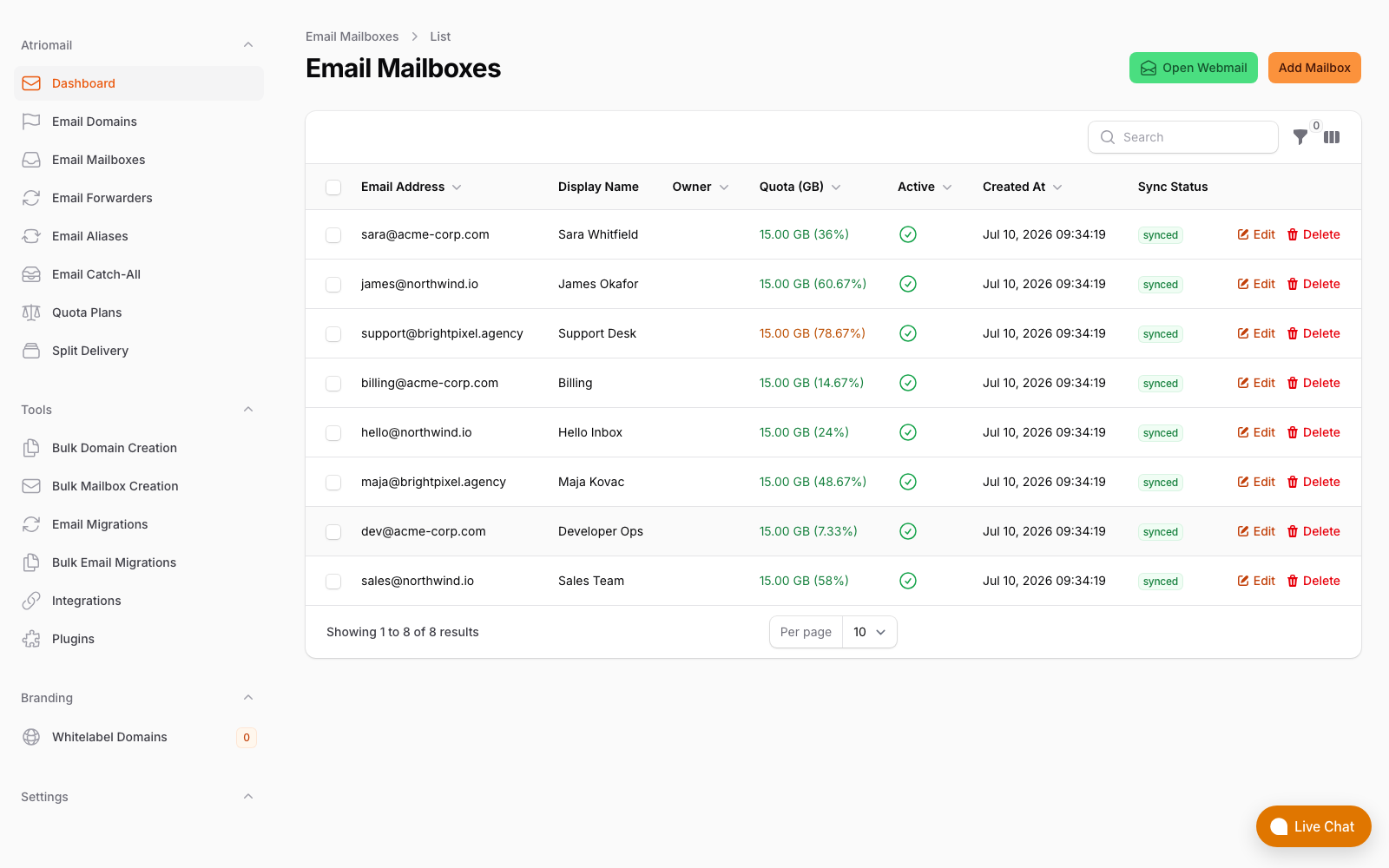
A dedicated email platform keeps the full mailbox list, storage allocation, and DNS status for every client domain in one view.
The DNS Gap: Manual Work on Every Domain
The most operationally significant difference between OpenSRS and a purpose-built email reseller platform is authentication setup. Every business email domain needs SPF, DKIM, and DMARC records published in DNS before mail from that domain will reliably reach inboxes. Gmail and Microsoft have enforced strict sender authentication requirements since early 2024, and those requirements now apply to any volume of outbound mail, not just bulk senders.
OpenSRS does not automatically configure these records when you add a new client domain. Each domain requires you to log in, locate the correct DKIM public key for that mailbox group, copy it, and add the SPF, DKIM, and DMARC TXT records manually in whatever DNS provider the client uses. If the client uses Cloudflare, you do it in Cloudflare. If they use GoDaddy, Route 53, or their registrar's default nameservers, you do it there. There is no API or built-in connector that pushes records automatically on provisioning.
For a reseller with two or three domains, this is a one-time setup cost per client. For a reseller managing 50 domains, it becomes a recurring overhead item every time a client is added, every time they change DNS providers, and every time a DKIM key rotates. The risk of a missed or misconfigured record is also higher when the task is done by hand under time pressure rather than triggered automatically at provisioning. Incorrectly configured authentication records are one of the most common causes of deliverability problems for resellers managing multiple client domains simultaneously.
A white-label email platform with automated DNS pushes SPF, DKIM, and DMARC records automatically to the DNS provider on the same provisioning event that creates the mailbox. For Atriomail, that automation works across 15 supported DNS providers. The reseller's action is adding the domain; the platform handles the rest. At 50 client domains, the cumulative time difference across initial setup, rotations, and the occasional client DNS migration is measured in hours per year, not minutes.
The Margin Math at 50 Mailboxes
Here is what the numbers look like for a reseller billing 50 mailboxes at $5.00 per mailbox per month, billed to clients through WHMCS or Blesta:
| OpenSRS (5 GB per mailbox) | OpenSRS (15 GB per mailbox) | White-label hosting (15 GB per mailbox) | |
|---|---|---|---|
| Wholesale per mailbox | $0.50 | $1.50 | $1.39 |
| Total wholesale (50 mailboxes) | $25.00/month | $75.00/month | $69.50/month |
| Client billing (50 × $5) | $250.00/month | $250.00/month | $250.00/month |
| Gross margin | $225.00/month | $175.00/month | $180.50/month |
| Annualized | $2,700/year | $2,100/year | $2,166/year |
The $225/month margin on 5 GB mailboxes is real, but 5 GB is rarely the right product for business email clients in 2026. Business users with a few years of email history, attachments, and standard business correspondence routinely exceed 5 GB. Offering 5 GB as the default creates a situation where clients hit their limit within one to two years, triggering support tickets and mid-term storage upgrades that add billing complexity without adding client goodwill.
At the 15 GB tier where both platforms are genuinely comparable as business email products, the margin difference is $5.50 per month across 50 mailboxes. That gap is not the reason to choose one platform over the other. The reason to choose a platform is operational fit: how many DNS records do you want to configure manually, and how does the billing model work with your cash flow.
When OpenSRS Email Makes Sense
There are clear cases where OpenSRS email is the right choice:
- You are already a Tucows domain reseller. If your business runs domain registrations through OpenSRS, adding email through the same account means one platform, one credit balance, and one support relationship. The billing integration with WHMCS or Blesta already exists. The marginal work to add email is low.
- Email is a bundled add-on, not your main product. If clients buy hosting and domains from you and occasionally need a mailbox or two, OpenSRS email fits naturally alongside the rest. The overhead of manual DNS setup is proportionate when email is one item among many.
- You have a technical team that handles DNS setup as part of onboarding. The manual configuration requirement is a process problem, not an insurmountable one. A small hosting operation with a defined onboarding checklist can absorb it.
OpenSRS is less well suited to an MSP that primarily sells email hosting rather than hosting and domains. In that model, every new client is a new domain, and every new domain is a manual DNS task. The overhead compounds. A shared hosting platform with bundled email has the same manual DNS problem for a reseller managing many separate client domains; OpenSRS is not unique in this gap, but it is the context in which the gap is most noticeable.
It is also worth noting that OpenSRS data centers are located in Canada. If your clients are subject to EU data residency requirements (GDPR), US federal contractor requirements, or specific data sovereignty rules in markets like Argentina or Spain, a Canada-based email infrastructure needs to be evaluated against those requirements before you commit. This is not a disqualifier, but it is a question to answer before onboarding clients with specific regulatory constraints, for the same reason it comes up with self-hosted server placement decisions.
What the Comparison Actually Turns On
The real decision for a 1-15 person MSP evaluating OpenSRS email is not the price per mailbox. At 15 GB, the wholesale cost difference between OpenSRS and a dedicated white-label platform is $0.11 per mailbox per month. Across 50 mailboxes, that is $5.50 per month, or $66 per year. No business decision should hinge on that number.
The actual decision turns on three things:
- Whether you are already inside the Tucows ecosystem. If yes, OpenSRS email is a natural fit. If no, you are taking on a new platform relationship, a credit pre-pay model, and a $95 setup fee without an obvious ecosystem reason to do so.
- How many domains you manage. At 5-10 domains, manual DNS setup is a one-time cost per client. At 50-200 domains, it becomes a recurring cost that does not get smaller as you grow.
- Whether billing consolidation matters to your clients. OpenSRS invoices through the reseller's own billing system via WHMCS or Blesta, which is the same outcome a dedicated white-label platform produces. The delivery mechanism is the same; the difference is what happens automatically at provisioning versus what requires a manual step after the mailbox is created.
If your email clients are also your domain clients and you run a significant domain registrar volume, OpenSRS email is a practical choice. If you are building an email-specific revenue line and want each client domain to be fully authenticated and live without any manual DNS steps, a platform built specifically for that workflow removes the friction at every onboarding event. Either way, the migration path between platforms is straightforward via IMAP, so the decision is not a permanent one.
Where Atriomail Fits
The section above is right that $0.11 per mailbox should not decide this. Two things in the comparison should.
The first is the DNS gap, which this article calls the highest-overhead item in the platform. Atriomail publishes SPF, DKIM and DMARC automatically for each domain as it is added, across 19 supported DNS providers and panels, so 50 client domains is 50 automatic setups rather than 50 manual ones. That is the recurring cost the price comparison does not show.
The second is how you pay. There is no $95 activation fee and no pre-pay credit balance to top up: billing is monthly and usage-based through Stripe on one consolidated, itemised invoice, with no minimum and no contract. On rate, $1.39 covers 15 GB where the equivalent OpenSRS mailbox is $1.50, so the platform difference costs nothing per mailbox. For a shop whose business is domains first and email second, the OpenSRS add-on remains a reasonable fit. See the pricing page.
Frequently Asked Questions
More on email provisioning setup and billing in the full FAQ.
Does OpenSRS configure SPF, DKIM, and DMARC automatically for new domains?
No. OpenSRS provides the DNS record values you need, but adding those records to your client's DNS zone is a manual step you perform in whatever DNS provider the client uses. There is no API connector or provisioning-triggered automation for DNS record creation. On a platform with automated DNS, those three records are published the moment the domain is added, before the first mailbox is created.
Can I use OpenSRS email without being a domain reseller?
Yes. You can open an OpenSRS reseller account and use only the email product without reselling domains or SSL. You still pay the $95 activation fee and maintain a credit balance. The WHMCS and Blesta modules cover email provisioning independently of the domain and SSL modules, so you are not required to use the full platform to access the email piece.
How does OpenSRS handle migration from another email provider?
OpenSRS provides bulk migration tools and a professional services team for complex migrations. The actual migration mechanism is IMAP copy, the same process used across every major email platform. The technical steps for IMAP migration are the same regardless of destination, as covered in the email migration guide. The key difference is whether the destination platform provides a migration assistant in the admin panel or requires you to run the IMAP copy process yourself.
What does the OpenSRS WHMCS module actually provision?
The OpenSRS Email module for WHMCS creates and manages mailboxes, email forwards, filter-only accounts, and aliases in the OpenSRS platform when a client order is placed or a service is modified. It automates the mailbox lifecycle within OpenSRS. It does not touch DNS. SPF, DKIM, and DMARC record creation for the associated domain remains a manual task outside the module's scope.
Recommended
- Automate Email Billing in WHMCS and Blesta: Best Practices for Resellers and MSPs
- Automate DNS to Eliminate Email Setup Errors
- Effortless Email Migration: Impress Your Clients with Atriomail
- cPanel Email vs. White-Label Email Hosting: The Real Cost for Hosting Resellers
- Self-Hosted Email Server vs. White-Label Hosting: What MSPs Get Wrong About the Math
- Pricing and the Reseller Margin Calculator, Atriomail
Latest from the blog
- How to Rotate a DKIM Key Without Breaking Mail That's Already Signed · Oct 21, 2026
- Microsoft Cut CSP Partner Margins on Exchange Online: What It Does to Your Resale Price · Oct 20, 2026
- How to Fix Forwarded Mail That's Failing SPF and Breaking DMARC · Oct 19, 2026
- What to Check Before Onboarding a 200-Mailbox Client in Atriomail · Oct 18, 2026
- Hostinger Retires cPanel Reseller Hosting: What Happens to the Client Email You Bill · Oct 17, 2026