
Relying on big-name platforms leaves IT agencies and hosting providers fighting for thin margins and little brand recognition. Taking control with a branded email platform means your agency’s identity stays visible while you manage pricing, features, and client experience. White-label solutions give you that power and eliminate technical headaches by automating sender authentication with SPF, DKIM, and DMARC. This article clarifies myths, highlights real profit advantages, and explains how branded platforms protect client reputations from Business Email Compromise scams.
Table of Contents
- Branded Email Platforms Defined And Debunked
- Common Misconceptions About Branded Platforms
- Why Authentication Matters For Your Clients
- White-Label Email Vs. Traditional Solutions
- The Real Cost Comparison
- Control Without The Complexity
- Key Features: Control, Privacy, And Automation
- Complete Brand Control
- Privacy As Your Competitive Edge
- Automation Without The Headaches
- Profit Margins And Revenue Opportunities
- The Margin Economics
- Multiple Revenue Streams
- Automation Reduces Your Cost Structure
- Avoiding Common Pitfalls And Challenges
- Deliverability And Compliance Issues
- Integration And Technical Barriers
- Building Client Trust
Key Takeaways
| Point | Details |
|---|---|
| Branded Platforms Offer Control | Agencies can fully control branding, pricing, and customer experience without the technical complexities of traditional solutions. |
| Automation Enhances Efficiency | Streamlining processes through automation saves time and reduces costs, allowing agencies to focus on client relationships. |
| Misconceptions Are Common | Many agencies mistakenly believe branded platforms are complicated or unaffordable, overlooking their scalability and cost-effectiveness. |
| Strong Authentication Is Essential | Providing clients with robust email authentication protects their reputation and enhances deliverability, a critical selling point for agencies. |
Branded Email Platforms Defined and Debunked
A branded email platform is a white-label email hosting solution that lets you resell email services under your own brand identity. Unlike renting space on someone else’s infrastructure, you control the entire user experience.
Here’s what separates a branded email platform from generic hosting:
- Your branding throughout – Custom domains, logos, and user interfaces bearing your company name
- Complete control – You set pricing, features, support standards, and client onboarding processes
- Infrastructure management handled – The platform provider manages servers, security, and uptime while you focus on sales and client relationships
- Domain authentication built-in – Automated setup of SPF, DKIM, and DMARC protocols that verify sender identity
- API integration – Seamless connection to your existing systems and workflows
Common Misconceptions About Branded Platforms
Many agencies believe branded email platforms are complicated, expensive, or only for large enterprises. That’s not accurate.
Myth 1: You need deep technical knowledge. False. Modern white-label platforms handle DNS validation automatically, removing the technical burden from your team.
Myth 2: Branded platforms cost more than reselling existing services. Wrong. Usage-based pricing models mean you pay only for what clients consume, not inflated per-seat fees.
Myth 3: Brand control isn’t worth the effort. Consider this: clients see your logo every time they log in. That reinforces your brand while building loyalty.
Brand control isn’t a luxury feature—it’s your competitive advantage in a crowded hosting market.
Myth 4: You’ll lose clients to the email provider. With a truly branded platform, clients never know the infrastructure provider exists. Your agency stays front-and-center.
Why Authentication Matters for Your Clients
Email authentication isn’t just technical overhead. Business email compromise scams cost organizations billions annually. When you offer clients a platform with proper authentication built-in, you’re protecting their reputation and finances.
Your clients’ domains get legitimate verification signals. Receiving servers trust their emails more. Phishing filters let legitimate messages through. That’s real value you can explain to prospects.
Pro tip: Highlight authentication capabilities in your marketing—it’s a security differentiator that resonates with risk-conscious decision makers.
White-Label Email vs. Traditional Solutions
Traditional email solutions mean building and managing everything yourself. You handle servers, security patches, customer support, billing systems, and infrastructure costs. Your development team spends months building features instead of selling.
White-label email platforms flip this model. You rebrand a complete, battle-tested system and launch within weeks. The infrastructure provider handles the technical headaches while you focus on client relationships and growth.
Here’s the core difference:
Here’s how branded email platforms differ from traditional email solutions in key business areas:
| Aspect | Branded Email Platform | Traditional Solution |
|---|---|---|
| Implementation Time | Launches in weeks | Takes 6-12 months |
| Operational Burden | Mostly hands-off | Requires constant maintenance |
| Upfront Costs | Minimal, pay-as-you-grow | Large capital investment |
| Brand Visibility | Your brand is prominent | Provider branding visible |
| Growth Scalability | Easily scales with usage | Limited by internal resources |
- Traditional approach – You own the entire stack, manage all operations, hire specialized staff
- White-label approach – Third-party provider manages infrastructure, you handle branding and sales
- Time to market – Traditional takes 6-12 months; white-label launches in weeks
- Operational burden – Traditional requires constant maintenance; white-label is hands-off
- Capital requirements – Traditional demands significant upfront investment; white-label uses pay-as-you-grow pricing
The Real Cost Comparison
Many agencies assume traditional solutions are cheaper. They’re not. Building in-house email infrastructure requires dedicated engineers, 24/7 monitoring, compliance expertise, and security certifications. That’s expensive.
White-label solutions reduce development costs dramatically. You skip the engineering phase entirely. Usage-based pricing means costs scale with revenue, not vice versa.
Consider your time investment. Every hour spent managing servers is an hour not spent acquiring clients. For agencies, that’s opportunity cost that matters.
With white-label, you’re paying for a solution, not building one from scratch.
Control Without the Complexity
White-label doesn’t mean losing control. You maintain complete branding across every touchpoint. Clients see your logo, your support team, your interface. The backend infrastructure remains invisible to them.
You set pricing. You control feature rollouts. You decide support response times. That’s real control without operational nightmares.
Traditional solutions give you control but chain you to maintenance obligations. White-label gives you control over what matters—your brand and client experience.
Pro tip: Start with white-label while your agency scales, then evaluate whether building custom infrastructure makes financial sense at enterprise scale.
Key Features: Control, Privacy, and Automation
Branded email platforms live or die on three core features. Control your branding and client experience. Protect privacy so clients trust you. Automate workflows so your team scales without hiring.

Getting these three right separates platforms that agencies love from platforms that create headaches.
Complete Brand Control
With a branded platform, your clients never see the infrastructure provider’s logo, interface, or branding. Every login screen, notification, and email bears your company identity.
That control extends beyond aesthetics:
- Custom domains – Clients use your domain for their email setup
- Whitelabeled interface – Your colors, fonts, and messaging throughout
- Pricing control – You set rates and margins for each client
- Feature selection – Choose which capabilities to offer clients
- Support branding – Your support team handles all client interactions
This visibility compounds over time. Clients associate email quality with your agency, not some faceless infrastructure company.
Privacy as Your Competitive Edge
Privacy-focused email services implement end-to-end encryption and secure data storage that protect client information. When you offer clients a platform with strong privacy defaults, you’re building trust that’s hard to replicate.
Your clients’ email data stays their property. No platform vendor mining metadata. No surprise policy changes exposing their communications. That clarity matters in regulated industries like healthcare, finance, and law.
Privacy isn’t a feature—it’s a promise you make to every client.
Regulatory compliance becomes easier too. When your platform handles GDPR, HIPAA, and regional privacy laws correctly, you avoid legal liability entirely.
Automation Without the Headaches
Automation multiplies your capacity. Set up workflows once, serve hundreds of clients without additional overhead.
Open-source marketing automation platforms demonstrate what’s possible: campaign builders, personalized email sequences, and API integrations that handle repetitive work. Your team focuses on strategy while automation handles execution.
Key automation opportunities:
- Onboarding workflows – New clients get setup sequences automatically
- Billing automation – Invoices and payment reminders send themselves
- Domain validation – SPF, DKIM, and DMARC records configure automatically
- Client notifications – Security alerts and account updates trigger without manual input
- Reporting – Analytics and performance summaries generate on schedule
This saves your team 10-15 hours weekly on repetitive tasks. That’s capacity for growth.
Pro tip: Map your most time-consuming client workflows first, then prioritize automating those processes before expanding to other areas.
Profit Margins and Revenue Opportunities
Here’s the financial reality: branded email platforms let you capture profit margins that traditional reselling can’t match. You’re not just moving boxes. You’re building a scalable revenue engine.
Most agencies reselling email treat it like a commodity. Thin margins, high churn, constant customer acquisition battles. Branded platforms flip that equation entirely.
The Margin Economics
Digital platforms leverage scalable models with low marginal costs, allowing you to serve multiple clients without proportional cost increases. Once infrastructure is running, adding a new client costs almost nothing.
Compare this to traditional reselling:
- Commodity reselling – You mark up someone else’s service 15-25%, fight for every client, lose them easily
- Branded platform – You control pricing, build switching costs, achieve 40-60% margins on email services
- Scaling costs – Traditional increases customer service overhead linearly; branded platforms scale through automation
- Customer stickiness – Resold services get shopped constantly; branded services stay because they’re integrated into your brand
The difference compounds. A small agency could generate $50,000 monthly recurring revenue from 100 clients on a branded platform, while struggling to reach half that through traditional reselling.
Multiple Revenue Streams
Branded platforms unlock revenue opportunities beyond base email pricing. You’re no longer limited to selling storage and seats.
You can charge for:
- Premium features – Advanced security, compliance tools, expanded storage
- Support tiers – Basic, standard, and priority support at different prices
- Migration services – Charge to move clients from old platforms
- Custom integrations – API work connecting their systems
- Training and consulting – Help clients optimize their email strategy
Each client becomes a potential source of multiple revenue streams instead of a single line item.
Below is a summary of profit-boosting strategies enabled by branded email platforms:
| Strategy | Revenue Impact | Example |
|---|---|---|
| Offer premium features | Earn higher service fees | Advanced security add-ons |
| Implement support tiers | Upsell for better margins | Priority support pricing |
| Automate onboarding | Reduce labor costs | Save 5-10 hrs per client |
| Bundle migration services | Diversify income | Charge for moving clients |
| Enable custom integrations | Attract larger clients | API connections for CRMs |
Profit margin differences show digital platform businesses achieve higher operating margins through efficient scaling and automation.
Automation Reduces Your Cost Structure
Automation isn’t just a feature—it’s a margin multiplier. Every workflow you automate reduces your customer service costs and frees capacity for more clients.
Onboarding automation alone can save 5-10 hours per new client. At typical agency labor costs, that’s $500-1,000 saved per customer. Multiply that across 100 new clients annually, and you’ve just increased profit margins by 5-10 percentage points without raising prices.
Pro tip: Start with a 35-40% margin target when launching, then use automation savings to expand margins to 50%+ within 12 months.
Avoiding Common Pitfalls and Challenges
Launching a branded email platform looks straightforward until you hit real-world obstacles. Knowing what trips up most agencies helps you sidestep costly mistakes.
The good news: most pitfalls are predictable and preventable with the right approach.
Deliverability and Compliance Issues
Common email marketing mistakes include poor segmentation, weak opt-in practices, and neglecting privacy compliance. These aren’t just annoying—they tank deliverability rates and expose you to legal liability.
Your clients won’t see the technical issues until emails stop reaching inboxes. By then, your reputation takes the hit.
Avoid these specific mistakes:
- Skipping welcome sequences – Clients need onboarding to succeed; set them up for proper sender authentication immediately
- Poor segmentation – Help clients understand list hygiene; bad data destroys deliverability
- Ignoring privacy laws – GDPR, CCPA, and regional regulations aren’t optional; bake compliance into your platform
- Weak authentication defaults – SPF, DKIM, and DMARC must be mandatory, not optional features
Integration and Technical Barriers
Digital platforms face integration complexities and data security concerns that require proactive management. Clients want their email system connected to their CRM, accounting software, and support tools.
Under-invest in integrations, and you’ll lose deals to competitors who invested in them.
Your platform needs:
- API stability – Integrations fail if your API isn’t reliable and well-documented
- Data security practices – Clients demand encryption, backup systems, and disaster recovery
- Clear technical documentation – Your support team needs to help clients troubleshoot integrations quickly
Start with the 3-5 integrations your target clients demand most, then expand systematically.
Poor onboarding creates support burden later; invest in clear setup processes from day one.
Building Client Trust
Clients are skeptical about switching to unknown platforms. They worry about data safety, uptime, and whether you’ll abandon them later.
Address trust explicitly:
- Transparent uptime reporting – Show real-time status dashboards
- Clear data handling policies – Document where data lives, who accesses it, and how you protect it
- Migration guarantees – Promise easy data export if they leave
- Dedicated support contacts – Assign account managers to enterprise clients
Trust compounds over time. Early clients become your best salespeople if you deliver reliability and support.
Pro tip: Implement a 30-day free trial period so prospects experience your platform risk-free, which eliminates trust objections before they become deal-killers.
Unlock the Full Potential of Branded Email Platforms with AtrioMail
If you are an agency struggling to maintain brand control while avoiding the technical headaches of managing email infrastructure AtrioMail is the perfect solution designed just for you. The article highlights how branded email platforms offer you complete control over branding domains authentication and client experience without the complexity or cost of traditional solutions. AtrioMail extends these benefits by providing fully managed infrastructure with automation for DNS validation including MX SPF DKIM and DMARC setup ensuring your clients enjoy secure and trusted email from day one.
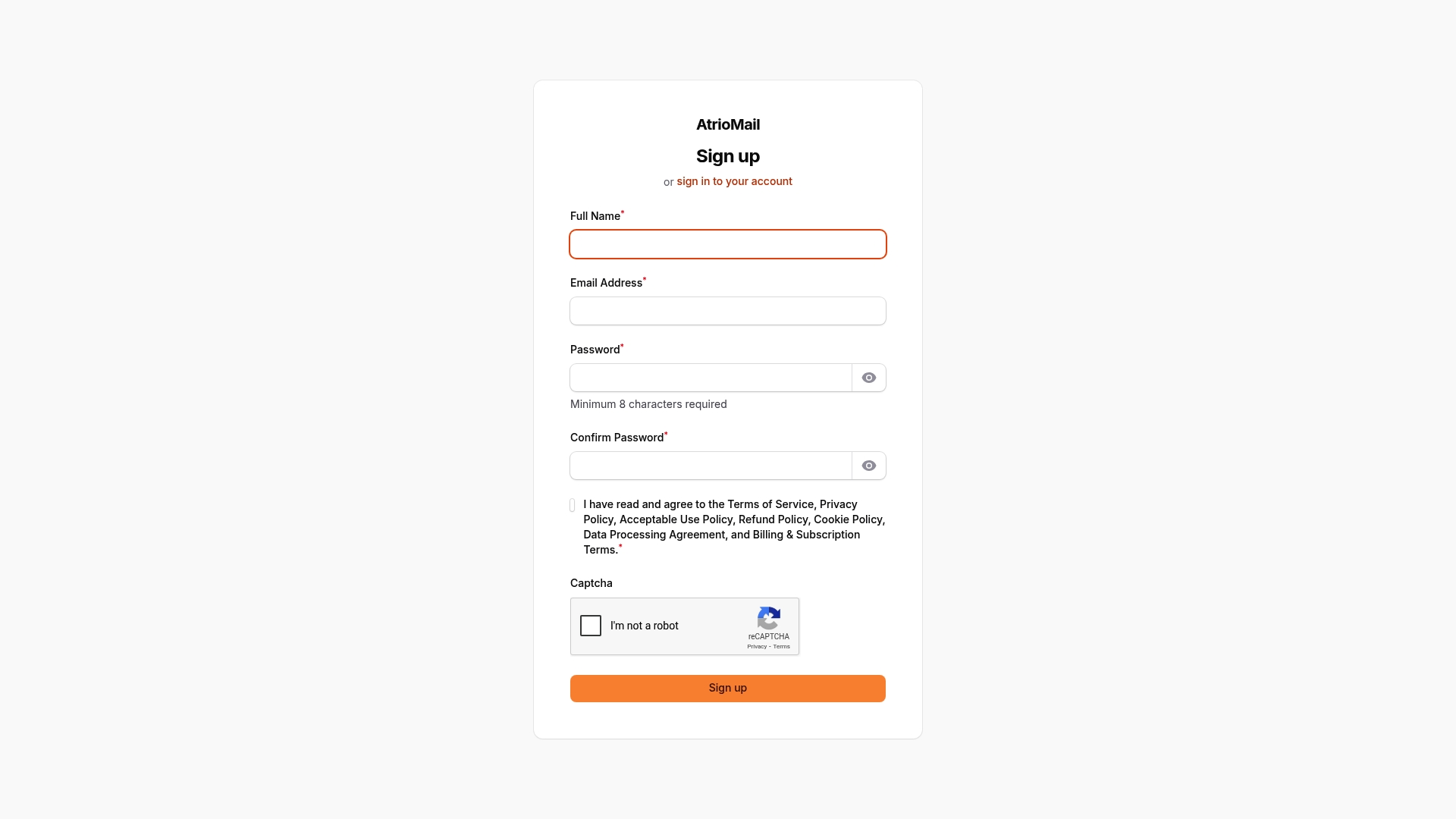
Take control of your agency’s email services today and increase your profit margins with scalable usage-based pricing and seamless API integration. Join the forward-thinking resellers and IT providers who trust AtrioMail to deliver enterprise-grade white-label email hosting. Get started now by registering at AtrioMail Sign Up and experience how effortless brand ownership and automation can transform your email offerings.
Frequently Asked Questions
What is a branded email platform?
A branded email platform is a white-label email hosting solution that allows agencies to resell email services under their own brand identity, providing complete control over user experience.
How do branded email platforms differ from traditional email solutions?
Branded email platforms are quicker to launch, require less operational maintenance, and provide hands-off infrastructure management compared to traditional email solutions, which typically involve significant setup and ongoing management efforts.
What are the benefits of using a branded email platform for my agency?
Using a branded email platform allows you to maintain branding visibility, offer automated workflows, reduce operational burdens, and unlock multiple revenue streams while preserving client trust and data privacy.
How can email authentication benefit my clients?
Email authentication, such as SPF, DKIM, and DMARC, is vital for protecting clients from email scams, enhancing deliverability, and building trust with recipients, which ultimately safeguards their reputation and finances.