
Managing your own email infrastructure can quickly drain resources, yet trusting third-party branding leaves your company invisible to clients. For IT agency owners and email service resellers, the struggle is finding a way to deliver powerful email services under your own identity without getting bogged down in technical headaches. With white-label email hosting, you offer a branded experience from custom domains to support, all while a specialized vendor handles the heavy lifting behind the scenes.
Table of Contents
- Defining White Label Email Services
- Key Features And Branding Capabilities
- How White Label Email Solutions Work
- Top Business Use Cases For Resellers
- Comparing White Label With Standard Email
- Benefits, Risks, And Common Pitfalls
Key Takeaways
| Point | Details |
|---|---|
| White-Label Email Services | Offering white-label email allows agencies to provide branded email services without managing the technical infrastructure themselves. |
| Customization and Branding | Agencies can fully customize the email experience, enhancing client trust and loyalty through consistent branding. |
| Operational Scalability | Partnering with a vendor enables scales of operation without the burden of managing email servers, allowing for growth with minimal overhead. |
| Vendor Dependency Risks | Careful selection of vendors is crucial to mitigate risks associated with service outages and maintaining quality control. |
Defining White Label Email Services
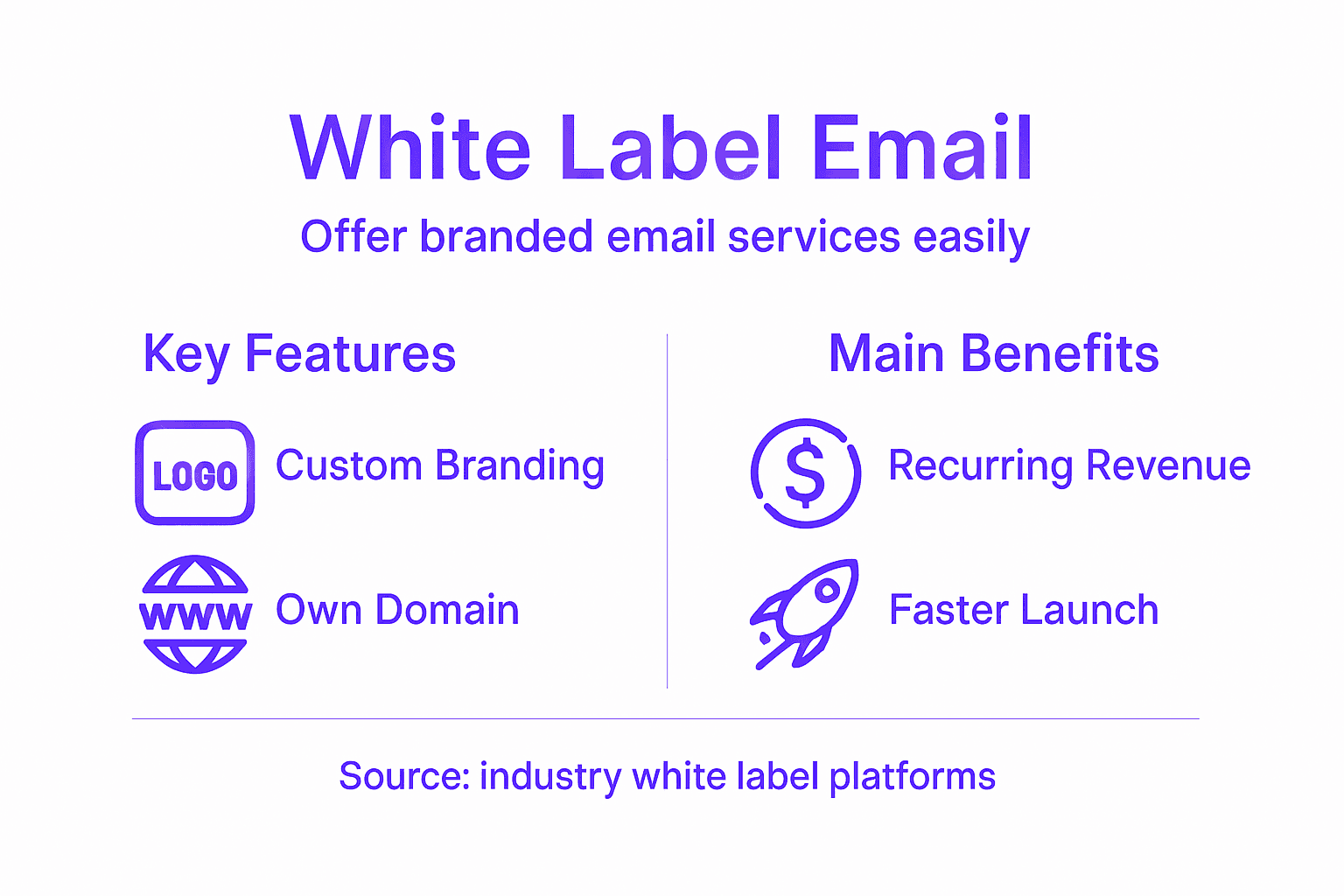
White-label email is a strategy where you offer email hosting services to your clients under your own brand while a third-party vendor handles all the underlying infrastructure, maintenance, and technical operations. The vendor stays completely invisible to your end users. They see your logo, your domain, your interface, and your branding everywhere, but you’re not building or managing the email servers, security protocols, or backup systems yourself.
Think of it like a restaurant that sources food from a distributor but presents everything as their own creation. The supplier remains unknown to customers. Similarly, white-labeling involves rebranding third-party services to create a seamless brand experience as if the services originated from your company. When you offer white-label email, your clients access full email functionality including IMAP, webmail, calendars, and contact management, all branded with your colors, domain, and messaging. Your brand becomes the sole touchpoint. Clients believe they’re using your proprietary system, not realizing a vendor manages the backend.
What makes this different from other approaches:
- DIY hosting requires you to own servers, manage security patches, handle email deliverability issues, and troubleshoot infrastructure problems. You assume all technical and legal responsibility.
- Reselling consumer email (like Gmail or Outlook accounts) means your clients use generic branding and interfaces controlled by massive tech companies. You have zero customization and minimal margins.
- White-label email provides the best of both worlds. You control the entire customer experience with branded interfaces while a specialized vendor manages the complex technical work behind the scenes.
The core value lies in how your IT agency or email reseller business scales. You’re not constrained by your own technical team’s capacity to manage infrastructure. Instead, you can add hundreds or thousands of email users by simply allocating them through your platform. Your vendor handles growth automatically. This is why white-label email solutions matter to agencies seeking control, privacy, and customizable branding for their clients’ email needs without the operational burden of managing servers and infrastructure.
Pro tip: When evaluating a white-label email partner, confirm they automate DNS validation (MX, SPF, DKIM, DMARC) so your team avoids manual setup errors and customer onboarding delays.
Key Features and Branding Capabilities
Your white-label email platform becomes an extension of your agency’s brand identity. Every element your clients see reinforces your company, not the underlying vendor. This is where white-label email solutions truly differentiate themselves from generic hosting options.
The core capabilities you gain include complete customization of visual elements. You control the domain clients use for sending email, the logo displayed in webmail interfaces, the color schemes throughout the platform, and even the fonts in email templates. Custom domains matter significantly because sending emails from a custom domain with branded subdomains enhances trust and improves deliverability rates. Clients receive messages that appear to originate from your company, strengthening your professional presence with every send.
Beyond aesthetics, technical branding features give you operational control:
- Dedicated IP addresses let you manage sender reputation independently, ensuring your clients’ email deliverability remains unaffected by other users on shared infrastructure
- Custom email templates with centralized design libraries allow you to lock specific sections, preventing clients from accidentally breaking brand guidelines
- Transactional email branding ensures password resets, account notifications, and order confirmations all reflect your identity consistently
- Domain management tools automate DNS configuration so clients never see vendor references or technical complexities
This unified branding approach directly impacts your bottom line. When clients perceive the email service as yours, they’re more willing to pay premium pricing and remain loyal longer. You’re not competing on commodity pricing against Gmail or Outlook. You’re offering a branded business tool that increases trust and engagement while maintaining complete separation from the underlying vendor infrastructure.
Many resellers overlook one critical feature: support attribution. Your clients should contact your support team exclusively. Your branding extends to customer service interactions, documentation, and help resources. The vendor handles everything behind the scenes, but your clients never know the difference.
Pro tip: Set up locked template sections in your design library immediately after onboarding to prevent brand inconsistencies as your client base grows and team members create new email campaigns.
How White Label Email Solutions Work
The mechanics behind white-label email are straightforward, yet the architecture that enables it is sophisticated. When you partner with a white-label email vendor, you’re essentially licensing their proven email infrastructure while taking complete ownership of the customer relationship and brand presentation.

Here’s how the operational flow functions. You sign up as a reseller or partner with the vendor’s platform. They provide you with administrative access through a multi-tenant control panel, which separates your customers’ data completely while allowing you to manage all of them from one dashboard. When you add a new client, the system automatically provisions their email account, DNS records, and security protocols. Resellers control branding, pricing, and customer relationships while the vendor manages everything infrastructure-related behind the scenes. Your clients log into their email portal and see your logo, colors, and domain. They never know a third-party handles the servers, backups, or security updates.
The technical architecture separates concerns cleanly. The vendor owns and operates the email servers, manages spam filtering, handles backup protocols, ensures security patches are deployed, and monitors uptime. You own the customer relationship, pricing structure, support interactions, and brand experience. This division of labor is what makes the model work at scale. You can onboard hundreds of clients without hiring a single infrastructure engineer or worrying about storage capacity.
Your control panel becomes the command center for everything your customers see:
- Client provisioning happens instantly with automated DNS validation
- Billing integration tracks usage and applies your custom pricing rules
- Support ticketing routes customer issues to your team exclusively
- Domain management automates security protocol setup (SPF, DKIM, DMARC)
- User management lets you create mailboxes, set permissions, and reset passwords
The beauty of this arrangement lies in scalability without operational burden. A vendor handling 50,000 mailboxes across 500 resellers can spread infrastructure costs efficiently, allowing you to offer competitive pricing while maintaining healthy margins. You benefit from enterprise-grade email systems without enterprise-grade operational overhead.
Pro tip: Test your vendor’s API integration before launch to ensure your billing system, CRM, and customer provisioning workflows sync seamlessly, avoiding manual data entry that eats into your profit margins.
Top Business Use Cases for Resellers
White-label email solutions fit specific business models where you need to offer professional email services without the overhead of building infrastructure yourself. Understanding which use cases align with your agency type helps you identify immediate revenue opportunities and position white-label email strategically within your existing service lineup.
Digital Agencies Expanding Service Offerings
Digital marketing and web design agencies frequently encounter clients requesting email hosting alongside website design and hosting services. You already have client relationships, trust, and billing infrastructure in place. Adding white-label email means selling another recurring revenue service with minimal additional operational burden. Your clients view email as part of your broader digital presence solution rather than a separate vendor relationship. An agency handling 50 websites can typically generate $15,000 to $30,000 in annual recurring revenue by offering email to just half their client base at modest pricing.
IT Managed Service Providers (MSPs)
IT service providers manage infrastructure, security, and business applications for clients. Email is foundational to any business system. Agencies expanding service portfolios benefit from ready-to-use platforms with customization and analytics to enhance customer engagement and differentiate service offerings. MSPs can bundle email with managed hosting, backup solutions, and security monitoring as part of comprehensive managed services packages. This increases customer lifetime value and creates stickier relationships because email is mission-critical infrastructure.
Hosting Providers and Cloud Resellers
Web hosting companies and cloud service resellers need email as a core offering. Whether you resell shared hosting, VPS, or cloud infrastructure, clients expect email included or available as an add-on. White-label email lets you offer it under your brand without managing mail servers yourself. Your existing control panel integrations and customer support team handle everything. Margin expansion becomes significant because customers willingly pay premium pricing for branded email as part of their hosting package.
Franchises and Multi-Location Businesses
Franchise networks and businesses with multiple locations need standardized communication tools. White-label email provides consistent branding across all locations while allowing individual franchisees to manage their own mailboxes and team members. Headquarters maintains oversight through the reseller control panel while franchisees enjoy the illusion of independent branded email. This creates a unified corporate communication experience across distributed operations.
SaaS and Software Companies
Software companies serving specific industries can embed white-label email into their platforms. Accounting software, real estate platforms, and project management tools all benefit from integrated email. Your users never leave your application to access email functionality. The integration strengthens your product offering without you managing mail infrastructure.
Pro tip: Start by auditing your current client base to identify which 20 percent of customers would most benefit from email services, then reach out with a targeted offer that positions email as a natural extension of services they already use.
To clarify how white-label email enables business growth, here is a summary of primary use cases and direct benefits:
| Business Type | Strategic Advantage | Typical Impact |
|---|---|---|
| Digital Agencies | Adds recurring revenue with client email | Increases client retention and revenue |
| IT MSPs | Bundles with managed IT services | Deepens long-term client engagement |
| Hosting Resellers | Offers branded email without servers | Expands margins and upgrades value |
| Franchises | Unifies communications across locations | Ensures consistent brand experience |
| SaaS Companies | Integrates email in core apps | Strengthens software product stickiness |
Comparing White Label with Standard Email
When you evaluate email solutions for your business, the choice between white-label and standard email services fundamentally shapes your brand positioning, customer experience, and profit margins. Understanding the distinctions helps you make the right decision for your agency or reseller operation.
Standard email services like Gmail, Outlook, or generic hosting provider accounts offer basic email functionality at consumer or commodity pricing. Your clients get reliable email, but they see Google’s logo, Microsoft’s branding, or the hosting company’s logo when they log in. You have minimal customization options. Your clients know they’re using a third-party service. The pricing is cheap, which means your margins are nonexistent. You can’t differentiate your service offering because every competitor offers the same thing. Support falls back to the email provider, and your brand becomes invisible in the customer experience.
White-label email services flip this equation entirely. Your clients see your logo, your domain, your colors, and your branding everywhere. White label email hosting allows businesses to brand the email service fully as their own, maintaining control over domain, logos, and user experience while outsourcing infrastructure management. This branded experience extends to login screens, control panels, support interactions, and email headers. Customers believe they’re using your proprietary email system. You control pricing and can charge premium rates that reflect the branded, professional nature of the service.
Here’s where the real differences emerge in practical terms:
| Aspect | Standard Email | White-Label Email |
|---|---|---|
| Branding | Third-party logos visible | Your branding exclusively |
| Deliverability | Generic sender reputation | Your dedicated IP reputation |
| Pricing Control | Minimal margins | Premium pricing opportunity |
| Customer Perception | Generic commodity service | Professional branded solution |
| Support Attribution | Vendor handles support | Your team provides support |
| Customization | Limited or none | Complete domain and template control |
| Scalability | Constrained by provider limits | Scales with your growth |
Deliverability differences matter significantly. Standard email services often include third-party branding and lack sender customization, which can reduce trust and engagement from recipients. When clients send email from a generic domain or shared sender address, ISPs treat the message with less trust. Spam filters become more aggressive. Recipients may not recognize the sender. With white-label email, your clients send from custom domains with your branding, improving recipient recognition and reducing spam filtering issues.
The financial impact compounds quickly. A client receiving email from “[email protected]” versus “[email protected]” represents the difference between perceived professionalism and commodity service. That perception justifies higher pricing and increases customer retention significantly.
Pro tip: When pitching white-label email to prospects, highlight deliverability improvements and brand consistency as primary benefits, not just the ability to customize logos.
Benefits, Risks, and Common Pitfalls
White-label email delivers genuine business advantages, but success requires understanding the tradeoffs and potential obstacles you’ll encounter. The benefits are substantial, but they come with responsibilities that many resellers underestimate.
The Real Benefits
White-label email creates recurring revenue with minimal operational overhead. Once you onboard a client, you collect monthly or annual fees for email service with virtually no additional cost beyond your vendor’s wholesale pricing. This residual income scales beautifully. An agency with 100 email clients paying $20 per month generates $24,000 in annual recurring revenue with zero infrastructure management.
Brand control matters more than you might think. Every client interaction reinforces your company identity. Clients perceive email as your service, strengthening loyalty and making them less likely to shop around. This perception justifies premium pricing compared to commodity email hosting.
Time-to-market accelerates dramatically. You don’t build infrastructure, hire engineers, or manage deployments. You launch your email service in weeks, not months.
The Genuine Risks
Vendor dependency creates real exposure. If your white-label provider experiences an outage, your clients can’t send or receive email. Your reputation suffers, but you have limited control over the underlying service quality. You’re entirely dependent on their infrastructure stability and security practices. Risks include dependency on third-party providers, potential quality control issues, and possible lower profit margins, which can directly impact your business if the vendor underperforms.
Profit margins compress if you don’t manage pricing strategy carefully. Cheap wholesale pricing from your vendor leaves little room for your markup. Aggressive resellers often undercut their own margins by racing to the bottom on price.
Client retention risks emerge when your vendor changes terms, increases wholesale pricing, or degrades service quality. Clients blame you, not the vendor. You own the relationship and the reputation damage.
Common Pitfalls to Avoid
Inadequate partner due diligence is the biggest mistake. You must evaluate vendor stability, uptime track records, security certifications, and support quality before committing. Poor vendor selection cascades into operational nightmares.
Failing to fully customize the service destroys brand integrity. Clients notice when the interface still shows vendor traces, support emails reference the wrong company, or documentation mentions the third-party provider. These gaps undermine trust.
Communication silos between you and your vendor create problems. Clear escalation paths, dedicated vendor support contacts, and regular check-ins prevent misunderstandings that damage your client relationships. Challenges include client retention risks if providers engage directly, communication silos, and ensuring quality assurances.
Underestimating support demands causes burnout. Your team owns client support entirely. Budget time and resources for help desk, onboarding, and troubleshooting.
The following table outlines common pitfalls and proven prevention strategies for white-label email providers:
| Common Pitfall | Prevention Strategy |
|---|---|
| Weak vendor due diligence | Review uptime, security, support records |
| Incomplete branding customization | Audit all client touchpoints for vendor traces |
| Communication silos with vendor | Schedule regular escalation meetings |
| Underestimating support demands | Allocate help desk staffing up front |
Pro tip: Negotiate a Service Level Agreement (SLA) with your vendor that includes specific uptime guarantees, response times, and remedies for failures, then ensure your client contracts reference those same guarantees.
Take Full Control of Your Brand With White Label Email Solutions
Organizations seeking to expand their email service offerings face challenges like complex infrastructure management, limited branding control, and scalability concerns outlined in the article “What Is White Label Email and Why It Matters”. AtrioMail answers these pain points by delivering a fully managed, white-label email platform that eliminates manual DNS validation errors and offloads server maintenance to trusted experts. Your agency or hosting business can confidently provide email solutions under your own brand with features such as dedicated IP reputation management, customizable domains, and seamless client support—empowering you to scale rapidly without technical headaches.
Get started today with AtrioMail and experience how effortless it is to onboard clients, control pricing, and protect your brand identity. Harness enterprise-grade email hosting designed specifically for resellers and IT agencies wanting complete independence and enhanced profit margins.
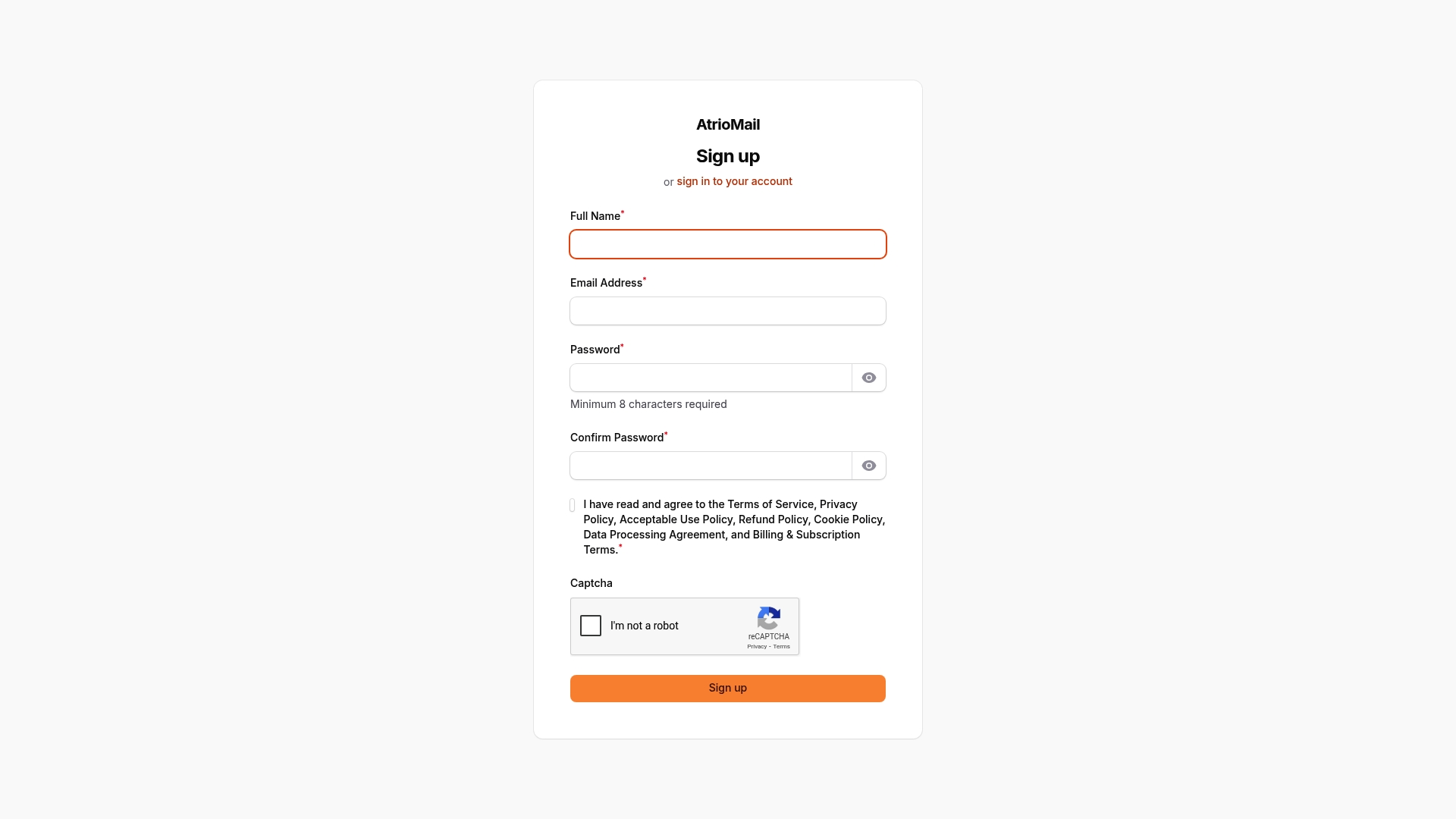
Ready to grow your business with a true white-label email offering that aligns perfectly with your goals? Discover the power of automation, branding, and stable infrastructure by registering now at AtrioMail. See why resellers everywhere trust us to simplify email hosting while maximizing revenue and brand loyalty.
Frequently Asked Questions
What is white label email?
White label email is a service where businesses can offer email hosting under their own brand, while a third-party vendor manages the technical aspects, infrastructure, and maintenance. Clients perceive the email service as the provider’s own, seeing their branding throughout the platform.
How does white label email differ from standard email services?
Standard email services often feature third-party branding and minimal customization options, whereas white label email allows for complete branding control, including logos and domain usage, giving the appearance of a proprietary service.
What are the benefits of using white label email solutions?
The key benefits include generating recurring revenue without operational overhead, maintaining brand control, improving client trust and engagement, and offering a scalably branded email solution without the complexities of managing infrastructure.
What are potential risks when using white label email services?
Risks include vendor dependency, potential quality control issues, compressing profit margins, and client retention challenges if there are changes in service terms or quality. It’s crucial to conduct thorough due diligence on the vendor before partnering.
Recommended
- 7 Essential Email Branding Best Practices for Resellers – Atriomail
- Boost Your Agency’s Brand Identity with White-Label Email: A Comprehensive Guide – Atriomail
- Why Resellers Are Ditching Big Providers for White-label Platforms – Atriomail
- Step-by-Step Guide to White Label Email for Agencies – Atriomail