
Managing branded email services for multiple clients often means sacrificing control or wrestling with complex backend systems. For Email service resellers and IT agencies, finding a solution that blends rapid scaling, strong client isolation, and easy management is vital. Multi-tenant email hosting provides a streamlined path to serve diverse organizations securely, letting providers uphold unique branding and elevate support standards while bypassing heavy infrastructure headaches.
Table of Contents
- Multi-tenant Email Hosting Defined And Debunked
- Architectural Models And Data Isolation Approaches
- How White-label And Reseller Platforms Leverage Multi-tenancy
- Major Benefits For IT Resellers And Agencies
- Risks, Security Concerns, And Key Comparisons
Key Takeaways
| Point | Details |
|---|---|
| Multi-Tenant Benefits | Multi-tenant email hosting optimizes resource utilization and lowers operational costs while ensuring data isolation for clients. |
| Architectural Models | Understanding the Silo, Bridge, and Pool models helps tailor security and performance strategies for different organizational needs. |
| White-Label Advantage | Multi-tenancy allows white-label platforms to efficiently serve multiple clients with unique branding while minimizing infrastructure complexity. |
| Security Challenges | Implementing robust security protocols is essential for addressing data isolation risks and potential security vulnerabilities in multi-tenant environments. |
Multi-tenant Email Hosting Defined And Debunked
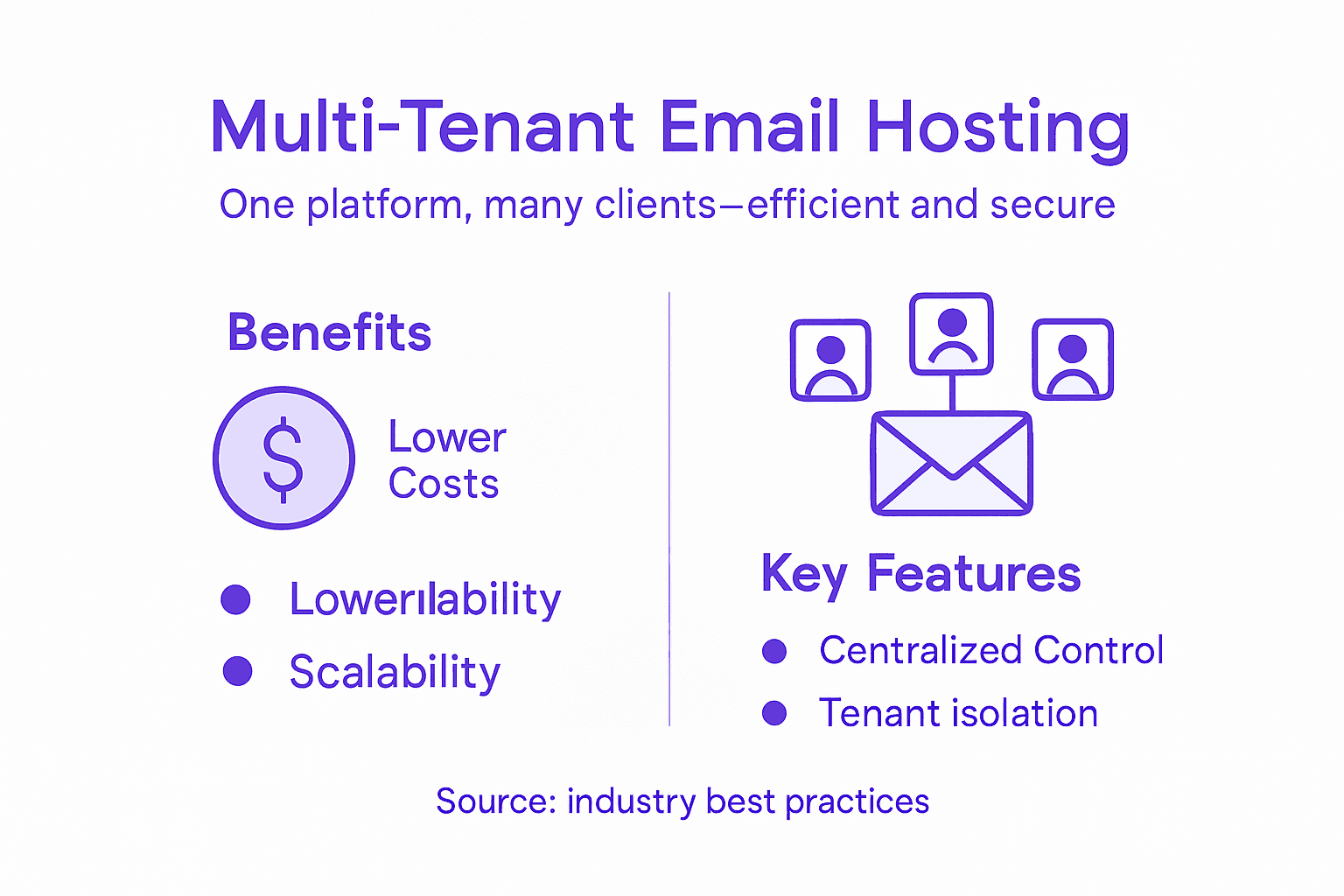
Multi-tenant email hosting represents a sophisticated architectural approach that enables a single email infrastructure to serve multiple independent organizations securely and efficiently. This model allows service providers to optimize resource utilization while guaranteeing each client’s data remains completely isolated. Multi-tenancy in software architecture fundamentally transforms how email services are delivered and managed.
The core mechanism of multi-tenant hosting involves creating logical separations within a shared infrastructure, ensuring each tenant operates as if they have a dedicated environment. Key characteristics include:
- Complete data isolation between different organizational clients
- Shared computational resources for improved cost-efficiency
- Scalable infrastructure that adapts to changing client needs
- Centralized management and maintenance capabilities
- Enhanced security protocols preventing cross-tenant data access
Understanding the nuanced architectural principles of multi-tenancy reveals three primary implementation models: silo, bridge, and pool. Each model offers different levels of resource sharing and isolation, allowing email hosting providers to customize their approach based on specific security and performance requirements.
For email resellers and IT agencies, multi-tenant hosting represents a strategic solution that dramatically reduces infrastructure complexity while maintaining robust service quality. By leveraging shared resources, organizations can significantly lower operational costs, accelerate deployment timelines, and offer more competitive pricing to their clients.
Pro tip: When evaluating multi-tenant email hosting solutions, prioritize providers offering granular access controls and comprehensive tenant isolation mechanisms.
Architectural Models And Data Isolation Approaches
Email hosting providers have developed sophisticated multi-tenant architectural models that address critical security and performance requirements. These models create strategic approaches to data isolation, allowing organizations to balance resource efficiency with robust tenant protection.
Three primary architectural models emerge as standard practices in multi-tenant email hosting:
- Silo Model: Completely isolated databases per tenant
- Bridge Model: Dedicated schemas with shared infrastructure
- Pool Model: Shared tables with row-level security mechanisms
Each model presents unique trade-offs between operational complexity, cost management, and security implementation. The multi-tenant architecture design requires careful evaluation of an organization’s specific compliance, scalability, and performance needs.
The Silo Model provides maximum security by giving each tenant a separate database instance, ensuring complete logical and physical isolation. This approach works exceptionally well for clients with stringent regulatory requirements or highly sensitive data. Conversely, the Pool Model offers maximum resource optimization by implementing sophisticated row-level security within shared database structures, dramatically reducing infrastructure costs.

Here’s a quick comparison of the three main multi-tenant architectural models for email hosting:
| Model | Data Isolation Method | Cost Efficiency | Best Fit For |
|---|---|---|---|
| Silo | Separate databases per client | Higher operating cost | High-security needs |
| Bridge | Shared infrastructure, isolation by schema | Balanced cost | Customizable environments |
| Pool | Row-level security in shared tables | Maximum cost savings | Large-scale deployments |
Selecting the right multi-tenant architectural model is not just a technical decision, but a strategic business choice that impacts long-term scalability and operational efficiency.
Pro tip: Conduct a comprehensive security and compliance assessment before selecting your multi-tenant architectural model to ensure alignment with your specific operational requirements.
How White-label And Reseller Platforms Leverage Multi-tenancy
White-label and reseller platforms have revolutionized their service delivery by strategically implementing multi-tenant SaaS architectures. This approach allows them to serve multiple customers through a single software infrastructure while maintaining unique branding and configuration capabilities for each client.
Key advantages of multi-tenancy for white-label platforms include:
- Unified Infrastructure: One centralized platform serving multiple clients
- Customization Flexibility: Unique branding and feature configurations per tenant
- Cost-Effective Scaling: Reduced operational expenses through shared resources
- Rapid Deployment: Quick onboarding of new clients without extensive infrastructure changes
- Enhanced Security: Sophisticated data isolation mechanisms
The multi-tenant architecture design enables resellers to offer tailored solutions that appear as fully independent services. This model allows businesses to create unique email hosting experiences without managing complex backend infrastructures, dramatically reducing technical overhead and time-to-market.
Multi-tenancy transforms white-label platforms from simple service providers into agile, scalable technology ecosystems that can rapidly adapt to diverse market demands.
Pro tip: Prioritize multi-tenant platforms that offer granular customization options and robust tenant isolation to maximize your service differentiation and security capabilities.
Major Benefits For IT Resellers And Agencies
IT resellers and agencies discover transformative advantages through multi-tenant infrastructure strategies that revolutionize their service delivery models. These platforms enable businesses to dramatically reduce operational complexities while expanding their service capabilities with unprecedented efficiency.
Key strategic benefits include:
- Cost Optimization: Significantly lower infrastructure and maintenance expenses
- Rapid Scalability: Quickly onboard new clients without complex deployments
- Enhanced Customization: Offer unique, branded solutions for each client
- Streamlined Management: Centralized control across multiple tenant environments
- Reduced Technical Overhead: Minimal backend infrastructure management required
The multi-tenant approach empowers IT agencies to transform their business models from traditional service providers to agile technology partners. By sharing a unified infrastructure, resellers can allocate resources more strategically, focusing on customer experience and innovative service development rather than managing complex technical ecosystems.
This summary highlights how multi-tenancy changes the business strategy for IT resellers and agencies:
| Business Factor | Traditional Hosting | Multi-tenant Hosting |
|---|---|---|
| Onboarding Speed | Manual, time-intensive | Automated, rapid setup |
| Customization Level | Limited, resource-heavy | High, with easy configuration |
| IT Overhead | Extensive, siloed | Minimal, centralized management |
| Growth Potential | Slower, infrastructure limits | Fast scalability, fewer barriers |
Multi-tenant architectures are not just a technological solution, but a strategic business transformation framework that redefines service delivery for modern IT providers.
Pro tip: Evaluate multi-tenant platforms based on their flexibility, customization capabilities, and robust security mechanisms to maximize your service differentiation and operational efficiency.
Risks, Security Concerns, And Key Comparisons
Multi-tenant email hosting platforms introduce complex security challenges and architectural risks that require sophisticated mitigation strategies. While these platforms offer tremendous scalability and cost advantages, they simultaneously create potential vulnerabilities that demand rigorous security protocols and architectural design.
Key security risks and comparative considerations include:
- Data Isolation Vulnerabilities: Potential cross-tenant data exposure
- Resource Contention: Performance impacts from shared infrastructure
- Authentication Complexity: More intricate access management requirements
- Potential Attack Surfaces: Increased risk of lateral movement between tenants
- Compliance Challenges: Meeting diverse regulatory requirements simultaneously
Compared to single-tenant environments, multi-tenant architectures require a more nuanced approach to security. The multi-tenant security model demands comprehensive strategies including robust authentication, strict authorization protocols, advanced encryption mechanisms, and least-privilege access principles.
Security in multi-tenant environments is not about eliminating risks entirely, but about implementing sophisticated, layered defense mechanisms that prevent and mitigate potential vulnerabilities.
Pro tip: Conduct regular comprehensive security audits and implement continuous monitoring tools specifically designed for multi-tenant architectures to proactively identify and address potential security gaps.
Unlock the Full Potential of Multi-Tenant Email Hosting with AtrioMail
Multi-tenant email hosting promises powerful scalability, secure data isolation, and cost optimization for resellers and IT agencies. However, managing that complexity while maintaining brand control and ensuring robust security can be overwhelming. AtrioMail solves this challenge by offering a fully managed, white-label email hosting platform that removes the infrastructure headache and automates key DNS validations like MX, SPF, DKIM, and DMARC.
With AtrioMail you gain:
- Complete white-label branding to maintain your unique market identity
- Scalable pricing based on actual usage to optimize costs
- Seamless API integration for rapid deployment and customization
- Enhanced security measures aligned with multi-tenant best practices
Ready to transform your email service offering with a trusted multi-tenant platform designed for resellers and agencies? Take the next step now and experience freedom from big ecosystem dependencies while increasing your profit margins. Start your journey with AtrioMail by registering today at https://system.atriomail.com/admin/register. Discover how our solutions can help you deliver scalable, secure, and branded email hosting that meets your clients’ complex needs.
Explore more about our managed email hosting capabilities and how we enable rapid onboarding and effortless management by visiting AtrioMail Register.
Frequently Asked Questions
What is multi-tenant email hosting?
Multi-tenant email hosting is an architectural approach where a single email infrastructure serves multiple independent organizations, ensuring data isolation while optimizing resource utilization.
What are the benefits of using multi-tenant email hosting?
The main benefits include reduced operational costs, scalable infrastructure, centralized management, and enhanced security protocols that prevent cross-tenant data access.
How do architectural models impact security in multi-tenant email hosting?
Different architectural models, such as silo, bridge, and pool, offer varying levels of data isolation and resource sharing, affecting overall security and compliance requirements in multi-tenant environments.
What should I consider when evaluating multi-tenant email hosting solutions?
Prioritize providers that offer granular access controls, comprehensive tenant isolation mechanisms, and robust security features to meet your organization’s specific operational and compliance needs.
Recommended
- Email Hosting Terminology Explained: Key Terms for Resellers – Atriomail
- Role of Managed Email Hosting for Resellers – Atriomail
- Email Hosting in B2B: Empowering Brand Control – Atriomail
- Managed Email Hosting Explained: Elevating B2B Services – Atriomail
- Cloud Hosting Solutions with Enterprise-Grade Security | Singleclic
- Remote Connectivity: Key Technologies