
Managing client email solutions often brings a maze of technical terms that slow down decision making. For IT agency owners and resellers, grasping the differences between shared hosting, cloud services, and enterprise email is pivotal when upgrading service portfolios for companies from France to Canada to Singapore. This guide clarifies the most important email hosting terminology, equipping you with the clear definitions needed for confident client conversations and powerful white-label offerings.
Table of Contents
- Essential Email Hosting Terminology Defined
- Types of Email Hosting Services Compared
- Core DNS Records: MX, SPF, DKIM, DMARC
- Security and Compliance Terms Explained
- White-Label Email: Key Concepts for Resellers
Key Takeaways
| Point | Details |
|---|---|
| Understanding Email Hosting | Email hosting services provide necessary infrastructure for managing professional email communications. Resellers should familiarize themselves with hosting terminology for effective navigation of the landscape. |
| Evaluating Service Types | Analyze different email hosting options, from free webmail to enterprise solutions, ensuring alignment with business needs and scalability potential. |
| Importance of DNS Records | Implement core DNS records like MX, SPF, DKIM, and DMARC for robust email security and authentication. This setup protects against phishing and enhances email deliverability. |
| Focus on Security and Compliance | Develop a multi-layered security strategy that includes encryption and two-factor authentication, adhering to compliance regulations like GDPR and HIPAA to mitigate risks. |
Essential Email Hosting Terminology Defined
Email hosting encompasses a sophisticated ecosystem of technical services that enable businesses to manage digital communication infrastructure effectively. Email hosting services provide specialized platforms for organizations to create, manage, and maintain professional email communication channels beyond basic free email solutions.
Understanding key terminology is crucial for resellers navigating this complex landscape. Email Hosting fundamentally refers to a service where a third-party provider manages email servers, storage, and related infrastructure on behalf of businesses. This includes critical components like mailbox allocation, domain management, storage capacity, and security protocols. Different hosting models exist – from shared hosting environments where multiple clients utilize the same server infrastructure to dedicated solutions offering exclusive resources for enterprise-level requirements.
The core terminology breaks down into several essential categories. Mailbox Provisioning involves creating and configuring individual email accounts within an organization’s domain. Domain Email specifically refers to email addresses using a custom domain name (like [email protected]), which provides professional branding compared to generic free email services. Cloud Email Services represent modern hosting solutions where email infrastructure is maintained across distributed servers, offering enhanced scalability, reliability, and accessibility from multiple devices.
Pro tip: When evaluating email hosting solutions, always prioritize providers offering robust security features, comprehensive backup options, and seamless scalability to accommodate your business growth.
Types of Email Hosting Services Compared
Email hosting services represent a diverse ecosystem of digital communication solutions tailored to meet varying organizational needs. Email hosting options span from basic free services to comprehensive enterprise-level platforms, each designed to address specific business requirements and communication strategies.
The primary categories of email hosting services can be segmented into distinct tiers. Free Webmail Services represent the most basic tier, typically offering limited storage and basic functionality for individual users. Shared Hosting Email Services provide a step up, allowing multiple clients to utilize the same server infrastructure, which makes them cost-effective for small businesses and startups. Cloud Email Services have emerged as a sophisticated solution, offering scalable, distributed server environments that provide enhanced reliability, accessibility, and advanced collaboration tools.
Enterprising resellers must carefully evaluate hosting options based on critical factors. Enterprise Email Solutions typically feature dedicated server infrastructure, offering maximum security, extensive storage capabilities, and advanced administrative controls. These solutions often include sophisticated features like comprehensive compliance tools, advanced spam filtering, and integration with productivity suites. Pricing models vary significantly – from per-user monthly subscriptions to annual contracts with volume-based discounting, enabling flexibility for businesses of all sizes.
Pro tip: When selecting an email hosting service, prioritize providers that offer seamless scalability, robust security protocols, and transparent pricing structures to ensure long-term compatibility with your business growth.
Here’s a concise comparison of the main types of email hosting services and their business fit:
| Service Type | Ideal User | Key Strength | Typical Limitation |
|---|---|---|---|
| Free Webmail | Individuals | No cost | Limited storage, support |
| Shared Hosting Email | Small Businesses | Cost-effective | Moderate security, scale |
| Cloud Email | Growing Teams | Scalability | May have monthly fee |
| Enterprise Email | Large Organizations | Advanced control | Higher cost, complex setup |
Core DNS Records: MX, SPF, DKIM, DMARC
Domain Name System (DNS) records are fundamental to email authentication and delivery, serving as the digital infrastructure that ensures secure and reliable communication. Email authentication protocols play a critical role in preventing unauthorized use of domains and protecting against email spoofing, phishing, and other malicious activities.
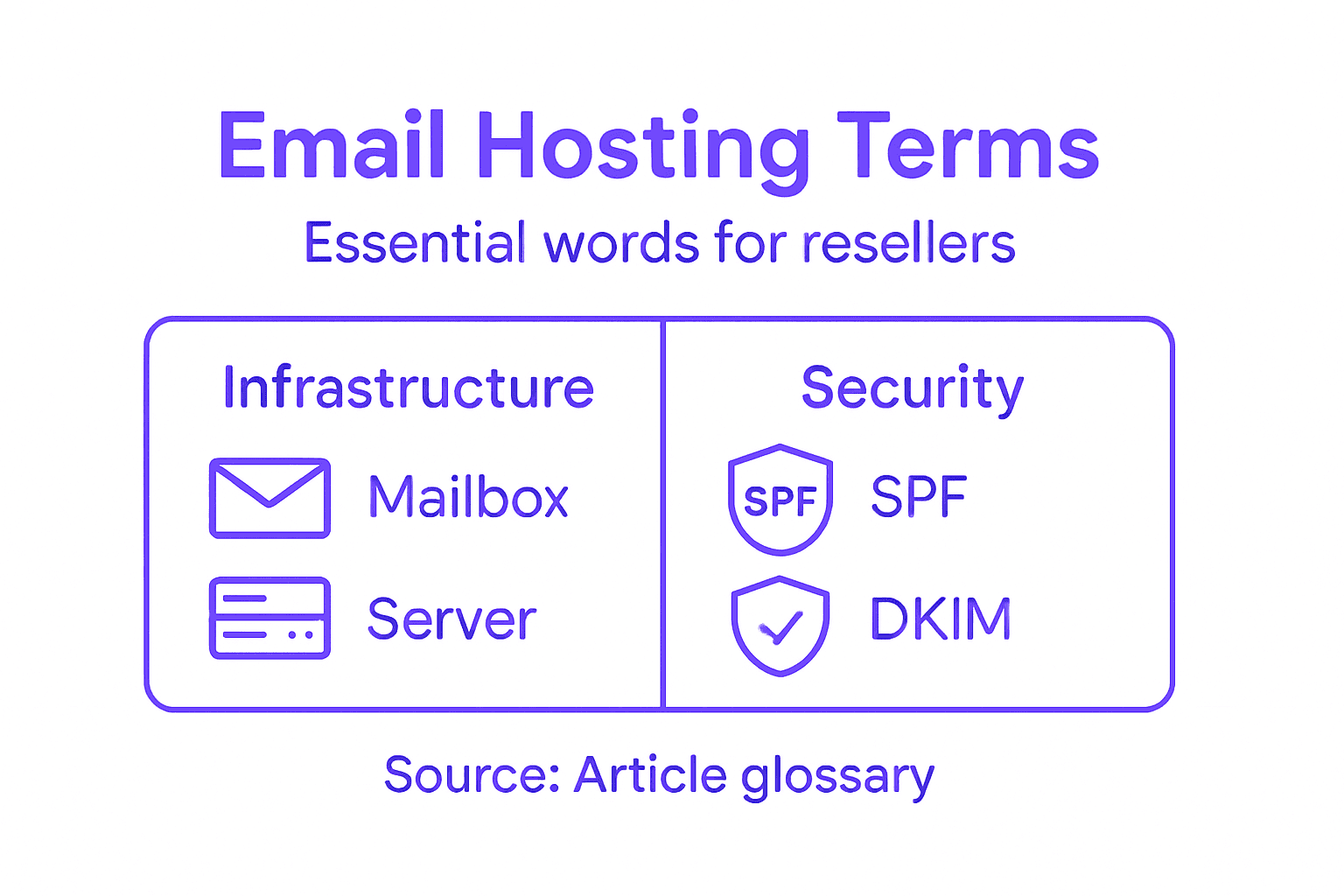
Four primary DNS records are essential for comprehensive email security. MX (Mail Exchanger) Records specify the mail servers responsible for receiving emails for a specific domain, directing incoming messages to the correct email hosting infrastructure. SPF (Sender Policy Framework) records define which IP addresses and servers are authorized to send emails on behalf of a domain, creating a whitelist of legitimate sending sources. DKIM (DomainKeys Identified Mail) adds a cryptographic signature to outgoing emails, providing a verifiable method to confirm that an email truly originated from the claimed domain and has not been tampered with during transmission.

DMARC (Domain-based Message Authentication, Reporting, and Conformance) represents the most advanced email authentication protocol, acting as an umbrella framework that combines SPF and DKIM validation. This record instructs receiving mail servers on how to handle emails that fail authentication checks – whether to reject, quarantine, or accept them. DMARC also provides detailed reporting mechanisms, enabling domain owners to monitor potential email abuse and track unauthorized sending attempts.
Pro tip: Implement all four DNS records systematically, configuring them in order: SPF, DKIM, DMARC, and finally MX, to build a comprehensive email authentication and security strategy.
Use this table to quickly reference major DNS records and their impact on email security:
| DNS Record | Primary Purpose | Security Benefit | Business Impact |
|---|---|---|---|
| MX | Directs email traffic | Ensures proper delivery | Reliable email flow |
| SPF | Authenticates senders | Reduces spoofing risk | Protects domain reputation |
| DKIM | Signs outgoing mail | Validates message integrity | Defends against tampering |
| DMARC | Sets authentication policy | Enables reporting and control | Strengthens anti-phishing measures |
Security and Compliance Terms Explained
Email security protocols represent a comprehensive approach to protecting digital communication infrastructures against increasingly sophisticated cyber threats. These protocols encompass a complex ecosystem of technologies, standards, and practices designed to safeguard sensitive information and maintain the integrity of email communication systems.
Key security and compliance terminology centers around several critical concepts. Encryption refers to the process of encoding email content to prevent unauthorized access, transforming readable data into complex algorithms that can only be decrypted by authorized recipients. Two-Factor Authentication (2FA) adds an additional layer of security by requiring users to provide two distinct verification methods before accessing email systems, typically combining a password with a temporary code sent to a secondary device. Spam Filtering represents an automated screening process that identifies and segregates potentially malicious or unwanted email communications based on predefined criteria and sophisticated algorithmic assessments.
Compliance frameworks establish rigorous standards for protecting sensitive information across different industries. GDPR (General Data Protection Regulation) mandates strict protocols for handling personal data, requiring businesses to implement robust security measures and obtain explicit user consent for data processing. HIPAA (Health Insurance Portability and Accountability Act) specifically governs medical information security, establishing stringent requirements for protecting patient data and defining precise guidelines for electronic communication in healthcare environments. These regulatory frameworks impose significant penalties for non-compliance, making comprehensive security infrastructure essential for businesses operating in regulated sectors.
Pro tip: Develop a multi-layered security strategy that combines technical protocols, employee training, and continuous monitoring to create a holistic approach to email security and regulatory compliance.
White-Label Email: Key Concepts for Resellers
White-label email hosting represents a strategic approach that enables businesses to offer professional email services without managing complex technical infrastructure. This model allows resellers to provide fully branded email solutions while leveraging established backend technologies, creating a seamless service offering for their clients.
The fundamental concepts of white-label email hosting revolve around several key principles. Branding Control is paramount, allowing resellers to customize email platforms with their own logos, color schemes, and domain configurations. Infrastructure Management remains with the primary hosting provider, who handles server maintenance, security updates, and technical backend operations. Pricing Flexibility emerges as a critical advantage, enabling resellers to set their own pricing structures, create custom service packages, and develop unique value propositions that differentiate them in competitive markets.
Successful white-label email reselling requires understanding complex operational dynamics. Customer Support Provisioning involves managing client interactions while the underlying technical infrastructure remains invisible to end-users. Technical Integration demands seamless API connections and robust management interfaces that allow resellers to provision accounts, monitor performance, and troubleshoot issues efficiently. Scalability represents another crucial concept, with white-label solutions enabling businesses to expand their service offerings without significant capital investment in technological infrastructure.
Pro tip: Develop a comprehensive onboarding strategy that emphasizes your unique branding and service value, focusing on how your white-label email solution solves specific customer pain points.
Elevate Your Email Hosting Game with AtrioMail
Navigating the complex world of email hosting terminology like MX, SPF, DKIM, DMARC, and managing white-label services can be overwhelming. If you are a reseller or IT agency seeking full control over branding while avoiding technical headaches, AtrioMail offers a powerful solution. Our fully managed email hosting platform automates DNS validation and security protocols so you can focus on growth instead of technical setup. Enjoy the freedom to break away from big ecosystems while maximizing profit and scalability.
Discover how AtrioMail empowers resellers to deploy customizable, secure email services under their own brand. Experience seamless API integration, scalable pricing, and comprehensive domain management all in one place. Take the next step to simplify your email hosting journey and partner with a platform built for your success by registering today at AtrioMail Register. Transform your service offering with confidence and start maximizing revenue now.
Frequently Asked Questions
What is email hosting?
Email hosting is a service provided by third-party providers to manage email servers, storage, and related infrastructure for businesses, enabling them to create and maintain professional email communication channels.
What are the key differences between shared hosting and dedicated email hosting?
Shared hosting allows multiple clients to use the same server infrastructure, making it cost-effective but with limited resources. Dedicated email hosting provides exclusive server resources for a single organization, enhancing security and control.
What are MX, SPF, DKIM, and DMARC records?
These are DNS records crucial for email security: MX records direct email traffic, SPF records authenticate senders, DKIM adds cryptographic signatures to emails, and DMARC sets policies for handling email authentication failures.
Why is email encryption important for businesses?
Email encryption protects sensitive information by encoding the content, preventing unauthorized access and ensuring that only intended recipients can read the emails.