
Managing client communications across multiple domains often brings complex infrastructure challenges for IT agency owners and email resellers. Secure, scalable email hosting is more than a technical requirement—it is a pathway to reliable brand control and client trust. By embracing business email hosting, organizations gain dedicated mailbox storage, robust security, and full administrative control tailored for professional B2B environments. This guide outlines the features and models that help agencies worldwide expand with confidence.
Table of Contents
- Understanding Email Hosting for B2B Environments
- Key Email Hosting Types and Variations
- Essential Features for Resellers and Agencies
- Brand Control, Profit Margins, and Scalability
- Comparing Alternatives and Avoiding Common Pitfalls
Key Takeaways
| Point | Details |
|---|---|
| Importance of Email Hosting | Email hosting is essential for B2B communication, establishing credible digital identities with customizable domain-based services. |
| Types of Hosting Models | Various email hosting models (shared, dedicated, cloud, reseller) cater to different business needs and come with distinct advantages and limitations. |
| Feature Requirements for Agencies | Resellers and agencies should prioritize features such as multi-domain management and white-label branding to enhance client offerings and trust. |
| Evaluation of Providers | A comprehensive evaluation matrix is crucial for selecting the right email hosting provider, focusing on performance, security, scalability, and support. |
Understanding Email Hosting for B2B Environments
Email hosting represents a critical infrastructure for professional business communication, enabling organizations to establish credible digital identities through customized domain-based email services. Unlike consumer email platforms, business email hosting provides sophisticated technological frameworks designed specifically for organizational needs. Professional email hosting services fundamentally transform how businesses communicate by providing dedicated server environments with robust security and administrative controls.
The technical architecture of business email hosting involves multiple sophisticated components. These include secure message transfer protocols, dedicated mailbox storage, comprehensive authentication mechanisms, and layered security infrastructure. Organizations can leverage these services to create email accounts using their unique domain names, which enhances professional credibility and provides full control over communication channels. Managed email hosting infrastructure typically integrates advanced features like TLS encryption, spam filtering, and complex authentication frameworks to protect sensitive business communications.
Key characteristics of effective B2B email hosting include scalability, security, and seamless integration capabilities. Businesses require email solutions that can adapt to changing organizational needs, provide enterprise-grade security protections, and integrate smoothly with existing business tools and communication platforms. Modern email hosting services offer granular administrative controls, enabling IT managers to configure user permissions, implement company-wide security policies, and monitor email traffic effectively.
Pro tip: When selecting an email hosting provider, prioritize services offering comprehensive security features, scalable infrastructure, and robust administrative tools that align with your specific business communication requirements.
Key Email Hosting Types and Variations
Email hosting encompasses a diverse range of service models designed to meet the unique communication needs of different businesses. Email hosting variations include shared hosting, dedicated hosting, cloud hosting, and reseller hosting, each offering distinct advantages and limitations for organizational communication strategies.
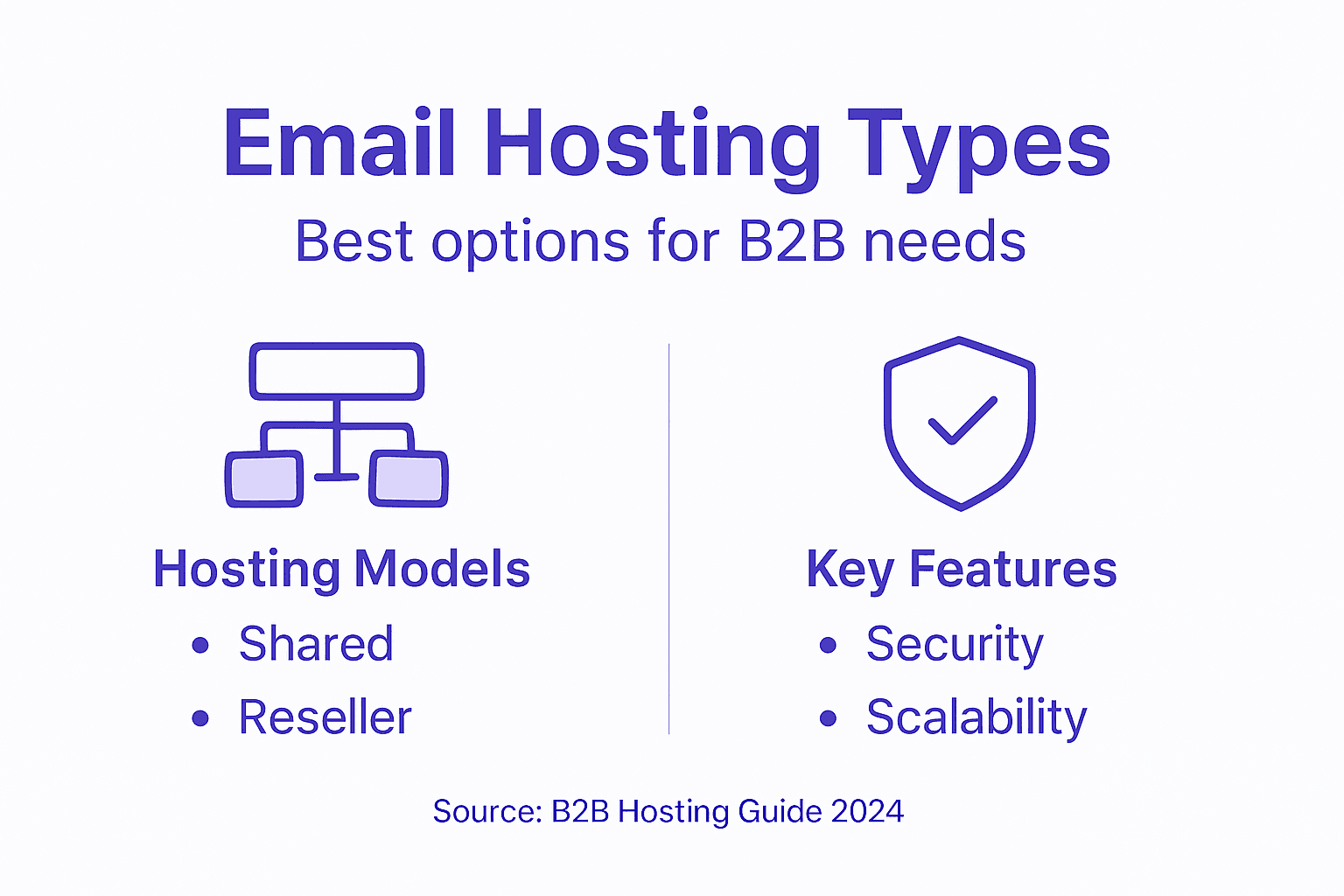
Shared hosting represents the most economical option, where multiple organizations share server resources. While cost-effective, this model typically provides limited customization and potentially reduced security. Dedicated hosting stands in stark contrast, offering exclusive server resources that deliver enhanced performance, superior security controls, and complete administrative autonomy. Cloud-based email hosting has emerged as a flexible alternative, providing scalable infrastructure that can dynamically adjust to changing organizational requirements, with built-in redundancy and geographic distribution of data centers.
Reseller hosting presents a unique model specifically tailored for IT service providers and agencies. This approach allows businesses to purchase email hosting resources in bulk and subsequently redistribute them to clients under their own brand identity. Hosting service models differ significantly in their architectural design, with each type addressing specific operational challenges. Businesses must carefully evaluate their communication infrastructure needs, considering factors such as security requirements, scalability, budget constraints, and desired level of administrative control when selecting an appropriate email hosting solution.
Pro tip: Conduct a comprehensive audit of your organization’s communication infrastructure requirements before selecting an email hosting solution, focusing on security, scalability, and long-term integration potential.
Here’s a concise comparison of different B2B email hosting models and their ideal use cases:
| Hosting Model | Key Benefit | Limitation | Best For |
|---|---|---|---|
| Shared Hosting | Low cost, easy setup | Lower security, less control | Small businesses |
| Dedicated Hosting | Full control, high security | Expensive, requires admin | Larger enterprises |
| Cloud Hosting | Scalable, global access | Complex billing, vendor lock-in | Growing organizations |
| Reseller Hosting | White-label, client management | Setup complexity, support required | Agencies, IT providers |
Essential Features for Resellers and Agencies
Email hosting for resellers and agencies demands a comprehensive set of features that enable seamless brand management, client support, and operational efficiency. Email hosting for agencies requires sophisticated infrastructure that goes beyond basic communication tools, providing robust administrative controls and scalable solutions tailored to professional service providers.
Key essential features include advanced multi-domain management capabilities, which allow resellers to create and manage email accounts across multiple client domains from a centralized platform. This functionality is critical for agencies managing numerous client portfolios. Additional crucial features encompass granular user permission settings, comprehensive security protocols, spam filtering, email archiving, and seamless integration with existing business productivity tools. White-label branding options emerge as a paramount requirement, enabling resellers to customize email services completely under their own brand identity, maintaining professional appearance and client perception.
Technical infrastructure must support sophisticated administrative tools that provide real-time monitoring, detailed analytics, and automated management processes. These features empower resellers to efficiently scale their email hosting services, troubleshoot potential issues proactively, and deliver consistently high-quality communication solutions to their clients. Reseller email hosting platforms must offer flexible API integrations, robust security mechanisms like two-factor authentication, and comprehensive backup and recovery systems to ensure uninterrupted business communication.
Pro tip: Prioritize email hosting solutions that offer extensive customization options, allowing you to create a unique service offering that differentiates your agency in a competitive marketplace.
The table below summarizes essential email hosting features for agencies and how each drives business value:
| Feature | Business Value | Operational Impact |
|---|---|---|
| Multi-domain management | Serve many clients | Centralized oversight |
| White-label branding | Boosts client trust | Distinct market offering |
| API integrations | Seamless automation | Faster onboarding |
| User permissions | Enhanced data security | Controlled access |
| Real-time monitoring | Immediate problem identification | Proactive support |
Brand Control, Profit Margins, and Scalability
Brand control in email hosting represents a critical strategic advantage for resellers and agencies seeking to establish professional credibility and market differentiation. B2B email infrastructure enables businesses to leverage custom domain email addresses, which dramatically enhance perceived professionalism and strengthen client trust through consistent branding.

Profit margins in email hosting are directly influenced by the ability to offer customizable, value-added services with white-label branding capabilities. Successful resellers understand that differentiation comes from providing comprehensive solutions that extend beyond basic email communication. This includes offering advanced security features, integrated collaboration tools, and seamless administrative controls that allow clients to manage their email ecosystems efficiently. By positioning email hosting as a strategic service rather than a commodity, agencies can command premium pricing and develop recurring revenue streams.
Scalability emerges as a fundamental consideration for email hosting providers, with cloud-based infrastructures offering unprecedented flexibility and growth potential. Modern email hosting platforms must support dynamic user volume expansion without compromising performance or security. This means implementing robust backend architectures that can seamlessly accommodate increasing client demands, add new domains, and maintain consistent service quality. Scalable email hosting solutions enable resellers to grow their client base exponentially while maintaining operational efficiency and minimizing additional infrastructure investments.
Pro tip: Design your email hosting offerings with modular, scalable architecture that allows clients to easily upgrade services as their communication needs evolve.
Comparing Alternatives and Avoiding Common Pitfalls
Email hosting alternatives require meticulous evaluation to ensure businesses select solutions that align with their strategic communication needs. Email hosting provider selection demands a comprehensive analysis of multiple critical factors beyond surface-level pricing considerations.
When comparing potential email hosting solutions, businesses must conduct deep assessments across several key dimensions. Performance metrics should include reliability indicators, uptime guarantees, server infrastructure quality, and geographical distribution of data centers. Security capabilities emerge as a paramount consideration, encompassing multi-factor authentication, end-to-end encryption, robust spam filtering, and comprehensive threat protection mechanisms. Scalability potential represents another crucial evaluation criterion, with businesses needing platforms that can seamlessly accommodate growth without requiring complete infrastructure redesigns.
Common pitfalls in email hosting selection often stem from overlooking nuanced technical requirements and operational constraints. Many organizations mistakenly prioritize cost over comprehensive service quality, leading to compromised communication infrastructure. Avoiding free or consumer-grade email services becomes critical for professional entities, as these platforms typically lack advanced security features, customization options, and dedicated support channels. Thorough examination of service level agreements, infrastructure redundancy, data migration capabilities, and long-term support models can help mitigate potential risks associated with suboptimal email hosting selections.
Pro tip: Create a detailed evaluation matrix that scores potential email hosting providers across multiple dimensions, including technical capabilities, support responsiveness, scalability, and total cost of ownership.
Take Full Brand Control with AtrioMail’s White-Label Email Hosting
The article highlights a major challenge for B2B resellers and agencies: managing secure, scalable, and fully branded email hosting that strengthens client trust without the burdens of infrastructure management. If your goal is to offer professional, customizable email services that enhance profitability while maintaining total administrative control and seamless client support, AtrioMail provides exactly that solution. Built to empower businesses with multi-domain management, robust security, and easy automation of DNS settings like MX, SPF, DKIM, and DMARC, our platform lets you focus on growth—not technical headaches.
Discover how AtrioMail’s scalable, white-label platform can elevate your service offerings today. Join other IT providers and agencies who have increased their profit margins through our fully managed infrastructure and API-driven deployment tools. Start creating independent branded email hosting solutions with full customization and industry-grade security by registering now at AtrioMail Registration. Take the step towards freedom from large providers and unlock your email hosting potential with AtrioMail.
Frequently Asked Questions
What is email hosting and why is it important for B2B communication?
Email hosting is a service that allows businesses to use custom domain names for their email addresses, enhancing professionalism and credibility. It provides robust security, administrative controls, and scalability tailored for organizational needs, making it crucial for effective B2B communication.
What are the different types of email hosting services available for businesses?
The main types of email hosting services include shared hosting, dedicated hosting, cloud hosting, and reseller hosting. Each offers distinct benefits and limitations depending on the organization’s requirements, such as budget, security needs, and scalability.
How can businesses ensure their email hosting solution is secure?
To ensure security, businesses should look for email hosting solutions that offer features like TLS encryption, multi-factor authentication, spam filtering, and comprehensive threat protection. Regular security audits and compliance with industry standards are also vital.
What features should resellers look for in an email hosting service?
Resellers should prioritize features like multi-domain management, white-label branding, user permission settings, real-time monitoring, and API integrations. These capabilities help maintain brand control, streamline client management, and facilitate scalability.