
Managing email costs as your Canadian or British reseller company grows can feel like a balancing act. You want every new client to boost your margins, not complicate your billing or erode profitability. Scalable email pricing empowers IT managers and business owners to align expenses with real usage, streamlining operations and protecting long-term growth. This guide shows how modern pricing models transform reseller businesses, making cost control, brand management, and revenue forecasting far easier.
Table of Contents
- Defining Scalable Email Pricing For Resellers
- Types Of Scalable Pricing Models For Email Platforms
- How Usage-Based Pricing Drives Flexibility
- Financial Implications For Resellers And Agencies
- Comparing Alternatives: Fixed Vs. Scalable Pricing
- Avoiding Common Mistakes In Scalable Email Pricing
Key Takeaways
| Point | Details |
|---|---|
| Scalable Pricing Model | Scalable email pricing allows costs to grow proportionally with revenue, providing flexibility for resellers without frequent contract renegotiations. |
| Usage-based Benefits | Charging based on actual consumption ensures predictable costs and aligns with customer value, promoting trust and efficiency. |
| Operational Efficiency | A single relationship with a provider reduces administrative overhead and simplifies accounting, enabling resellers to focus on growth. |
| Choosing the Right Model | Understanding various pricing models helps resellers select one that supports growth and meets diverse client expectations effectively. |
Defining scalable email pricing for resellers
Scalable email pricing isn’t about finding the cheapest option. It’s about structuring your costs so they grow proportionally with your revenue, not faster. As a reseller or IT manager, you need pricing that flexes when you add five clients or fifty clients without forcing you to renegotiate contracts every quarter.
Traditional fixed-tier pricing models create friction. You pay for a bracket that may cover 100 users but only use 60, wasting money. Or you stay in a lower tier until you burst through the ceiling, then face a painful jump to the next level. Scalable email pricing solves this by charging based on actual consumption rather than arbitrary user counts or storage buckets.
Reseller email hosting lets you purchase email services in bulk from a provider and resell them under your own brand. The key advantage? Your cost structure becomes predictable. You buy capacity at wholesale rates, spread those costs across multiple clients, and adjust your own pricing to maintain healthy margins as your client base grows.
This matters because profitability scales with efficiency. When costs rise linearly with usage instead of in jumps, you can forecast revenue accurately and avoid surprise overages. You’re not caught between price tiers wondering if you should turn away new business or absorb a 40% cost increase.
Real scalability means your pricing model supports growth at any stage. Early on, you might have ten clients on minimal plans. Later, you could have 500 clients with varying needs. Your underlying infrastructure and pricing should adapt without requiring manual intervention or renegotiation every time you hit a new milestone.
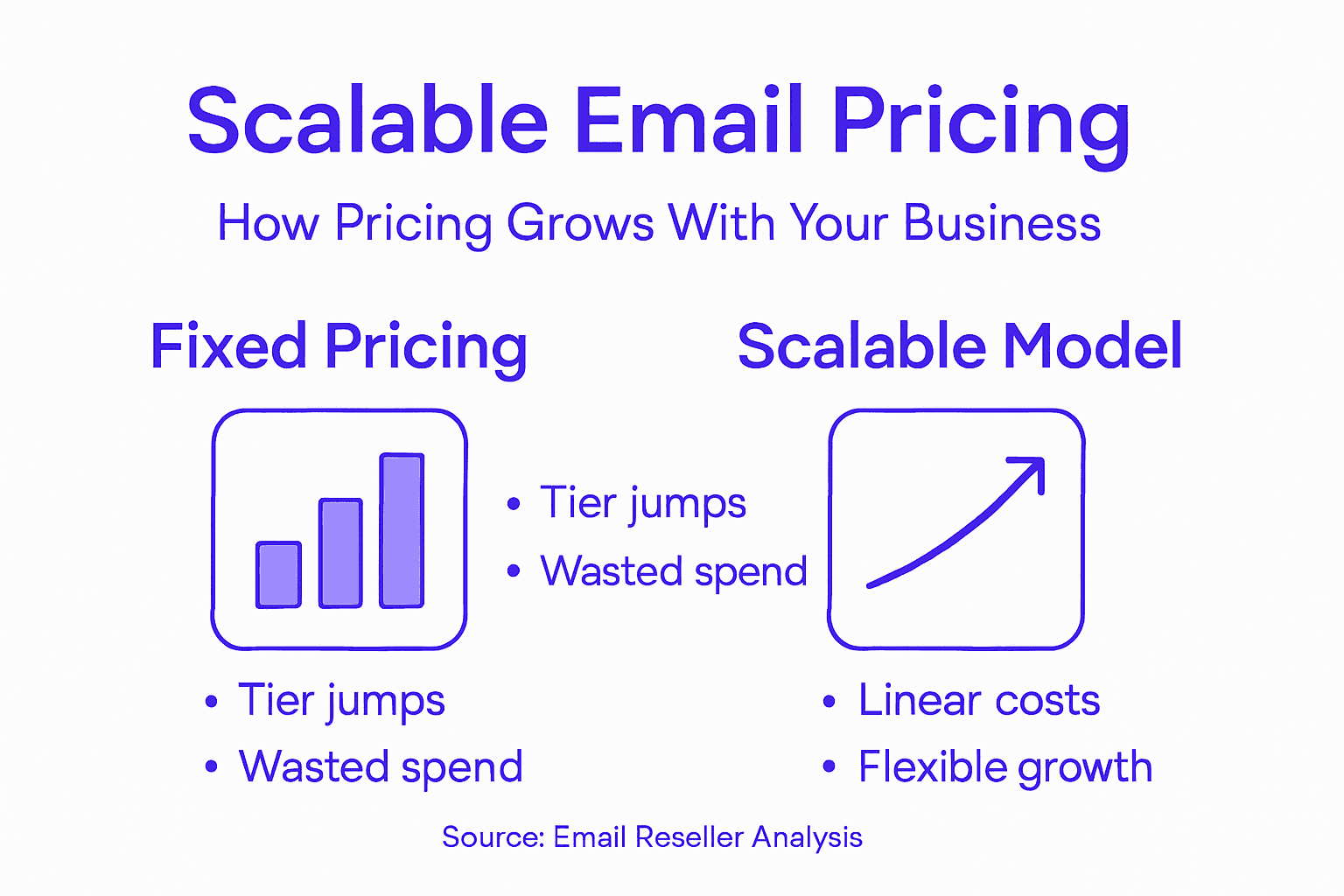
The structural difference matters operationally too. You’re not managing multiple vendor contracts at different price points. You’re managing one relationship with a provider that grows with you, which simplifies accounting, reduces administrative overhead, and lets you focus on selling rather than managing procurement.
This summary highlights key operational benefits of scalable pricing for email resellers:
| Benefit | Description | Positive Business Outcome |
|---|---|---|
| Predictable Costs | Costs align with real usage | Reliable forecasting |
| Reduced Admin Overhead | Fewer contracts, more automation | Lower labor costs |
| Margin Stability | Expenses grow with client revenue | Profitable long-term growth |
| Flexible Infrastructure | Pricing adapts without renegotiation | Supports rapid client base changes |
Pro tip: Calculate your customer acquisition cost and average revenue per user before committing to any pricing structure, then test how your margins hold at 10x your current client count to ensure the model actually scales profitably.
Types of scalable pricing models for email platforms
Not all pricing models scale equally. Your choice determines whether adding clients feels effortless or creates operational chaos. Understanding the different approaches available helps you pick the model that aligns with your business growth and client expectations.
Usage-based pricing charges customers for what they actually consume, whether that’s emails sent, storage used, or accounts maintained. This model appeals to resellers because costs stay predictable and aligned with customer value. A small client using minimal email capacity pays less than one sending thousands of messages daily. The fairness of this approach builds trust, and margins remain consistent as your client base grows.
Tiered pricing offers distinct packages at different price points, each with specific features or capacity limits. Customers choose a tier matching their needs and upgrade when they outgrow it. This structure works well for resellers managing diverse client segments, from solopreneurs to enterprises. The flexibility lets you serve different markets without creating custom quotes for every deal.
Per-user pricing models charge by the number of mailboxes or accounts. This works when client needs correlate directly to user count. It simplifies accounting and forecasting, though it can feel restrictive for clients experiencing growth spikes. Hybrid approaches combine per-user metrics with usage thresholds to balance simplicity and fairness.
Flat-rate pricing charges a single price regardless of usage volume. Simple to understand and market, but it sacrifices scalability. Customers paying the same amount whether they use minimal or maximum capacity create margin pressure as your infrastructure costs grow.
Hybrid models combine two or more approaches to capture different value drivers. You might charge per user with overages for excess email volume, or offer tiered packages with usage-based add-ons. This flexibility maximizes revenue while accommodating varied customer profiles.
The strongest pricing models for email reselling let costs rise with revenue, not faster. Your choice should reduce billing friction and support how your clients actually grow.
Here’s a side-by-side look at major email pricing models and how they impact resellers:
| Pricing Model | Core Mechanism | Scaling Impact | Business Fit |
|---|---|---|---|
| Usage-based | Charges by consumption | Rises directly with usage | Flexible, supports growth |
| Tiered | Fixed feature packages | Jumps at tier boundaries | Diverse client segments |
| Per-user | By account/mailbox | Linear with user count | Predictable client size |
| Flat-rate | One rate, all usage | Margins shrink at large scale | Simple, less scalable |
| Hybrid | Mixes multiple methods | Adapts to client profiles | Maximizes varied revenue |
Pro tip: Test multiple pricing models with a small subset of customers before full rollout, tracking which one generates the highest customer satisfaction and lowest churn rates in your specific market.
How usage-based pricing drives flexibility
Usage-based pricing removes the friction point that kills most reseller relationships: arbitrary limits. Your clients don’t feel penalized for growth. They don’t face surprise overages or forced tier upgrades. Instead, they pay exactly for what they consume, and you build sustainable margins without constant renegotiation.
The core appeal is simple. A small firm starting with five email accounts at minimal usage shouldn’t pay the same rate as one managing 500 accounts sending thousands of daily messages. Usage-based pricing aligns costs with value, making the relationship feel fair to both sides. Clients see a direct connection between what they use and what they pay.
For you as a reseller, this model creates predictability. You’re not managing tiered brackets where clients hover at the ceiling of one tier, tempted to jump to another. Instead, billing scales smoothly. Add a client with 20 users, your costs rise proportionally. Add one with 200 users, your revenue and expenses grow together. The margins don’t compress unless you let them.
Accurate usage tracking and metering make this work operationally. Your infrastructure must count what matters—emails sent, accounts created, storage consumed. Billing automation handles the rest. Without proper tracking, usage-based models create accounting nightmares. With it, they’re nearly hands-off.
Flexibility also means lower entry barriers for prospects. New clients aren’t intimidated by monthly commitments. They start small, use what they need, and expand naturally as their business grows. This attracts a broader customer base and reduces sales friction. Many prospects say yes when the price scales with their confidence in your service.
The model also discourages waste. When customers pay per unit of consumption, they think harder about utilization. Inactive mailboxes cost them money. Over-provisioned storage becomes visible. This alignment between their behavior and your billing creates accountability without feeling punitive.
Pro tip: Implement usage caps and alerts before hitting bill shock, notifying clients when they approach usage thresholds so overage fees never blindside them and retention stays strong.
Financial implications for resellers and agencies
Scalable pricing isn’t just about flexibility for clients. It directly impacts your bottom line. When your cost structure aligns with how you actually bill, profit margins become predictable and defensible rather than eroded by fixed overhead that grows faster than revenue.

The traditional model creates margin squeeze. You buy email hosting at a fixed rate per user or per gigabyte. Then you resell it in tiers, hoping the margins work out. But clients cluster at tier boundaries, and you’re stuck managing pricing mismatches between what you pay upstream and what you charge downstream. Every client negotiation risks your profitability.
Cost savings from bulk purchasing give you leverage. When providers offer usage-based or volume discounts, you buy at their lowest rate and resell at a markup that stays consistent as clients scale. Your cost per unit stays flat while revenue per client grows with their usage. That’s the math that makes profitability compound.
Fixed infrastructure costs become your biggest advantage when spread across more clients. Ten clients using 100 gigabytes each versus one hundred clients using 10 gigabytes each costs you the same on the backend. But the second scenario lets you segment pricing by client size, capturing more revenue from heavier users while keeping lighter users profitable at lower price points.
Operational efficiency multiplies these gains. Manual provisioning, account creation, and DNS configuration consume time that doesn’t scale. Automation through API integration and white-label platforms reduces per-client overhead dramatically. You handle five times more clients with the same staff, transforming your cost structure from linear to logarithmic.
Predictable revenue also improves unit economics. When clients pay based on usage, churn becomes visible immediately. You spot declining usage before accounts go dark. This early warning lets you intervene with support or adjust pricing before losing revenue. Tiered models hide this decline until the invoice goes unpaid.
Pro tip: Model your margin at different client scales before choosing a pricing structure, stress testing how profitability holds if your top ten customers leave, and ensure you can sustain operations on smaller clients alone.
Comparing alternatives: fixed vs. scalable pricing
Fixed pricing looks simple on a spreadsheet. You charge one flat rate and call it done. But simplicity isn’t the same as profitability, especially when your business grows unpredictably. The moment a client’s needs diverge from your fixed package, friction appears.
With fixed pricing, you’re essentially gambling on average usage. You guess how many emails clients will send, how much storage they need, how many accounts they’ll create. Charge too little and you lose money on heavy users. Charge too much and you price out smaller prospects. Most resellers respond by creating multiple fixed tiers, which reintroduces the complexity they tried to avoid.
Scalable pricing models adapt costs based on actual usage, eliminating the guessing game. You’re not predicting client behavior. You’re responding to it. A startup using five accounts pays proportionally less than an enterprise with fifty. Both feel the pricing is fair because it reflects reality.
The operational difference matters just as much. Fixed pricing requires manual tier management. Client usage creeps upward and suddenly they’re at tier boundaries, threatening to churn unless you grandfather them or negotiate. Scalable pricing automates this. Usage goes up, billing increases automatically, no awkward conversations required.
Fixed pricing offers budget predictability upfront, which appeals to CFOs planning annual budgets. But that benefit disappears the moment clients exceed their allowances or outgrow your tier structure. Then they either churn or demand renegotiation. Scalable pricing creates different predictability: margins stay consistent regardless of client scale.
Billing complexity cuts differently too. Fixed pricing seems simpler until you’re managing exceptions. Scalable pricing requires metering infrastructure and automation, but once configured, it handles thousands of clients with no manual intervention. You trade upfront complexity for operational simplicity.
The choice depends on your growth strategy. If you’re targeting stable, predictable clients with consistent needs, fixed pricing works. If you’re building a growing reseller base with diverse usage patterns, scalable pricing compounds profitability at scale.
Pro tip: Pilot scalable pricing with 20 percent of your client base before full migration, comparing churn rates and per-client revenue between fixed and scalable segments to validate the model for your specific market.
Avoiding common mistakes in scalable email pricing
Scalable pricing fails not because the concept is flawed, but because execution cuts corners. The most damaging mistakes happen quietly, eroding margins and customer relationships before you notice the pattern.
Overcomplicating the structure tops the list. You create tiers within tiers, add conditional pricing for different features, introduce seasonal adjustments. Pretty soon, prospects can’t figure out what they’ll pay, and your sales team can’t explain it consistently. Complexity kills conversion. Keep it simple enough that a prospect understands pricing in under two minutes.
Ignoring what customers actually need is equally destructive. You design pricing around what seems elegant on a spreadsheet, not around how clients actually use email. Maybe you charge per storage gigabyte when clients care about mailbox count. Or you charge per user when they care about sending limits. Pricing structures that fail to accommodate different customer needs create friction at every tier boundary.
Neglecting to update pricing as your business evolves creates hidden problems. Your infrastructure improves. Your costs drop. Your competitive landscape shifts. But your pricing stays frozen in 2019. Either you’re leaving money on the table or undercutting your value. Set a quarterly pricing review into your calendar and actually do it.
Cutting corners on metering infrastructure builds technical debt that compounds painfully. You skip proper usage tracking, implement billing manually, or use spreadsheets instead of automated systems. This works until you hit 50 clients. At 500 clients, you’re managing chaos. Over-customization without proper technical discipline delays projects and reduces system reliability.
Missing cross-departmental alignment breaks everything downstream. Sales promises features that support doesn’t understand. Finance designs billing thresholds that product can’t sustain. Your customers experience the friction when overage charges apply unexpectedly or tier boundaries don’t match their actual usage patterns.
The correction is disciplined design. One clear metric. Transparent pricing. Automated metering. Regular reviews. Infrastructure built to scale before you need it.
Pro tip: Run your pricing structure past five current customers and five prospects before launch, documenting which pricing tiers confuse them and which upgrade paths feel natural, then simplify ruthlessly.
Scale Your Email Reselling with Confidence and Control
Understanding scalable email pricing from the article shows how critical it is for resellers to avoid margin squeeze and billing friction as clients grow. If you want to stop juggling complex contracts or fearing price jumps at tier boundaries then you need a truly usage-based pricing model that scales seamlessly with your business. AtrioMail solves this by delivering fully managed infrastructure, automated DNS setup, and powerful API integration to streamline your operations. Our white-label solution puts your brand front and center without the headaches of managing backend complexity.
Ready to maximize your profitability and simplify your email service delivery? Join the ranks of resellers and IT agencies who trust AtrioMail’s scalable platform for predictable costs and margin stability. Get started today with our hassle-free registration and experience how scalable usage-based pricing can transform your business growth. Register now at AtrioMail platform and unlock the freedom to grow without limits.
Frequently Asked Questions
What is scalable email pricing?
Scalable email pricing is a cost structure that adjusts based on actual usage, allowing resellers to pay according to the volume of services consumed instead of fixed tiers. This ensures that costs grow in proportion to revenue, providing greater profit margins.
How does usage-based pricing benefit email resellers?
Usage-based pricing benefits email resellers by ensuring that they only pay for the services their clients actually use. This model allows for predictable costs without the surprise of overage fees, making it easier to scale with client growth while maintaining stable profit margins.
What are the disadvantages of fixed pricing models for email services?
Fixed pricing models can create friction when client needs exceed predefined tiers, leading to unexpected overages or the need for costly tier upgrades. This can also force resellers into complicated negotiations with clients, impacting profitability and client relationships.
How can I determine if a scalable pricing model is right for my business?
To determine if a scalable pricing model is right for your business, calculate your customer acquisition cost and average revenue per user. Testing various pricing structures with a small subset of your clients can help assess profitability and customer satisfaction before a full rollout.