
Email systems that cannot scale quickly enough have caused over 65 percent of american businesses to suffer critical communication delays. For IT agency owners and directors, maintaining seamless operations while growing client bases demands more than just adding inboxes or storage. Discover how scalable, white-label email hosting delivers the dynamic flexibility and branded experience your clients expect, without the daily headache of managing complex infrastructure.
Table of Contents
- What Scalable Email Hosting Really Means
- White-Label Vs. Traditional Email Hosting
- Core Features Of Scalable Email Platforms
- Pricing Models And Usage-Based Scaling
- Email Security, Deliverability, And Compliance
- Avoiding Costly Mistakes In Email Reselling
Key Takeaways
| Point | Details |
|---|---|
| Scalable Email Hosting | Scalable email hosting ensures flexibility, allowing organizations to adapt resources according to fluctuating demands without performance degradation. |
| White-Label Email Hosting | This model allows businesses to create customized email solutions that enhance brand identity, offering more control compared to traditional hosting. |
| Usage-Based Pricing | Aligning costs with actual resource usage helps organizations avoid unnecessary expenses and manages email hosting as a dynamic resource. |
| Email Security and Compliance | Robust security measures are critical; organizations must implement comprehensive authentication protocols to maintain sender reputation and compliance with regulations. |
What Scalable Email Hosting Really Means
Scalable email hosting represents far more than simply adding more user accounts or storage capacity. It is a sophisticated approach to managing digital communication infrastructure that dynamically adapts to organizational growth and changing technological demands. Intelligent management of email systems requires an elastic infrastructure capable of expanding seamlessly without disrupting existing operations.
At its core, scalable email hosting means creating a flexible system that can handle fluctuating workloads, increased data volumes, and evolving user requirements without compromising performance or reliability. Unlike traditional fixed-capacity email solutions, scalable platforms leverage cloud technologies and distributed computing architectures to provide instant resource allocation. This approach ensures businesses can rapidly adjust their email ecosystem to match precise operational needs without expensive hardware investments or complex manual configurations.
The key characteristics of a truly scalable email hosting solution include:
- Automatic resource provisioning
- Elastic user and storage capacity
- Performance consistency under varying loads
- Cost-effective infrastructure management
- Minimal manual intervention for system expansion
Modern enterprises require email systems that grow organically with their business, supporting hybrid work environments and global communication strategies. Scalable email hosting eliminates traditional bottlenecks by implementing intelligent load balancing, automated redundancy, and dynamic resource allocation.
Pro tip: When evaluating email hosting solutions, request detailed scalability benchmarks and stress test reports to understand how the platform performs under real-world expansion scenarios.
White-Label vs. Traditional Email Hosting
White-label email hosting represents a transformative approach to digital communication infrastructure, fundamentally different from traditional email hosting models. While conventional email services offer standardized solutions, white-label platforms enable businesses to provide fully customized email experiences under their own brand identity. Resellers are increasingly moving away from big providers to gain greater control and flexibility in their email service offerings.
Traditional email hosting typically involves using pre-configured services from major providers like Google or Microsoft, where businesses are confined to predetermined features, branding, and pricing structures. In contrast, white-label email hosting allows IT agencies and resellers to create a completely branded email ecosystem that looks and feels like their own proprietary service. This approach provides several critical advantages:
- Total brand consistency across communication channels
- Customizable pricing and service packages
- Independent infrastructure management
- Enhanced privacy and data control
- Ability to create unique value-added services
The fundamental difference lies in ownership and customization. Traditional hosting treats email as a commodity, while white-label solutions transform email into a strategic business asset. White-label platforms enable businesses to design email services that precisely match their operational requirements, client expectations, and brand positioning. This model empowers IT agencies to differentiate themselves in a competitive market by offering unique, tailored email solutions that go beyond off-the-shelf services.

Here’s a side-by-side comparison of white-label and traditional email hosting approaches:
| Email Hosting Approach | Branding Control | Customization Level | Key Business Benefit |
|---|---|---|---|
| White-Label Hosting | Full brand ownership | Highly customizable features | Enables market differentiation |
| Traditional Hosting | Provider-branded only | Limited customization options | Fast setup, standardized services |
Pro tip: When evaluating white-label email hosting, prioritize platforms that offer robust API integrations and comprehensive whitelabel branding capabilities to maximize your service differentiation.
Core Features of Scalable Email Platforms
Scalable email platforms represent a sophisticated technological ecosystem designed to handle complex communication needs for growing businesses. Comprehensive email infrastructure requires multiple sophisticated components that work seamlessly together to ensure reliable, efficient, and resilient message delivery across diverse operational environments.
The core architectural components of a truly scalable email platform include several critical technological elements. These foundational features enable businesses to manage increasing email volumes without compromising performance or reliability:
- Message Queues: Facilitate asynchronous email processing
- Email Processing Workers: Distribute and handle message loads dynamically
- Robust Databases: Manage email templates, tracking, and status information
- SMTP Servers: Ensure reliable message transmission
- Load Balancers: Intelligently distribute network traffic
- Comprehensive Monitoring Systems: Provide real-time analytics and issue detection
Advanced scalable email platforms also incorporate elastic infrastructure capabilities that allow for both horizontal and vertical scaling. Intelligent storage solutions and adaptive infrastructure enable organizations to maintain peak performance during traffic spikes while optimizing resource allocation. This approach ensures high availability, cost efficiency, and seamless growth potential for businesses with evolving communication requirements.
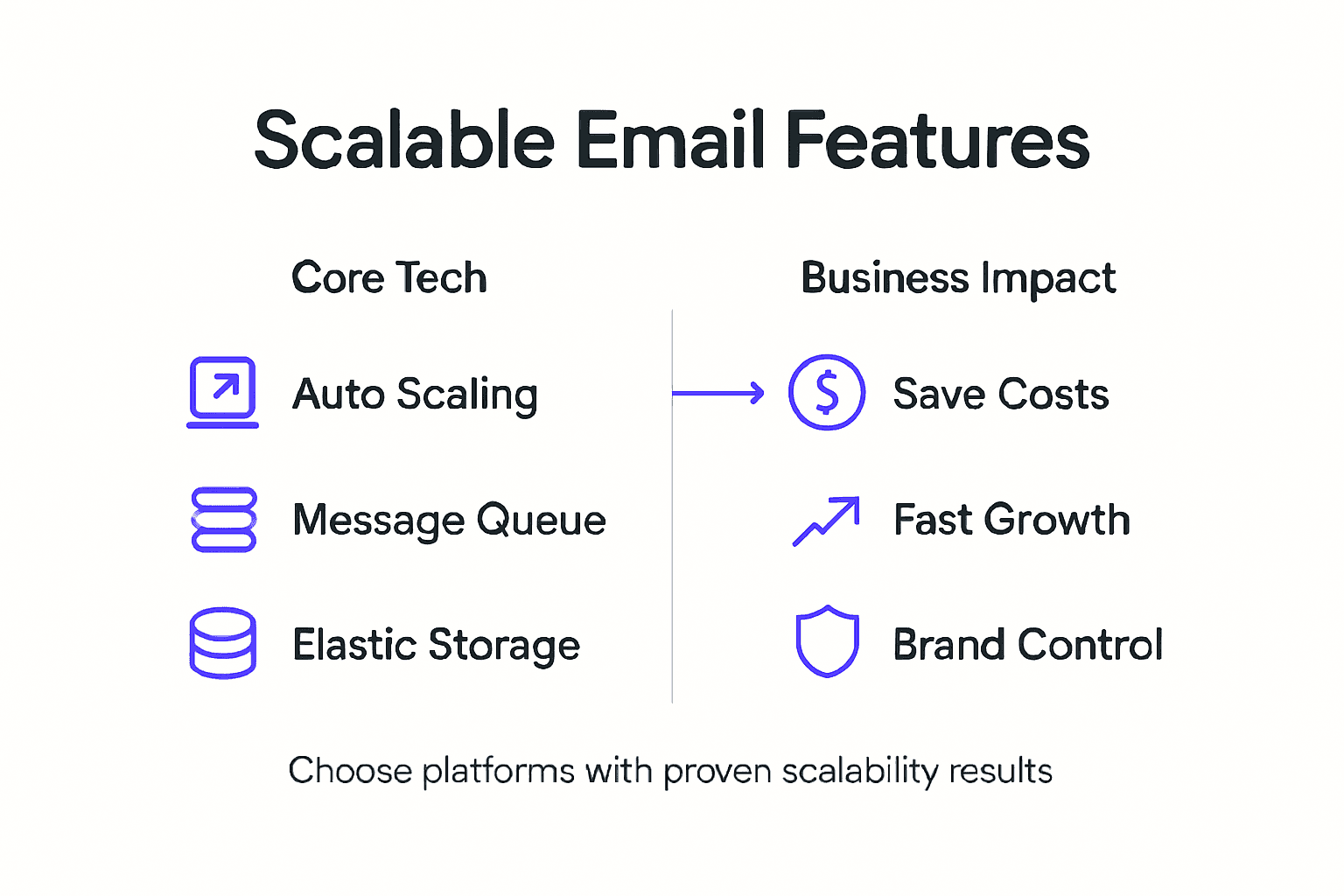
Below is a summary of essential components in a scalable email platform and how each contributes to reliability and growth:
| Platform Component | Role in Scalability | Impact on Business |
|---|---|---|
| Message Queues | Manage message flow asynchronously | Handle peak loads efficiently |
| Load Balancers | Distribute traffic intelligently | Ensure consistent performance |
| Email Processing Workers | Dynamically process email jobs | Enable rapid, flexible scaling |
| Monitoring Systems | Track system health and metrics | Detect issues before interruptions |
Pro tip: When evaluating scalable email platforms, request detailed performance benchmarks that demonstrate the system’s ability to handle sudden traffic increases and maintain consistent delivery rates.
Pricing Models and Usage-Based Scaling
Usage-based pricing represents a revolutionary approach to email hosting that aligns cost directly with actual resource consumption. Innovative pricing strategies charge customers based on precise resource utilization rather than traditional fixed-tier subscription models, enabling businesses to pay exactly for what they consume.
Traditional email hosting often locks organizations into rigid, predetermined pricing tiers that force unnecessary overspending or limit growth. In contrast, modern usage-based scaling offers dynamic pricing frameworks that adapt seamlessly to organizational needs. Key characteristics of this model include:
- Granular resource metering
- Real-time consumption tracking
- Flexible cost adjustments
- Predictable expense management
- Elimination of wasted capacity
Advanced email hosting platforms now incorporate sophisticated billing automation and scalable pricing structures that transform how businesses approach communication infrastructure costs. These models enable precise financial control by allowing organizations to scale email services incrementally, adding users or storage exactly when needed without committing to expensive, oversized packages. This approach transforms email hosting from a fixed expense into a dynamic, responsive operational resource that grows alongside business requirements.
Pro tip: When evaluating usage-based email hosting, calculate potential cost savings by comparing your projected email consumption against traditional fixed-tier pricing models to understand true financial flexibility.
Email Security, Deliverability, and Compliance
Email security has become a complex, multifaceted challenge for modern organizations seeking to protect communication infrastructure and maintain reliable message delivery. Email deliverability in 2023 demands sophisticated authentication and compliance strategies that go far beyond traditional spam prevention techniques.
The core components of robust email security and deliverability include multiple critical authentication protocols:
- SPF (Sender Policy Framework): Validates sending mail servers
- DKIM (DomainKeys Identified Mail): Provides cryptographic email signatures
- DMARC (Domain-based Message Authentication): Establishes comprehensive sending policies
- Global Regulation Compliance: Meeting GDPR, CAN-SPAM requirements
- Engagement Metric Monitoring: Tracking sender reputation indicators
Moreover, emerging requirements from major email providers like Google and Yahoo are transforming email authentication landscapes. Organizations must now implement consistent, rigorous authentication configurations across all email sending platforms to maintain domain reputation and ensure critical communications reach intended recipients securely and reliably.
Pro tip: Regularly audit your email authentication protocols and maintain low spam complaint rates to preserve your domain’s sending reputation and maximize inbox placement.
Avoiding Costly Mistakes in Email Reselling
Email reselling represents a complex ecosystem where minute errors can trigger substantial financial and reputational consequences. Costly mistakes in email campaigns can dramatically damage brand reputation and reduce revenue if not managed with strategic precision and systematic oversight.
Successful email resellers must implement rigorous pre-deployment protocols that address multiple critical dimensions of email quality and delivery. These comprehensive strategies include:
- Meticulous content proofreading
- Comprehensive link validation
- Precise audience segmentation
- Strategic subject line optimization
- Cross-platform email testing
- Sender identity verification
- Unsubscribe mechanism confirmation
- Personalization accuracy checks
Systematic review processes and digital collaboration tools provide essential safeguards against potential errors. By establishing standardized workflows and leveraging advanced technological solutions, email resellers can significantly mitigate risks associated with miscommunication, technical failures, and compliance violations. Proactive error prevention not only protects operational integrity but also reinforces customer trust and long-term business sustainability.
Pro tip: Create a comprehensive pre-send checklist with automated validation steps and mandatory review gates to catch potential errors before email deployment.
Unlock True Scalability and Brand Control with AtrioMail
The article highlights the challenges of managing scalable email hosting that adjusts seamlessly to growing business needs while maintaining reliability and full customization. If you are a reseller or IT agency seeking to move beyond traditional fixed-tier services and avoid costly infrastructure headaches, AtrioMail offers the perfect solution. With usage-based pricing, automated DNS validation for SPF, DKIM, and DMARC, and complete white-label branding, you gain the freedom to build a flexible, secure, and profitable email platform tailored exactly to your clients’ demands.
AtrioMail’s managed SaaS platform takes the complexity out of email hosting and lets you focus on expanding your business with confidence. Whether you want to scale dynamically, own your brand identity fully, or automate deployment via seamless API integration, AtrioMail empowers your growth with enterprise-grade features and support.
Experience the difference that scalable, independent, white-label email hosting can make. Start your hassle-free journey with AtrioMail today.
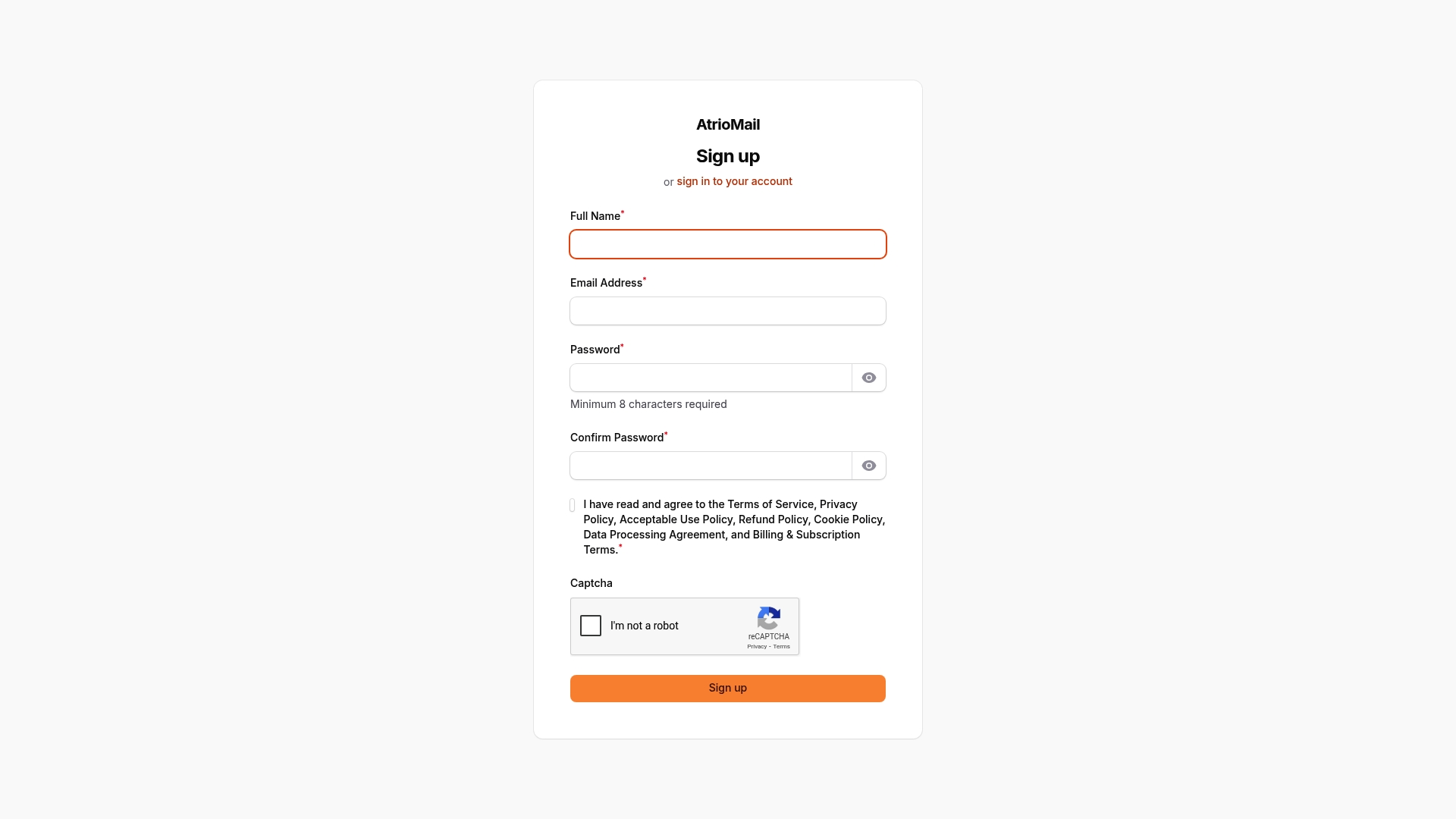
Ready to elevate your email offerings and increase profit margins without sacrificing control or performance Explore how AtrioMail’s platform can transform your email services now by registering at https://system.atriomail.com/admin/register and begin scaling your success today.
Frequently Asked Questions
What does scalable email hosting mean?
Scalable email hosting refers to a flexible system designed to manage digital communication needs that can grow and adapt with an organization. It allows for dynamic adjustments in resource allocation, ensuring performance and reliability without the need for expensive hardware investments.
How can scalable email hosting benefit my business?
Scalable email hosting provides numerous benefits, including automatic resource provisioning, elastic storage and user capacity, consistent performance under varying loads, and cost-effective management. This ensures your email system can efficiently grow alongside your business while supporting modern work environments.
What are the core features to look for in a scalable email platform?
Key features of a scalable email platform include message queues for asynchronous processing, load balancers for traffic distribution, email processing workers to manage message loads, robust databases, and comprehensive monitoring systems to provide real-time analytics and issue detection.
How does usage-based pricing work in scalable email hosting?
Usage-based pricing aligns costs with actual resource consumption rather than fixed subscription tiers. This model enables businesses to pay based on real-time usage, providing financial flexibility and eliminating wasted capacity, which is particularly beneficial for growing organizations.