
More than 85 percent of American companies rank branded communication as a top priority to stand out in crowded digital markets. If you are running an IT agency or reselling email services, mastering white-label email hosting is crucial for building brand identity and securing higher profit margins. This guide breaks down practical steps for configuring scalable email pricing, management, and seamless American branding so your business stays both agile and competitive.
Table of Contents
- Step 1: Assess Target Client Profiles And Usage Patterns
- Step 2: Configure Usage-Based Pricing Tiers And Automation
- Step 3: Integrate Scalable Billing And Management Tools
- Step 4: Validate Seamless White-Label Deployment And Branding
- Step 5: Monitor Usage, Margins, And Customer Satisfaction
Quick Summary
| Essential Insight | Detailed Explanation |
|---|---|
| 1. Understand Client Profiles | Analyze company size, industry, and communication needs to create precise client profiles for targeted email service strategies. |
| 2. Use Tiered Pricing Models | Develop flexible pricing structures based on usage metrics to accommodate different client needs, making upgrades attractive. |
| 3. Implement Advanced Billing Tools | Choose billing platforms that support customized billing automation and real-time consumption tracking for operational efficiency. |
| 4. Ensure Effective White-Labeling | Customize platforms fully to create a unique branded experience for users, ensuring consistency in visual identity and functional aspects. |
| 5. Monitor Performance Metrics | Regularly review email performance and customer satisfaction metrics to identify opportunities for upselling and improve service delivery. |
Step 1: Assess target client profiles and usage patterns
Creating an effective email pricing strategy starts with understanding your potential clients inside and out. When you develop an ideal customer profile, you create a precise roadmap for targeting and pricing your email hosting services.
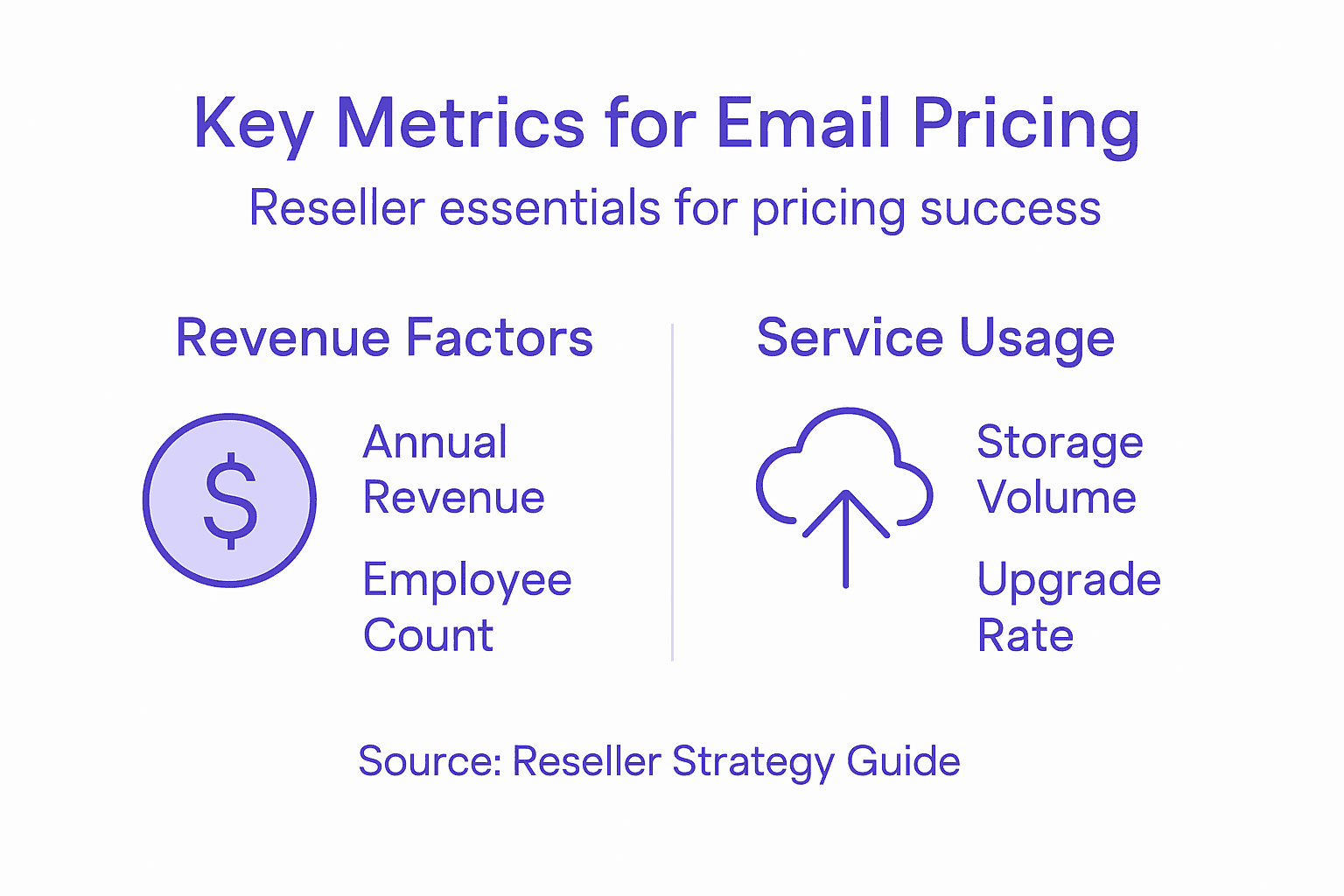
To build a comprehensive client profile, gather quantitative and qualitative data about potential email service buyers. Start by analyzing company size, industry vertical, current communication infrastructure, and past technology purchasing behaviors. Look for patterns in company growth, technology adoption rates, and specific communication needs. Some key metrics to track include annual revenue, number of employees, current email hosting expenses, and technology upgrade frequency. Pay special attention to companies experiencing rapid scaling or digital transformation, as these organizations often require flexible email infrastructure.
Organizing this data will help you transform fragmented information into actionable insights about potential email service clients. Create detailed segment profiles that outline specific usage patterns, budget ranges, and service requirements. This approach allows you to design tiered pricing models that match different client needs precisely.
Here’s a summary of essential metrics for building client profiles:
| Metric | Why Track It | Business Impact |
|---|---|---|
| Annual Revenue | Reveals budget potential | Enables tailored pricing tiers |
| Employee Count | Indicates organization size | Helps predict service demand |
| Tech Upgrade Frequency | Signals digital adoption pace | Targets clients ready for change |
| Current Email Expenses | Shows existing spend thresholds | Aids in competitive positioning |
| Growth Rate | Highlights scalability needs | Identifies flexible infrastructure needs |
Pro Tip: Create a dynamic client profile spreadsheet that you update quarterly to ensure your targeting remains accurate and responsive to market changes.
Step 2: Configure usage-based pricing tiers and automation
Designing flexible pricing models for email hosting requires strategic thinking and smart technology. When you implement Configure Price Quote software, you create a powerful framework for managing complex billing scenarios that adapt to your clients unique consumption patterns.
Start by mapping out your service usage metrics carefully. Break down your email hosting offerings into measurable components such as storage volume, number of user accounts, email traffic, and additional features like archiving or compliance tools. Develop tiered pricing structures that reflect these different consumption levels. For instance, create entry level plans for small businesses with limited email needs and scalable enterprise plans for organizations with high volume communication requirements. Each tier should offer clear value propositions that make upgrading attractive.
To streamline your billing process, leverage usage-based pricing automation that tracks consumption in real time. Modern billing platforms can automatically calculate charges based on actual usage, generate invoices, and manage billing cycles without manual intervention. This approach not only reduces administrative overhead but also provides transparency to your clients about their exact service consumption and associated costs.

Pro Tip: Design your pricing tiers with clear upgrade paths and include usage calculators on your website to help potential clients understand their expected costs.
Step 3: Integrate scalable billing and management tools
Streamlining your email reseller business requires powerful billing infrastructure that adapts to your growing client base. Billing software automates complex revenue management processes essential for tracking diverse service consumption and maintaining financial precision.
Choose a comprehensive billing platform that supports multiple pricing models and integrates seamlessly with your existing systems. Look for tools that can handle usage based billing, generate automatic invoices, track payments across different currencies, and provide real-time reporting. WHMCS represents a leading platform for reseller billing workflows, offering robust automation for provisioning, invoicing, and customer support management. Prioritize solutions that allow custom branding, support multiple payment gateways, and provide granular control over billing cycles.
Effective billing tool integration goes beyond basic transaction management. Configure your platform to generate usage reports, set up automatic payment reminders, and create flexible renewal options that match your clients unique consumption patterns. This approach reduces administrative overhead and provides transparent, predictable billing experiences that build long term client trust.
Here’s a comparison of popular billing platform features:
| Feature | WHMCS | Generic Billing Tool |
|---|---|---|
| Automation | Advanced workflows | Basic auto-invoicing |
| Integration | Seamless API and plugins | Limited extension options |
| Custom Branding | Fully white-label support | Minimal branding tools |
| Reporting | Real-time, detailed | Standard monthly reports |
| Payment Gateways | Multiple supported | Fewer options available |
Pro Tip: Select a billing platform with robust API capabilities to enable future integrations and customize your workflow as your business evolves.
Step 4: Validate seamless white-label deployment and branding
Transforming your email hosting platform into a fully branded solution requires meticulous attention to every visual and functional detail. White-label integration creates native user experiences that make your service feel completely unique and professionally crafted.
Begin by thoroughly customizing your platform’s visual identity. This means replacing every default interface element with your company’s logos, color schemes, typography, and design language. Verify that custom domains are fully functional and that all client facing interfaces display your brand consistently. Pay special attention to login screens, dashboards, email templates, and support portals to ensure no trace of the underlying technology provider remains visible. White-label solutions support comprehensive brand management allowing you to create a completely seamless experience that feels like a proprietary product.
Test your white-label deployment comprehensively by simulating multiple user scenarios. Create test accounts, navigate through entire user workflows, and verify that every interaction reinforces your brand identity. Check that automated emails, system notifications, and support communications maintain your unique visual and tonal brand guidelines. Confirm that API integrations and backend systems remain invisible to end users while providing robust functionality.
Pro Tip: Conduct a blind user test with individuals unfamiliar with your underlying email infrastructure to validate the completeness of your white-label branding.
Step 5: Monitor usage, margins, and customer satisfaction
Successful email resellers transform raw data into strategic insights that drive business growth. Email performance metrics reveal critical customer engagement patterns that help you optimize service delivery and maintain healthy profit margins.
Develop a comprehensive monitoring dashboard that tracks key performance indicators across multiple dimensions. Focus on metrics like email volume, open rates, response times, user activity levels, and customer support interactions. Calculate your profit margins for each client segment by comparing service costs against revenue generated. Pay special attention to usage trends that might indicate potential upsell opportunities or early signs of customer dissatisfaction. Customer satisfaction metrics provide actionable business intelligence that can help you proactively address potential churn risks and refine your service offerings.
Implement a regular review cycle where you analyze these metrics monthly or quarterly. Look for patterns in customer behavior such as declining usage, increased support tickets, or reduced engagement. Use these insights to make data driven decisions about pricing adjustments, service improvements, and targeted customer retention strategies. Remember that understanding your customers consumption patterns is just as important as the technical infrastructure you provide.
Pro Tip: Create automated reporting that sends key performance snapshots directly to your management dashboard to enable real time strategic decision making.
Scale Your Email Reseller Business with Confidence Using AtrioMail
The article highlights challenges every email reseller faces, such as creating flexible usage-based pricing tiers, automating complex billing, and maintaining complete white-label branding. These hurdles can slow down growth and reduce profitability if not handled with precision. AtrioMail solves these critical pain points by offering a fully managed SaaS platform that empowers resellers to design scalable pricing models, automate DNS validation and billing, and deliver a seamless branded experience to their clients.
With AtrioMail, you gain freedom from the burdens of infrastructure management while retaining full control over your customer’s email platform. Our solution simplifies deploying tiered plans that match diverse client needs and automates processes to boost operational efficiency and profit margins. Whether you are scaling rapidly or seeking to differentiate your email services, AtrioMail provides the enterprise-grade tools and API integrations you need to grow without compromise.
Unlock superior control and enhance your branding capabilities today by starting your journey with us at AtrioMail.
Ready to transform your email service pricing and delivery? Explore how our white-label email hosting platform streamlines billing and management so you can focus on growth.
Get started now with AtrioMail and build your scalable, profitable email reseller business without the complexity. Register today and experience the freedom to create flexible pricing and fully branded email platforms that your clients will trust.
Frequently Asked Questions
How do I assess target client profiles for scalable email pricing?
To assess target client profiles, gather quantitative and qualitative data about potential email service buyers. Focus on metrics like company size, industry, and current email hosting expenses, which will help you tailor your pricing strategy effectively.
What metrics should I track to develop email pricing tiers?
Key metrics to track include annual revenue, employee count, and technology upgrade frequency. By analyzing these metrics, you can establish tiered pricing models that meet the specific needs of different client segments.
How can I implement usage-based pricing for my email services?
Start by mapping out service usage metrics such as storage volume and email traffic. Develop tiered pricing structures that reflect these usage patterns, ensuring each tier offers clear value and appropriate options for small and large organizations.
What features should I look for in billing software for email reselling?
Look for billing software that supports usage-based billing, automated invoicing, and real-time reporting. Prioritize platforms that allow custom branding and integrate seamlessly with your existing systems for enhanced functionality.
How do I ensure my email service delivery remains scalable?
To ensure scalable service delivery, continuously monitor usage patterns and customer satisfaction metrics. Regularly analyze key performance indicators to identify trends and potential upsell opportunities, allowing you to adjust your services and pricing accordingly.
What steps do I need to take for effective white-label branding?
Begin by customizing your platform’s visual identity with your logo, color scheme, and design language. Test the user experience thoroughly to ensure your brand identity is consistently represented across all client-facing interfaces.