
Managing email costs as your client list grows can feel unpredictable without the right pricing model. For Canadian, British, or American resellers aiming to stay competitive, choosing a solution that scales with demand is the difference between steady profits and shrinking margins. Scalable email pricing models go beyond basic fixed rates, offering flexibility that matches your service level to what your customers actually use. Discover practical options for modern, white-label email hosting that make margin growth and client satisfaction possible at any stage.
Table of Contents
- Defining Scalable Email Pricing Models
- Types of Scalable Email Pricing Structures
- Key Features For Resellers And Msp
- How Usage-Based Billing Impacts Margins
- Choosing Scalable Email Pricing Over Alternatives
Key Takeaways
| Point | Details |
|---|---|
| Scalable Email Pricing Models | Service providers should adopt scalable email pricing models that adapt to customer usage for better revenue alignment and flexibility. |
| Types of Pricing Structures | Emphasize usage-based and tiered pricing models to match client needs and enhance profitability. |
| Key Features for Resellers | Choose email platforms that offer multi-user support, advanced security, and transparent pricing for better customer satisfaction. |
| Margin Optimization | Implement robust tracking systems and flexible pricing strategies to manage unpredictability associated with usage-based billing. |
Defining Scalable Email Pricing Models
Scalable email pricing models represent sophisticated approaches for service providers to align pricing with customer growth and usage. These innovative pricing strategies go far beyond traditional fixed-rate structures by dynamically adjusting costs based on actual consumption and business needs. SaaS pricing models have transformed how businesses approach software monetization, creating flexible frameworks that support evolving customer requirements.
At their core, scalable email pricing models incorporate several key characteristics:
- Flexibility in pricing tiers
- Dynamic cost adjustment based on usage
- Predictable revenue streams for service providers
- Customer-centric billing structures
These models typically manifest through multiple approaches, including:
- Subscription-based pricing
- Usage-based billing
- Tiered feature access
- Volume-dependent rates
Unlike traditional fixed pricing, subscription-based models enable businesses to access email services without substantial upfront investments. This approach supports scalability by allowing organizations to expand or contract their email infrastructure seamlessly.
Subscription models work particularly well for resellers because they:
- Reduce initial financial barriers
- Provide predictable recurring revenue
- Enable rapid service deployment
- Support diverse customer segments
By implementing these flexible pricing strategies, email service providers can create more attractive, adaptable solutions for businesses of all sizes.
Pro tip: Always design your pricing model with future growth in mind, allowing seamless scaling without complex contract renegotiations.
Types of Scalable Email Pricing Structures
Scalable email pricing structures represent diverse strategies that enable service providers to create flexible, adaptable billing models for email services. Pricing models range from simple flat-rate approaches to sophisticated consumption-based frameworks that dynamically adjust costs based on actual usage patterns. These structures are critical for resellers seeking to match pricing with customer needs and market demands.
The most common scalable email pricing structures include:
- Contacts-based pricing: Costs determined by total number of stored contacts
- Send-based pricing: Billing tied directly to email volume sent
- Flat-rate models: Fixed monthly fees with predefined feature sets
- Tiered pricing: Packages with increasing features and usage limits
- Usage-based billing: Costs directly proportional to actual email consumption
Email pricing approaches typically fall into two primary categories that resellers must understand:
- Contacts-based models, ideal for businesses with stable email lists
- Send-based models, perfect for organizations with variable communication needs
Usage-based pricing offers particular advantages for email service resellers. This model allows granular cost tracking, enables precise billing, and provides maximum flexibility for clients with fluctuating email communication requirements. By aligning costs directly with consumption, resellers can create more transparent and fair pricing structures.
Enterprise-level resellers benefit from these scalable models by:
- Offering customized pricing solutions
- Reducing financial risks
- Supporting diverse client needs
- Enabling rapid service adaptation
Pro tip: Design your pricing structure with built-in flexibility, allowing seamless transitions between tiers as client needs evolve.
Here’s a side-by-side comparison of common scalable email pricing structures and their ideal use cases:
| Pricing Structure | Ideal For | Revenue Predictability |
|---|---|---|
| Contacts-based | Stable email list clients | Moderate, depends on list size |
| Send-based | Variable campaign senders | Fluctuates with campaign volume |
| Flat-rate | Small, consistent usage | Highly predictable |
| Tiered | Growing businesses | Predictable with potential for upgrades |
| Usage-based | Enterprises with dynamic needs | Least predictable, most flexible |
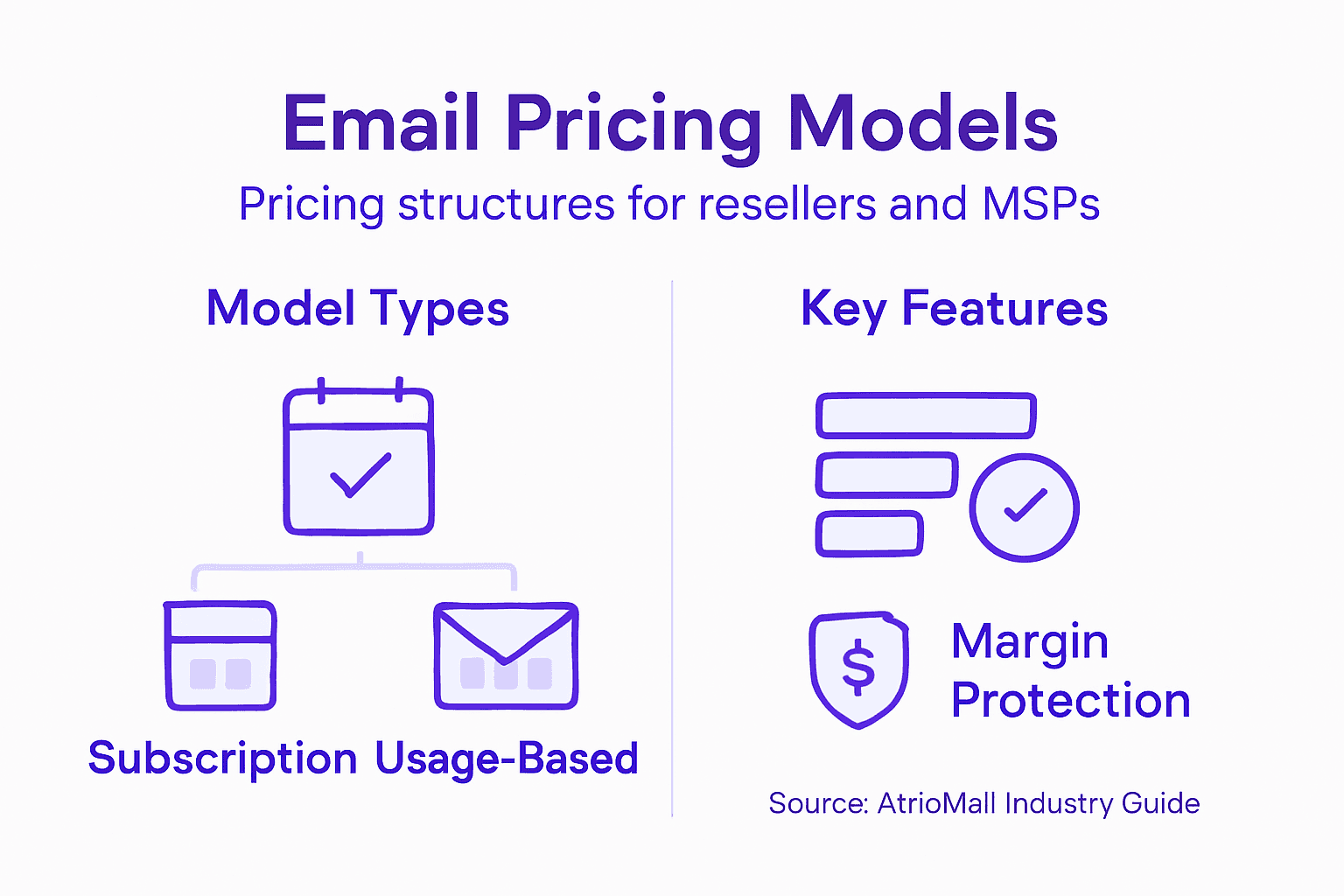
Key Features for Resellers and MSPs
Scalable email solutions for resellers and managed service providers (MSPs) demand comprehensive features that enable seamless business operations and client support. Professional email solutions must incorporate robust capabilities that address the complex needs of modern businesses, from security to scalability and beyond.
Key features that distinguish top-tier email platforms for resellers include:
- Multi-user support for complex organizational structures
- Advanced security measures:
- Spam filtering
- Email encryption
- Two-factor authentication
- Flexible storage options
- Comprehensive collaboration tools
- Transparent pricing tiers
Email outreach solutions for resellers must also prioritize critical technical capabilities:
- API integrations for workflow automation
- Volume-based pricing flexibility
- Sender reputation management tools
- Compliance with email regulations
- Advanced segmentation capabilities
Technical integrations play a crucial role in creating scalable email infrastructure. Resellers need platforms that offer seamless connections with productivity tools, customer relationship management (CRM) systems, and other business-critical applications. By selecting email solutions with robust API capabilities, MSPs can create more integrated and efficient service offerings.
Enterprise-level resellers can maximize their value proposition by:
- Implementing comprehensive security protocols
- Offering flexible, customizable email solutions
- Maintaining high deliverability standards
- Providing transparent, usage-based pricing
Pro tip: Prioritize email platforms that offer granular control and white-label branding to maintain your unique service identity.

This table summarizes key features that enable resellers and MSPs to deliver high-value email solutions:
| Feature | Operational Value | Customer Benefit |
|---|---|---|
| API Integrations | Simplifies automation workflows | Eases system linking and expansion |
| Advanced Security | Reduces data breach risk | Protects sensitive communications |
| Collaboration Tools | Improves team productivity | Enables seamless group projects |
| Flexible Storage | Scales with business growth | Avoids data limits disruptions |
| Transparent Pricing | Enhances client trust | Allows clear cost expectations |
How Usage-Based Billing Impacts Margins
Email marketing pricing models create complex challenges for resellers seeking to optimize their profit margins. Usage-based billing represents a dynamic approach that directly ties costs to actual email consumption, fundamentally transforming how managed service providers (MSPs) generate revenue and manage financial risk.
The primary margin impact mechanisms include:
- Variable cost structures
- Direct usage correlation
- Flexible pricing adaptation
- Granular consumption tracking
- Predictive revenue modeling
Strategic pricing approaches for resellers must address several critical margin considerations:
- Accurate usage forecasting
- Cost recovery mechanisms
- Bundling complementary services
- Implementing tiered usage limits
- Continuous pricing model refinement
Usage-based billing introduces significant complexity for resellers. While this model prevents overpayment and allows precise cost alignment, it simultaneously creates unpredictable revenue streams that require sophisticated financial management. Successful implementations demand robust tracking systems, transparent communication with clients, and agile pricing strategies that can adapt to fluctuating consumption patterns.
Margin optimization strategies for usage-based billing include:
- Implementing comprehensive usage tracking
- Developing flexible pricing tiers
- Creating predictive financial models
- Establishing clear billing transparency
Pro tip: Design your usage-based billing model with built-in margin protection mechanisms that automatically adjust as customer consumption patterns evolve.
Choosing Scalable Email Pricing Over Alternatives
Scalable pricing models represent a strategic evolution beyond traditional fixed pricing approaches for email service resellers. Unlike rigid pricing structures that create barriers to growth, these dynamic models provide unprecedented flexibility for managed service providers (MSPs) to adapt to diverse customer needs and market dynamics.
Key advantages of scalable pricing over alternatives include:
- Adaptive cost structures
- Flexible customer segmentation
- Revenue alignment with value
- Lower customer acquisition barriers
- Seamless business growth support
Pricing strategies demonstrate several critical differentiators between scalable and traditional pricing models:
- Dynamic value capture
- Customer success correlation
- Market responsiveness
- Resource allocation efficiency
- Margin optimization potential
Traditional fixed pricing models create significant limitations for resellers. They restrict revenue potential, prevent precise value matching, and often force customers into one-size-fits-all packages that do not reflect actual usage or needs. Scalable models, by contrast, enable granular pricing that grows alongside customer requirements, creating a more symbiotic service relationship.
Strategic pricing benefits include:
- Reducing customer churn
- Enabling precise cost management
- Supporting diverse market segments
- Creating transparent billing mechanisms
Pro tip: Develop pricing tiers that offer clear upgrade paths, allowing customers to seamlessly expand services as their needs evolve.
Unlock Scalable Email Pricing That Grows With Your Business
Managing variable email usage and unpredictable costs can be a major challenge for resellers and managed service providers striving for flexible, profitable email hosting solutions. The article highlights key pain points like balancing dynamic pricing, maintaining predictable revenue, and offering custom pricing tiers that fit diverse client needs. Concepts such as usage-based billing and tiered pricing show the importance of adaptable models that scale with customer growth while protecting profit margins.
AtrioMail directly solves these challenges by delivering a white-label, managed email hosting platform designed for resellers who want full control without the hassle of infrastructure management. Our fully automated DNS validation and scalable usage-based pricing empower you to easily implement flexible pricing structures that match your clients’ evolving demands. With seamless API integration and comprehensive brand customization options, AtrioMail lets you increase profit margins while offering enterprise-grade security and service reliability.
Make pricing complexity a thing of the past and unlock new revenue streams by partnering with AtrioMail for your email resale business. Experience why top MSPs and IT agencies trust our platform to scale effortlessly and deliver transparent billing aligned with actual email consumption.
Discover the freedom to customize pricing and enhance scalability today.
Explore AtrioMail’s benefits and start your journey toward scalable email success by registering at AtrioMail Signup. Seize this opportunity to transform your email services with a platform built for growth and flexibility.
Frequently Asked Questions
What are scalable email pricing models?
Scalable email pricing models are dynamic approaches that allow service providers to align pricing with customer growth and usage, allowing costs to adjust based on actual consumption and business needs.
How do subscription-based pricing models benefit resellers?
Subscription-based pricing models reduce initial financial barriers, provide predictable recurring revenue, and allow for rapid service deployment, making them particularly beneficial for resellers targeting diverse customer segments.
What are the differences between contacts-based pricing and send-based pricing?
Contacts-based pricing is ideal for businesses with stable email lists, as it charges based on the total number of stored contacts. In contrast, send-based pricing is designed for organizations with variable communication needs, charging based on the volume of emails sent.
How does usage-based billing impact profit margins for email resellers?
Usage-based billing links costs directly to actual email consumption, which can create unpredictable revenue streams. However, it allows for precise cost alignment and flexible pricing adaptation, which can optimize profit margins through effective tracking and billing strategies.