
Safeguarding sensitive information in business email is becoming more complex every year. As digital threats evolve, so do the expectations of clients who trust their information to email service resellers and IT agencies. Protecting privacy is not just about technology, it is about building trust and differentiating your brand with secure, customizable email solutions that meet global compliance standards. This article explores what true business email privacy means, the real risks involved, and how smart solutions can future-proof both client communication and your reputation.
Table of Contents
- Defining Privacy In Business Email Systems
- Types Of Privacy Risks In Email Communication
- How Email Metadata Exposes Business Data
- Key Email Privacy Regulations Globally
- Responsibilities Of Resellers And Agencies
- Technology Solutions For Email Privacy Protection
Key Takeaways
| Point | Details |
|---|---|
| Importance of Privacy in Business Email | Privacy in business email systems is essential for safeguarding sensitive information and ensuring compliance with regulations. Organizations should implement robust technical and organizational privacy measures. |
| Risks and Vulnerabilities | Business email communication is susceptible to various privacy risks, including unauthorized access and phishing attacks. Regular risk assessments and employee training are critical for enhancing security awareness. |
| Email Metadata Concerns | Email metadata can expose sensitive information about communication patterns. Organizations must adopt protocols to sanitize metadata and safeguard against unauthorized analysis. |
| Global Regulatory Compliance | Compliance with global email privacy regulations, such as GDPR and CCPA, is crucial. Organizations must develop flexible strategies to meet diverse regulatory requirements while ensuring data protection. |
Defining Privacy in Business Email Systems
Privacy in business email systems represents a comprehensive approach to protecting sensitive information and maintaining organizational confidentiality. Informational privacy principles define the fundamental right of individuals and organizations to control personal data disclosure within digital communication channels.
At its core, business email privacy encompasses several critical dimensions:
- Confidentiality of communication content
- Protection against unauthorized data access
- Compliance with regional data protection regulations
- Secure management of personal and corporate information
The technical infrastructure of privacy protection involves multiple strategic layers. Digital communication security frameworks emphasize the importance of implementing robust mechanisms that safeguard data confidentiality, integrity, and availability. These systems must balance technological solutions with organizational practices that respect user privacy rights.
Business email privacy is not merely a technical challenge but a complex ecosystem requiring human-centered innovation. Effective privacy strategies demand comprehensive approaches that integrate advanced encryption, access controls, and transparent data handling protocols. Organizations must develop nuanced frameworks that protect sensitive information while maintaining operational efficiency.
Pro tip: Regularly audit your email privacy protocols and update security measures to stay ahead of emerging digital threat landscapes.
Types of Privacy Risks in Email Communication
Business email communication faces numerous privacy risks that can compromise organizational security and brand reputation. Email communication vulnerabilities encompass a wide range of potential threats that demand comprehensive strategic management.
The primary privacy risks in email systems include:
- Unauthorized access to confidential communications
- Email interception and data breaches
- Metadata exposure revealing communication patterns
- Phishing and social engineering attacks
- Malware transmission through email attachments
- Inadequate encryption practices
Complex privacy challenges require multifaceted approaches. Privacy risk management strategies have evolved to address emerging digital threats, particularly focusing on protecting sensitive organizational information. These strategies must account for technological vulnerabilities, human error, and sophisticated cyber attack methodologies.
Modern organizations must recognize that email privacy risks extend beyond technical infrastructure. They involve comprehensive employee training, robust technological safeguards, and continuous monitoring of potential vulnerabilities. Developing a proactive privacy protection framework requires understanding the intricate landscape of digital communication threats and implementing adaptive security protocols.
Pro tip: Implement regular privacy risk assessments and conduct comprehensive employee training to create a culture of digital security awareness.
How Email Metadata Exposes Business Data
Email metadata represents an often overlooked yet critically vulnerable aspect of digital communication. Email metadata patterns can inadvertently reveal extensive details about organizational communication networks, potentially compromising sensitive business information.
Key metadata elements that expose business data include:
- Sender and recipient email addresses
- IP addresses and geographic routing information
- Precise transmission timestamps
- Server connection details
- Communication frequency and relationship maps
- Device and network identifiers
The comprehensive nature of metadata means that even encrypted communications can leak significant intelligence. Privacy protection strategies must account for these intricate digital footprints that can be exploited by sophisticated attackers seeking to map organizational communication structures.

Understanding metadata risks requires recognizing how seemingly innocuous technical information can construct detailed profiles of business interactions. Advanced organizations must implement sovereign encryption techniques and robust monitoring protocols to mitigate potential metadata exposure, protecting their communication infrastructure from unauthorized analysis and potential strategic compromises.
Pro tip: Implement advanced metadata sanitization protocols and conduct regular privacy audits to minimize unintended information leakage.
Key Email Privacy Regulations Globally
The digital communication landscape is increasingly governed by complex privacy regulations that span multiple jurisdictions. Global data privacy frameworks have emerged as critical mechanisms for protecting organizational and individual email communication rights across international boundaries.
Key global email privacy regulations include:
- European Union’s General Data Protection Regulation (GDPR)
- Brazil’s General Data Protection Law (LGPD)
- California Consumer Privacy Act (CCPA)
- Canada’s Personal Information Protection and Electronic Documents Act (PIPEDA)
- Asia-Pacific Economic Cooperation (APEC) Privacy Framework
- United Kingdom’s Data Protection Act
These regulations share fundamental principles that businesses must navigate. Organizations must implement robust data protection strategies that address consent, data minimization, purpose limitation, and individual privacy rights. The complexity of compliance requires a sophisticated approach that goes beyond simple checklist management.
Below is a comparison of major email privacy regulations and their primary focus areas:
| Regulation | Region | Key Focus | Unique Feature |
|---|---|---|---|
| GDPR | European Union | User consent, data minimization | Strict cross-border data transfer rules |
| CCPA | California, US | Consumer rights, opt-out options | Right to know and delete personal info |
| LGPD | Brazil | Data subject rights, accountability | Includes data protection officer requirement |
| PIPEDA | Canada | Fair information principles | Mandates breach notification to individuals |
| APEC | Asia-Pacific | Cross-border consistency | Emphasizes interoperability among economies |
| UK DPA | United Kingdom | Privacy rights protection | Post-Brexit adaptation of GDPR principles |
Navigating the global regulatory landscape demands continuous adaptation. Different regions have unique requirements, creating a challenging environment for businesses operating across international markets. Companies must develop flexible privacy frameworks that can accommodate diverse regulatory expectations while maintaining consistent protection standards.
Pro tip: Develop a centralized privacy compliance strategy that can be dynamically adjusted to meet varying international regulatory requirements.
Responsibilities of Resellers and Agencies
Digital agencies and resellers play a crucial role in managing email privacy and maintaining client trust. Data processing responsibilities extend far beyond simple service delivery, requiring comprehensive understanding of legal and ethical obligations in data management.
Key responsibilities for resellers and agencies include:
- Lawful data handling under privacy regulations
- Implementing robust security protocols
- Ensuring client data confidentiality
- Supporting transparent data processing
- Maintaining comprehensive breach notification procedures
- Protecting client communication infrastructures
Under regulatory frameworks like GDPR, agencies must navigate complex compliance requirements that define their roles as data processors. This means meticulously following client instructions, implementing stringent data protection measures, and maintaining accountability for their processing activities.
The ultimate goal for resellers and agencies is to create a secure, transparent ecosystem that protects both client interests and end-user privacy. This demands continuous education, proactive risk management, and a commitment to evolving privacy standards that respect individual data rights while enabling efficient business communications.
Pro tip: Develop a comprehensive privacy compliance checklist that can be regularly updated to reflect changing regulatory landscapes.
Technology Solutions for Email Privacy Protection
Modern email privacy demands sophisticated technological approaches that go beyond traditional security measures. Privacy Enhancing Technologies represent a comprehensive strategy for protecting sensitive business communications across digital platforms.
Key technological solutions for email privacy protection include:
- Encryption technologies for message content
- Multi-party secure computation frameworks
- Advanced anonymization techniques
- Decentralized routing mechanisms
- Secure server-side email search capabilities
- Zero-knowledge proof systems
Innovative privacy frameworks are revolutionizing email security by implementing complex computational techniques that distribute data processing across multiple providers. These solutions prevent single points of vulnerability and ensure that no individual service can access complete email content in its original form.
Implementing effective email privacy technologies requires a nuanced understanding of both technical capabilities and regulatory requirements. Organizations must continuously evolve their privacy protection strategies, balancing robust security measures with user-friendly communication experiences that maintain seamless workflow efficiency.
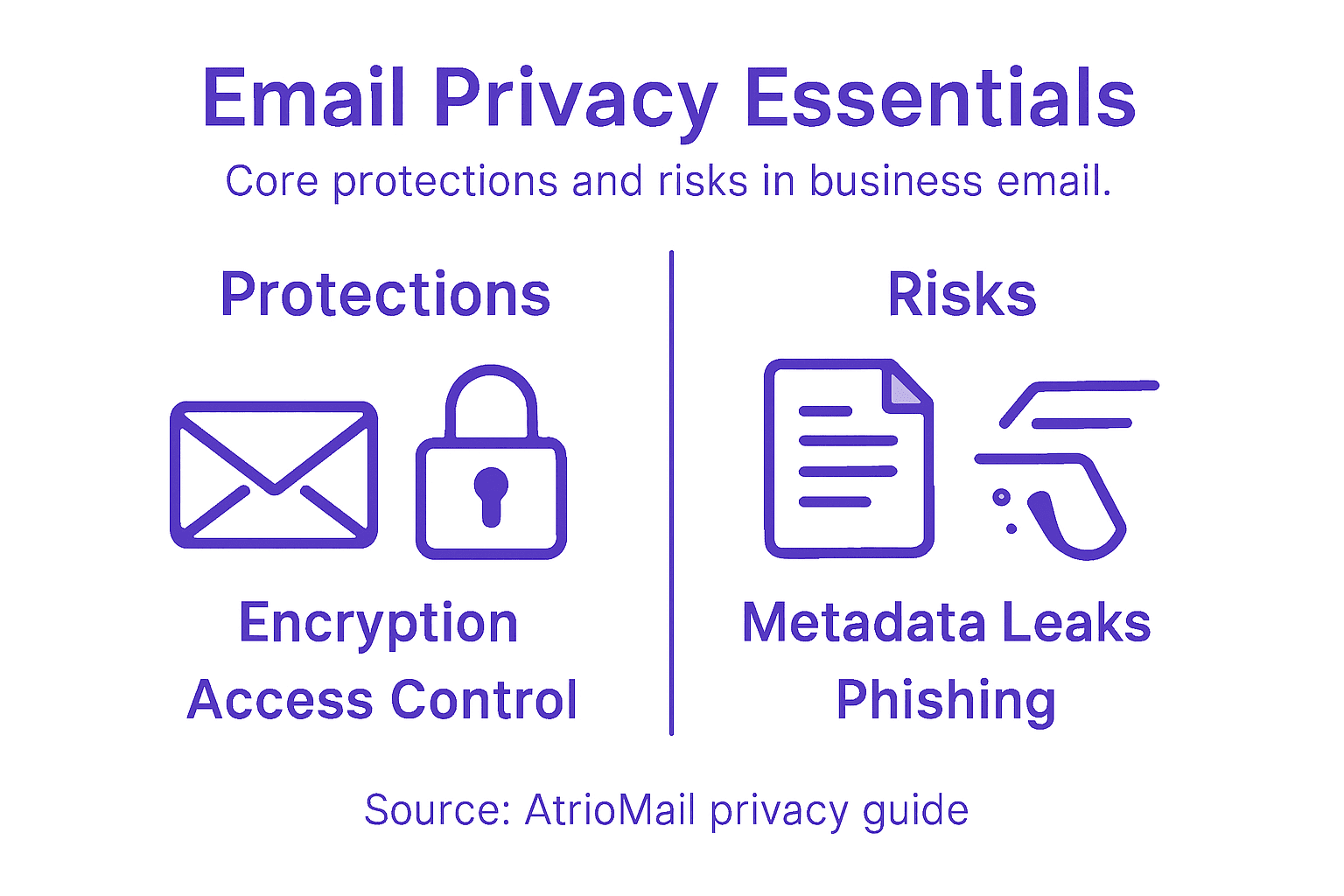
To illustrate how technology addresses business email privacy, see the summary below:
| Solution Type | Description | Business Benefit |
|---|---|---|
| Encryption | Scrambles content from sender to recipient | Prevents interception and data leaks |
| Metadata Sanitization | Removes sensitive routing information | Mitigates tracking and profiling risks |
| Multi-party Computation | Splits processing across providers | Eliminates single point of failure |
| Zero-Knowledge Proofs | Validates data without exposing it | Ensures authentication without sharing content |
Pro tip: Conduct regular privacy technology audits to ensure your email protection solutions remain current with emerging cybersecurity standards.
Secure Your Brand with Complete Control Over Business Email Privacy
Protecting sensitive business communications is more critical than ever. As the article highlights, privacy in business email systems requires robust measures to prevent unauthorized access, metadata exposure, and compliance risks. For resellers and agencies aiming to shield client data while offering fully branded email services, the challenge is maintaining privacy without sacrificing operational efficiency.
AtrioMail delivers a powerful solution designed for businesses that want to own their email infrastructure with privacy and compliance built-in. Benefit from automated DNS validation including MX, SPF, DKIM, and DMARC records that strengthen your email security posture effortlessly. Our platform empowers you to scale with usage-based pricing and manage everything through seamless API integration, enabling you to focus on what matters most—protecting your clients’ brands.
Ready to elevate your business email privacy and brand reputation? Discover how AtrioMail supports agencies and resellers in creating white-label, secure email platforms that put you in control. Take the next step and register now to start managing your fully branded email hosting with confidence today.
Frequently Asked Questions
What is the significance of privacy in business email systems?
Privacy in business email systems is crucial for protecting sensitive information and maintaining organizational confidentiality. It ensures that communication content remains confidential, prevents unauthorized access, and helps organizations comply with data protection regulations.
What are the main privacy risks associated with business email communication?
The primary privacy risks include unauthorized access to emails, email interception, phishing attacks, malware transmission, and inadequate encryption practices. These risks can lead to data breaches and loss of trust.
How does email metadata expose business data?
Email metadata, which includes sender and recipient information, timestamps, and IP addresses, can reveal extensive details about communication patterns. Even encrypted emails can leak metadata that attackers can exploit to gain insights into organizational structures.
What technological solutions can enhance email privacy?
Key technological solutions include encryption technologies, metadata sanitization, multi-party computation frameworks, and zero-knowledge proof systems. These technologies help protect sensitive communications and ensure data remains confidential and secure.