
Migadu's pitch is straightforward: one flat monthly fee, unlimited domains, unlimited email addresses. For a solo consultant running two or three client domains alongside their own, that model is genuinely attractive. For a 1-15 person MSP billing email across 20 or 50 client accounts, a set of structural constraints turns up quickly, and the total cost picture shifts in ways the headline pricing does not show.
This article works through what Migadu actually offers resellers: the tier pricing, the per-day sending limits that bound each tier, the absence of billing automation, and what the numbers look like against per-mailbox hosting at realistic client volumes.
Table of Contents
- What Migadu Is
- How the Flat-Rate Tiers Work
- The Per-Day Sending Limit: The Constraint That Compounds
- The Billing and Provisioning Gap
- The White-Label Gap
- Cost Comparison at 50 Mailboxes
- When Migadu Makes Sense for Resellers
- Where Atriomail Fits
- Frequently Asked Questions
Key Takeaways
| Point | Details |
|---|---|
| Flat-rate pricing, not per-mailbox | Migadu charges by tier ($9-$99/month), not per address or domain. Unlimited mailboxes are included, but each tier caps the number of messages your entire account can send and receive per day. |
| Shared rate limits bind faster than storage | The Mini tier allows 100 outgoing messages per day across all mailboxes. At 15 outgoing emails per mailbox per day, that cap is hit by about seven active mailboxes, before any storage concern appears. |
| No WHMCS or Blesta module | There is no native billing integration. Each client must be invoiced manually. An API exists in early beta but is not designed around automated reseller provisioning or deprovisioning at client churn. |
| No white-label branding | Clients who access webmail see Migadu's branding. There is no custom domain login, logo replacement, or reseller-branded panel at any price tier. |
| Cost crossover favors Migadu at large scale, but only on raw hosting cost | At 100 mailboxes, Migadu Maxi ($99/month) is cheaper than $1.39/mailbox ($139/month). The crossover is around 71 mailboxes. That math excludes manual billing overhead and assumes outgoing volume stays under 2,000 messages per day total. |
What Migadu Is
Migadu is a Swiss email hosting company that charges a flat monthly or annual fee covering unlimited email addresses and unlimited domains. Rather than billing per mailbox, Migadu's pricing is structured around email volume: how many messages per day the account can send and receive, and how much total storage is included across all mailboxes. The company positions this as a simpler alternative to per-seat pricing for organizations running many domains or addresses.
The service shows up regularly in technical communities, Reddit threads, and Hacker News discussions as a cost-effective option for people who manage many personal domains or run internal email for small groups. That audience is different from a managed-service provider billing 20-200 client mailboxes through a billing system and expecting automated provisioning when clients sign up or leave.
Understanding whether Migadu works for multi-client MSP use requires looking at the full tier structure rather than just the headline flat rate.
How the Flat-Rate Tiers Work
As of 2026, Migadu offers four published plans:
| Plan | Price | Storage | Incoming/day | Outgoing/day | Target |
|---|---|---|---|---|---|
| Micro | $19/year | 5 GB | 200 | 20 | Individuals, freelancers |
| Mini | $9/month | 30 GB | 1,000 | 100 | Startups, small groups |
| Standard | $29/month | 100 GB | 3,000 | 500 | SMEs, power users |
| Maxi | $99/month | 500 GB | 10,000 | 2,000 | Agencies, schools, large employers |
Storage limits are described by Migadu as soft: mailboxes will not start bouncing messages if you go over, though usage is tracked against the plan. Domains and addresses are unlimited at every tier, with some feature restrictions on the Micro plan. There is no annual billing option for Mini, Standard, or Maxi: only Micro can be paid yearly.
The critical constraint is not storage. It is the daily message counts. Every domain and every mailbox on the account shares the same sending and receiving pool. That shared pool is what limits practical client capacity at each tier.
The Per-Day Sending Limit: The Constraint That Compounds
The outgoing limit is the binding constraint for most business use. A modest assumption for a business mailbox is 15 outgoing emails per day, lower than most office workers actually send, but a reasonable floor for lightly used client accounts. At that assumption:
| Migadu tier | Outgoing limit/day | Mailboxes before limit hit (at 15 emails/mailbox/day) |
|---|---|---|
| Mini ($9/month) | 100 | ~6 |
| Standard ($29/month) | 500 | ~33 |
| Maxi ($99/month) | 2,000 | ~133 |
Mini's 100 outgoing per day works for approximately six active business mailboxes before the account starts queuing or refusing outbound messages. This is not a theoretical edge case: a single 10-person client with one email thread per person per hour on a busy day can consume the entire daily quota before lunch.
When one client account sends a burst, every other client on the same Migadu plan is affected. There is no per-client sending isolation, no per-domain limit, and no way to allocate part of the daily pool to one client's domain and protect the rest. The limit is global to the account.
This is structurally different from how shared storage pools work on services like MXRoute's reseller plans: MXRoute's storage is shared, but sending is per-domain and not pooled. On Migadu, a single active client can degrade deliverability for every other domain under the account.
For MSPs managing multiple client domains, that shared pool is a business risk, not just an inconvenience. A client complaint about delayed outbound email may have nothing to do with their domain configuration and everything to do with a different client on the same account having an active day.
The Billing and Provisioning Gap
Migadu has no native WHMCS or Blesta module. There is an API, described on the Migadu site as in early beta, which can create domains and mailboxes programmatically. But the API is not built around the provisioning lifecycle a billing system expects: automated account creation on payment, suspension on non-payment, termination on cancellation, and per-client invoicing from a single control point.
The practical result: every client who signs up for email needs a manual domain add, manual mailbox creation, and a manually generated invoice outside the billing system. When a client cancels, their domain and mailboxes need to be manually removed. When they miss a payment, there is no automated suspension. The billing automation that WHMCS and Blesta provide for per-mailbox hosting, including provisioning, suspension, termination and itemized monthly invoices, does not exist with Migadu as the backend.
At two or three client domains, manual management is feasible. At 15 or 20 clients, the overhead is significant. At 50 clients, it is a part-time job and an audit problem: knowing at any moment exactly how many mailboxes are active across all clients, what each client is consuming, and who is current on payment requires maintaining a separate spreadsheet that duplicates information a billing system should already hold.
This billing gap is not a limitation of Migadu's design; it is simply not what the product was built for. Migadu's flat-rate model is designed for organizations that want one invoice covering their own email needs across many domains, not for operators who need to generate 50 separate client invoices and automate every step of the client lifecycle.
The White-Label Gap
Migadu does not offer white-label branding at any tier. Clients accessing webmail see Migadu's interface and domain. There is no custom login page, no logo replacement, no way to present the platform under a different name. For agencies that sell email as part of a branded managed-service offering, this means every client who logs into webmail sees that the underlying product is Migadu, not the agency's platform.
This matters differently depending on how the MSP positions itself. If clients are primarily accessing email through a mail client like Outlook or Apple Mail, they may never see a Migadu-branded screen. If webmail is part of the offering, or if the agency wants to present a cohesive branded stack to clients, the absence of white-label is a hard constraint. The concept of what white-label email actually provides in the reseller context includes this branding layer, and Migadu does not offer it.
Cost Comparison at 50 Mailboxes
At 50 client mailboxes averaging 15 outgoing messages per day per mailbox, total outgoing is 750 per day. That exceeds the Standard plan's 500-per-day limit, so the required tier is Maxi at $99/month.
Atriomail's wholesale cost for the same 50 mailboxes at $1.39 per mailbox is $69.50 per month, with 15 GB of storage included per mailbox and no shared sending pool.
The crossover where Migadu Maxi becomes cheaper than Atriomail on raw hosting cost is around 71 mailboxes ($99 divided by $1.39). Above that point, Migadu's flat rate produces a lower line-item cost. That calculation does not include billing overhead: the time spent manually provisioning, invoicing, and deprovisioning clients that a WHMCS or Blesta integration handles automatically. It also assumes total daily outgoing volume stays under 2,000 messages, which 133 active mailboxes at 15 emails per day would exceed.
The comparison to Purelymail's flat-rate model is instructive: Purelymail at $10 per year is dramatically cheaper at large mailbox counts, but carries the same billing automation and rate-limit gaps. Understanding what the difference between flat-rate and usage-based email pricing means operationally is the more useful frame than comparing headline monthly costs alone.
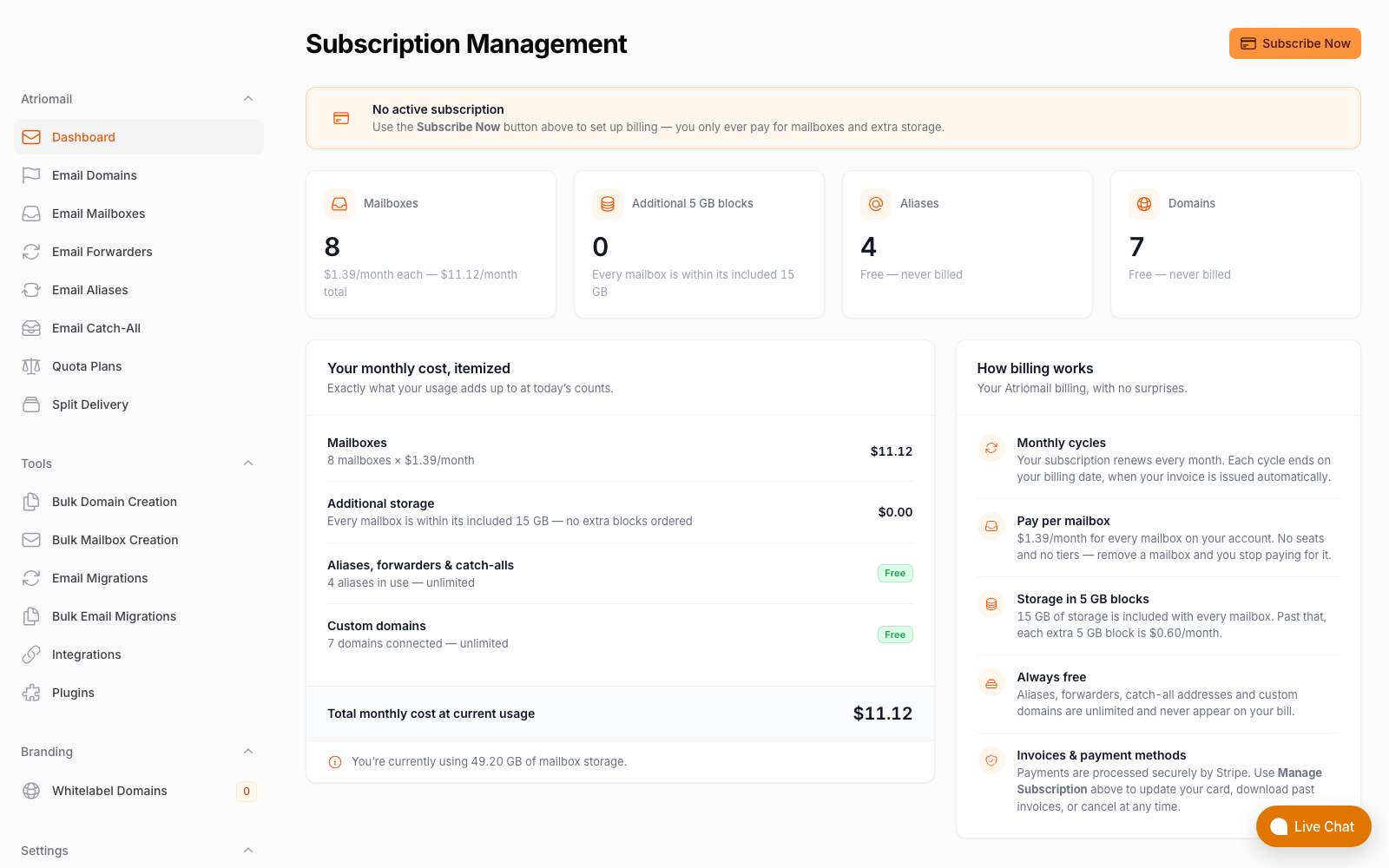
The Atriomail billing panel. Each client's mailboxes appear as a line item. No spreadsheet maintenance required.
When Migadu Makes Sense for Resellers
Migadu's flat-rate model is a good fit for a specific, genuinely common situation: a solo operator or very small shop that manages email for a handful of personally managed or closely held domains, where the operator is the de facto account owner for all of them.
Migadu works well when:
- The "reseller" is managing two to five domains that are effectively their own. A web designer who manages email for three long-term clients they also built sites for, where every mailbox is lightly used and bills are settled informally, fits this profile.
- Total outgoing volume is genuinely low. Internal-only teams, organizations with mostly inbound workflows, or non-profits with few active daily senders can stay inside Mini or Standard limits comfortably.
- White-label branding is not part of the value proposition. Clients access email via a desktop or mobile mail client and have no expectation of a branded webmail experience.
- Billing is handled outside any automation. The operator sends manual invoices and the overhead of doing so for five clients does not constitute a meaningful time cost.
- Privacy and data geography matter. Migadu operates from Switzerland, which may matter for specific client data-residency conversations.
The profile where Migadu breaks down is the one most MSPs and hosting resellers actually occupy: 15 or more client domains, each with multiple active mailboxes, billing automated through WHMCS or Blesta, and clients who expect their email to run without the operator manually checking whether another client's sending spike ate the daily quota.
Where Atriomail Fits
Atriomail is built for the reseller who needs billing automation, per-client isolation, and predictable per-mailbox cost from the first client rather than a flat rate that requires jumping tiers as the book grows.
At $1.39 per mailbox per month with 15 GB included, the wholesale cost scales linearly with the number of active mailboxes. There are no tier jumps, no shared sending pools, and no point at which adding a new client forces a plan upgrade that changes the cost of every existing client. Each domain has its own SPF, DKIM, and DMARC published automatically, so one client's sending behavior has no effect on another's deliverability.
The WHMCS and Blesta modules create the client's Atriomail account and domain when the order comes in, and carry suspensions and cancellations through to Atriomail. The per-mailbox billing model maps directly onto per-client line items: the mailboxes and storage a client orders in WHMCS or Blesta are billed there at your prices, not from a flat pool the operator has to allocate and track independently.
The gaps Migadu does not address are exactly the ones Atriomail is designed around: automated client lifecycle management, white-label branding for the webmail and admin panel, per-domain DNS automation, and a cost structure that does not require the operator to manage rate limits shared across clients. The case for per-mailbox pricing over flat-rate models is primarily operational: predictable cost per client, clean billing integration, and no shared-resource surprises.
Frequently Asked Questions
More on migration, billing and setup in the full FAQ.
Does Migadu have an API resellers can use to automate provisioning?
Migadu has an API described as in early beta that can create domains, mailboxes, and aliases. It is not designed around the billing integration lifecycle (automatic suspension, termination, per-client cost tracking) that WHMCS and Blesta provide. Building that workflow from the raw API would require custom development, and the early-beta status makes that a meaningful maintenance commitment.
Will a client mailbox bounce when the Migadu storage limit is reached?
No. Migadu describes its storage limits as soft: emails will not bounce due to a filled quota. However, storage usage counts against the plan and Migadu may contact account holders who substantially exceed the tier limit. For MSPs with a client whose archive grows large, this is worth monitoring, but it is not an immediate deliverability risk.
Can individual clients be given admin access to their own domains?
Yes. Migadu's multi-admin feature allows the account holder to grant additional administrators access limited to specific domains. This provides some client self-service capability, but the underlying account and billing relationship remains with the MSP. There is no client-facing portal that presents as the MSP's own branded platform.
How does Migadu compare to Purelymail for resellers?
Both use a flat-rate model with no per-mailbox cost. Purelymail charges $10 per year, making it significantly cheaper at large mailbox counts, but with even more restrictive per-client isolation. Migadu's tiers are higher cost but include more generous storage and higher daily message limits on the Standard and Maxi plans. Both share the same core gaps for MSPs: no WHMCS module, no white-label branding, and no automated client lifecycle management. The Purelymail comparison covers the flat-rate model at the low end of the cost range.
Recommended
- Why Per-Mailbox Pricing Wins for Resellers, Atriomail
- Automate Email Billing in WHMCS and Blesta, Atriomail
- Usage-Based Email Pricing Explained, Atriomail
- Purelymail for Email Resellers: What the $10/Year Model Looks Like at MSP Scale, Atriomail
- MXRoute Email Hosting for Resellers: Shared Storage, White-Label Reality, and the Per-Mailbox Math, Atriomail
- Pricing and the Reseller Margin Calculator, Atriomail
Latest from the blog
- How to Rotate a DKIM Key Without Breaking Mail That's Already Signed · Oct 21, 2026
- Microsoft Cut CSP Partner Margins on Exchange Online: What It Does to Your Resale Price · Oct 20, 2026
- How to Fix Forwarded Mail That's Failing SPF and Breaking DMARC · Oct 19, 2026
- What to Check Before Onboarding a 200-Mailbox Client in Atriomail · Oct 18, 2026
- Hostinger Retires cPanel Reseller Hosting: What Happens to the Client Email You Bill · Oct 17, 2026