
Managing email services for a diverse client base can quickly become complicated when fixed-cost pricing limits your flexibility and margins. As demand shifts and clients expect more tailored, responsive solutions, finding a model that aligns with real usage is essential. Adopting a usage-based pricing strategy means your agency or reseller business can respond to fluctuating needs, offer transparent billing, and position your brand as a flexible, scalable partner for North American organizations.
Table of Contents
- Defining Usage-Based Email Pricing Models
- Major Types And Key Differentiators
- How Usage-Based Billing Works In Practice
- Benefits For Resellers And It Agencies
- Financial Implications And Profitability Considerations
Key Takeaways
| Point | Details |
|---|---|
| Usage-Based Pricing Offers Flexibility | This model aligns revenue with actual customer consumption, making it beneficial for both small and large businesses. |
| Diverse Pricing Models Exist | Options like pay-as-you-go, tiered usage, per-unit pricing, and hybrid subscriptions cater to different customer needs and usage behaviors. |
| Operational Infrastructure is Crucial | Successful implementation requires robust systems for real-time tracking and accurate billing calculations. |
| Financial Dynamics Change | Transitioning to usage-based pricing alters revenue recognition and necessitates strategic planning to manage variable consumption patterns. |
Defining Usage-Based Email Pricing Models
Usage-based email pricing represents a transformative approach for email service resellers seeking flexible, scalable revenue models. Unlike traditional fixed-rate subscriptions, this strategy allows businesses to charge based on actual consumption of email services, creating a more dynamic and responsive pricing framework.
At its core, usage-based pricing enables companies to align their revenue directly with customer utilization. For email service providers, this means charging clients based on specific metrics like number of emails sent, storage volume, or API calls, rather than imposing flat monthly fees. The model provides granular flexibility, allowing customers to pay precisely for their actual email infrastructure requirements.
The strategic advantage of usage-based pricing lies in its ability to democratize email services. Small businesses can access enterprise-grade infrastructure without overwhelming upfront costs, while larger organizations can scale their email systems with predictable, consumption-driven expenses. Pricing models are shifting from static subscriptions to consumption-based strategies, reflecting a broader trend toward more customer-centric and adaptable service delivery.
Pro tip: When implementing usage-based email pricing, develop transparent, easy-to-understand pricing tiers that clearly communicate costs at different consumption levels to build customer trust and reduce potential billing confusion.
Major Types and Key Differentiators
Usage-based pricing models encompass several strategic approaches designed to match billing with actual service consumption. Pricing models range from simple to complex configurations that enable email service providers to create flexible, responsive revenue structures tailored to diverse customer needs.
Four primary usage-based pricing models dominate the email service landscape: pay-as-you-go, tiered usage, per-unit pricing, and hybrid subscription models. Pay-as-you-go structures allow customers to purchase email services incrementally, paying only for exact resources consumed. Tiered usage models introduce volume discounts, incentivizing higher consumption by offering progressively lower per-unit rates as customers increase their email infrastructure utilization. Per-unit pricing establishes a fixed rate for each email-related transaction, providing crystal-clear cost predictability. Hybrid models combine base subscription fees with variable usage charges, delivering a balanced approach that ensures baseline revenue while accommodating fluctuating customer requirements.
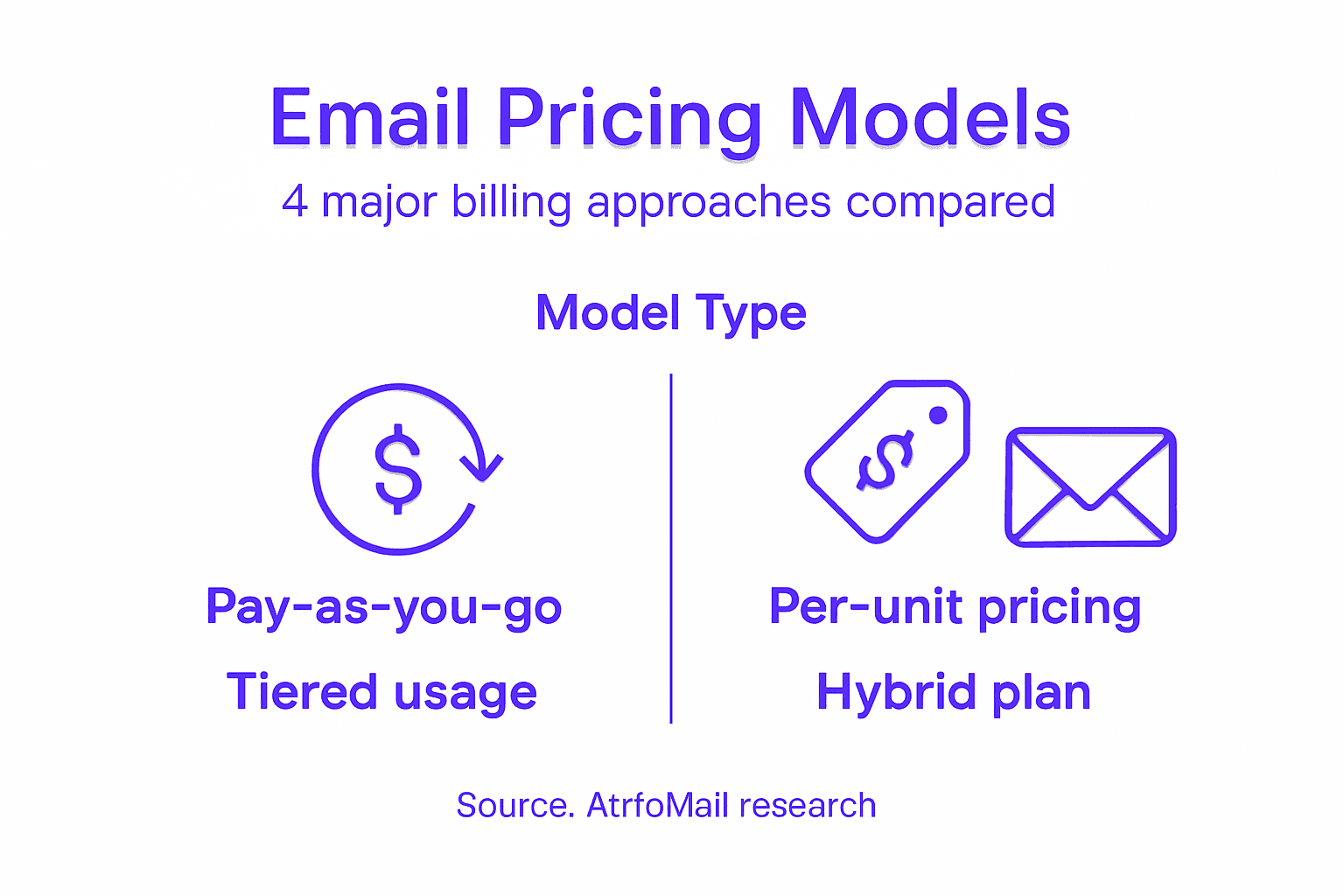
Here’s a comparison of the four primary usage-based email pricing models and their business impacts:
| Pricing Model | Billing Approach | Customer Flexibility | Business Impact |
|---|---|---|---|
| Pay-as-you-go | Charged per unit used | Maximum control over spending | Revenue scales linearly |
| Tiered Usage | Discount rates by tier | Incentivizes higher consumption | Margins improve with volume |
| Per-unit Pricing | Fixed rate per action | Simple, predictable for customers | Limited incentive for growth |
| Hybrid Subscription | Base fee + usage fees | Mix of predictability and scaling | Stable revenue, growth upside |
The key differentiators among these models lie in billing frequency, granularity of usage metrics, and customer flexibility. Successful implementation requires deep understanding of customer behavior, precise metric tracking, and transparent communication about pricing structures. Advanced email service providers leverage sophisticated analytics to design pricing models that not only cover operational costs but also create compelling value propositions for businesses of all sizes.
Pro tip: Conduct regular customer surveys and usage data analysis to continuously refine and optimize your pricing model, ensuring alignment with evolving market demands and customer expectations.
How Usage-Based Billing Works in Practice
Usage-based billing represents a sophisticated operational approach that transforms how email service providers track and monetize their infrastructure. Automated metering systems track customer consumption with precision, capturing granular data points about email service utilization across multiple dimensions such as volume, storage, and API interactions.

The technical implementation involves complex data pipelines that convert raw usage data into accurate billing calculations. Advanced billing engines apply sophisticated rules to process consumption metrics, handling intricate scenarios like prorated charges, plan transitions, and variable usage patterns. Operational readiness requires strategic alignment between sales, customer success, and technical teams to ensure seamless measurement and billing processes that maintain customer transparency and trust.
Successful usage-based billing demands robust technological infrastructure capable of real-time tracking, precise measurement, and flexible pricing logic. Email service providers must develop sophisticated internal systems that not only capture usage data accurately but also support dynamic pricing strategies. These systems must accommodate rapid scaling, handle complex billing scenarios, and provide clear, comprehensible invoicing that demonstrates direct value to customers.
Below is a summary of key operational needs for successful usage-based billing implementation:
| Requirement | Description | Business Benefit |
|---|---|---|
| Real-time Tracking | Monitor usage as it occurs | Enables accurate, up-to-date billing |
| Advanced Billing Engine | Automate charge calculations | Reduces errors, saves time |
| Transparent Invoicing | Clearly display consumption costs | Builds client trust and loyalty |
| Scalable Infrastructure | Support rapid customer growth | Facilitates business expansion |
Pro tip: Invest in comprehensive monitoring and analytics tools that provide real-time visibility into usage metrics, enabling proactive adjustments to your billing model and preventing potential revenue leakage.
Benefits for Resellers and IT Agencies
Usage-based pricing emerges as a transformative strategy for resellers and IT agencies seeking flexible, customer-centric email service solutions. Pricing models offer unprecedented contract flexibility that enable businesses to align billing precisely with actual service consumption, creating more transparent and trust-driven relationships with clients.
The economic advantages for resellers are particularly compelling. By adopting usage-based pricing, agencies can dramatically reduce upfront infrastructure investments while maintaining the ability to scale services dynamically. Scalable cost structures support growing business models that adapt seamlessly to fluctuating client demands, allowing IT agencies to offer more competitive and tailored email hosting solutions without compromising profit margins.
Advanced usage-based models provide resellers with sophisticated tools to differentiate their service offerings. By presenting granular, consumption-based billing, agencies can demonstrate clear value propositions, highlight cost efficiencies, and create more collaborative relationships with clients. This approach transforms email infrastructure from a fixed cost to a flexible, performance-driven service that directly reflects client needs and usage patterns.
Pro tip: Develop comprehensive usage dashboards that provide clients with real-time visibility into their email service consumption, transforming billing transparency into a competitive advantage.
Financial Implications and Profitability Considerations
Usage-based email pricing introduces complex financial dynamics that fundamentally transform revenue recognition and strategic planning for resellers. Precise usage metering enables dynamic revenue tracking by shifting from predictable subscription models to more fluid, consumption-driven financial frameworks that directly correlate service delivery with monetary value.
The profitability potential hinges on sophisticated operational infrastructure and strategic metric selection. Email service providers must invest in robust billing systems capable of handling nuanced usage calculations, ensuring accurate revenue capture while maintaining transparent client relationships. Strategic alignment between sales and operational teams becomes critical, as forecasting becomes more challenging with fluctuating consumption patterns that can dramatically impact monthly and quarterly financial projections.
Successful implementation requires a delicate balance between customer value perception and margin optimization. By carefully designing usage metrics that genuinely reflect service utility, resellers can create pricing models that feel fair to clients while preserving profitability. This approach transforms traditional fixed-cost email infrastructure into a dynamic, value-driven service that rewards efficiency and provides clear economic incentives for both providers and consumers.
Pro tip: Develop advanced predictive analytics tools that can model potential revenue scenarios based on historical usage data, enabling more accurate financial planning and risk management.
Unlock Scalable Brand Control with Usage-Based Email Pricing
The move to usage-based email pricing brings a new level of flexibility and fairness but introduces challenges like precise usage tracking and transparent billing. If you are a reseller or IT agency aiming to offer customizable, consumption-driven email services without the burden of managing complex infrastructure, AtrioMail provides the perfect solution. Our platform simplifies the adoption of pay-as-you-go and hybrid subscription models by automating DNS validation, usage metering, and scalable pricing management — letting you focus on growing your business and delighting your clients with fully white-label, brand-controlled email.
Experience how AtrioMail transforms your email offering into a dynamic revenue stream with clear cost visibility and operational ease. Start building your independent, scalable email platform today by registering for our service here. Discover the power of seamless API integration and managed infrastructure trusted by resellers who demand profitability and brand control with confidence.
Frequently Asked Questions
What is usage-based email pricing?
Usage-based email pricing is a flexible billing model that charges clients based on their actual consumption of email services, such as the number of emails sent, storage volume, or API calls, rather than a flat monthly fee.
What are the main benefits of usage-based email pricing for businesses?
The primary benefits include cost flexibility, allowing businesses to only pay for what they use, enhanced scaling options for both small and large companies, and the ability to access enterprise-level infrastructure without significant upfront costs.
How do different usage-based pricing models compare?
The four main models are pay-as-you-go, tiered usage, per-unit pricing, and hybrid subscriptions. Each offers varying degrees of flexibility and predictability, with tiered usage incentivizing higher consumption through volume discounts, while pay-as-you-go provides maximum control over spending.
What are the requirements for implementing usage-based billing in email services?
Successful implementation involves real-time tracking of usage, an advanced billing engine to automate calculations, transparent invoicing for clients, and a scalable infrastructure to support rapid growth and fluctuations in service consumption.