
Managing branded communications for clients can be complex when each business values its distinct identity. For IT agencies and managed service providers, delivering email solutions with white label branding means balancing operational simplicity and customization. By aligning core brand parameters with robust technical standards, you position your email services to meet varied client needs while enhancing reliability and brand recognition.
Table of Contents
- Step 1: Assess Your Branding And Client Requirements
- Step 2: Set Up Domains And Configure DNS Records
- Step 3: Implement White Label Branding Features
- Step 4: Integrate API For Scalable Automation
- Step 5: Test Deliverability And Brand Consistency
Quick Summary
| Key Insight | Explanation |
|---|---|
| 1. Assess Branding Requirements | Evaluate your agency’s brand elements and client needs to create tailored white label email solutions. |
| 2. Configure DNS Records Correctly | Set up essential DNS records like SPF, DKIM, and DMARC to ensure email authenticity and prevent security issues. |
| 3. Implement White Label Features | Customize email templates and branding elements to reflect each client’s identity consistently across the platform. |
| 4. Integrate an API for Automation | Use APIs to enhance your email service’s scalability and automate crucial processes like email sending and analytics. |
| 5. Rigorously Test Deliverability | Conduct thorough testing of email configuration and brand consistency to ensure successful deployment and effective communication. |
Step 1: Assess Your Branding and Client Requirements
Successfully implementing white label email requires a strategic assessment of your agency’s branding objectives and specific client needs. Understanding how brand identity impacts communication will help you design a cohesive email solution that reflects your unique value proposition.
Start by conducting a comprehensive evaluation of your agency’s core brand elements. This means documenting your mission, visual identity, tone of voice, and key differentiators. Simultaneously, analyze your clients’ branding requirements to ensure your white label email solution can accommodate diverse organizational needs. A thorough brand strategy assessment helps you map out exactly how your email services will integrate seamlessly with various client brand architectures.
Consider creating a detailed matrix that outlines specific branding parameters like logo placement, color scheme compatibility, domain customization options, and email signature templates. This approach allows you to standardize your offering while maintaining flexibility for individual client customization. By proactively mapping these elements, you can provide a more refined and professional white label email experience that truly represents each client’s unique brand identity.
Pro tip: Develop a comprehensive client onboarding questionnaire that captures precise branding requirements to streamline your white label email implementation process.
Here’s a summary of common branding parameters and how they influence white label email solutions:
| Branding Parameter | Importance for Agencies | Flexibility for Clients |
|---|---|---|
| Logo Placement | Ensures immediate brand recognition | Allows unique identity across domains |
| Color Scheme | Maintains visual consistency | Adapts to client guidelines |
| Domain Customization | Reinforces agency professionalism | Supports specific client branding |
| Email Signature Format | Standardizes messaging tone | Incorporates personalized elements |
Step 2: Set Up Domains and Configure DNS Records
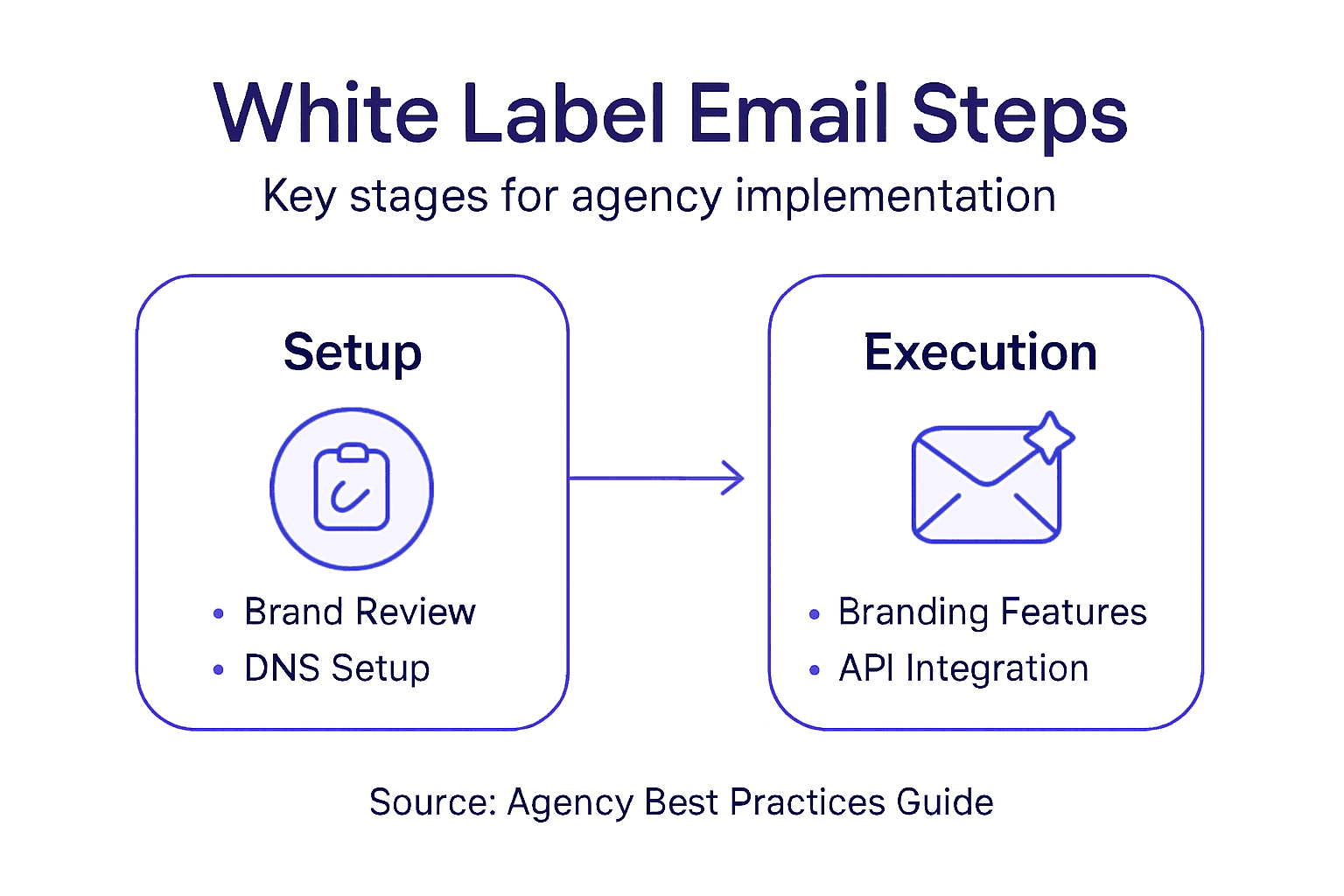
Configuring domain and DNS records is a critical step in establishing a robust white label email infrastructure. Proper DNS configuration ensures email authenticity and protects your clients’ communication channels from potential security threats.
Begin by setting up essential DNS records that validate and secure email communications. This includes creating SPF records to specify authorized sending servers, implementing DKIM for cryptographic message signing, and establishing DMARC policies to manage unauthorized email handling. Each record plays a crucial role in maintaining domain reputation and preventing email spoofing. Additionally, configure automatic email client DNS records like CNAME and SRV to enable seamless client configuration across platforms such as Outlook and Thunderbird.

Work systematically through each DNS record type, verifying configuration accuracy and testing email delivery before finalizing your setup. Pay close attention to details like record syntax, domain ownership verification, and potential conflicts with existing DNS entries. Remember that precise configuration directly impacts your white label email service’s reliability and professional perception.
Pro tip: Use automated DNS validation tools to streamline record configuration and quickly identify potential setup errors or misconfigurations.
Reference table: Key DNS record types and their business impact for secure email services.
| Record Type | Primary Purpose | Impact on Email Authenticity |
|---|---|---|
| SPF | Authorizes sending servers | Reduces risk of forged emails |
| DKIM | Signs emails cryptographically | Builds sender trust, prevents tampering |
| DMARC | Handles authentication failures | Protects against spoofing and phishing |
| CNAME/SRV | Simplifies client setup | Streamlines onboarding and configuration |
Step 3: Implement White Label Branding Features
Implementing white label branding features transforms your email service from a generic solution to a seamless extension of your client’s brand identity. White label branding requires coherent integration of corporate visual elements and messaging across all client touchpoints.
Begin by creating comprehensive brand guidelines that outline specific customization parameters. This includes designing email templates that precisely match your client’s color schemes, typography, and logo placement. Focus on developing consistent visual elements such as email headers, signatures, and dashboard interfaces that reflect each client’s unique brand personality. Ensure brand consistency guidelines are meticulously followed across all digital interfaces to maintain professional presentation and brand recognition.
Pay special attention to subtle branding nuances that elevate the user experience. This means going beyond simple logo insertion and creating a holistic branded environment that makes clients feel their email platform is a native part of their organizational ecosystem. Develop flexible template systems that allow minor customizations while maintaining overall brand integrity and design cohesiveness.
Pro tip: Create a standardized branding questionnaire that captures granular design preferences to streamline your white label customization process.
Step 4: Integrate API for Scalable Automation
Integrating an API is the critical infrastructure that transforms your white label email platform from a static service to a dynamic, responsive system. APIs enable seamless communication between applications and facilitate powerful automation capabilities for your agency’s email services.
Start by thoroughly reviewing the API documentation to understand its capabilities, authentication mechanisms, and endpoint structures. Focus on implementing RESTful API endpoints that support key functions such as email sending, list management, user provisioning, and analytics retrieval. Design your integration with scalability in mind, ensuring the API can handle increasing client loads and complex communication patterns. Consider developing robust error handling and retry mechanisms that maintain service reliability even under fluctuating system conditions.
Create a comprehensive testing strategy that validates API performance across different scenarios. This involves developing mock environments, conducting thorough integration tests, and establishing monitoring protocols that track API response times, success rates, and potential bottlenecks. By building a flexible and resilient API integration, you provide your agency with a powerful tool for delivering consistent, automated email services that can adapt to evolving client needs.
Pro tip: Implement comprehensive logging and monitoring tools to track API performance and quickly diagnose potential integration issues.
Step 5: Test Deliverability and Brand Consistency
Successfully launching a white label email service requires rigorous testing of both technical performance and brand representation. Email deliverability depends on multiple critical parameters that directly impact your clients’ communication effectiveness.
Begin by conducting comprehensive pre-deployment testing across multiple dimensions. This includes verifying SPF, DKIM, and DMARC authentication records to ensure optimal inbox placement. Run detailed content scans to identify potential spam triggers that could compromise email delivery. Simultaneously, perform visual and tonal brand consistency checks to confirm that every email template precisely reflects each client’s unique branding guidelines. Evaluate key metrics such as authentication success rates, bounce handling efficiency, and engagement potential through thorough simulated email campaigns.
Develop a systematic testing protocol that goes beyond initial validation. This means implementing ongoing monitoring mechanisms that track sender reputation, engagement rates, and potential deliverability issues in real time. Consistent post-send analytics will help you proactively identify and resolve any emerging challenges before they impact your clients’ communication strategies.
Pro tip: Create a standardized deliverability scorecard that allows quick visual assessment of email performance across multiple client domains.
Unlock Seamless White Label Email Solutions Tailored for Agencies
If you found the “Step-by-Step Guide to White Label Email for Agencies” helpful, you already know how critical it is to address brand consistency, accurate DNS setup, and scalable automation to successfully deliver branded email services. AtrioMail understands the challenges agencies face when implementing white label email, such as maintaining domain customization, automating DNS validation including SPF, DKIM, and DMARC, and integrating robust APIs to streamline operations while preserving brand identity.
With AtrioMail, you gain a fully managed SaaS platform designed specifically for agencies, resellers, and hosting providers who want to create independent email platforms without the complexity of managing underlying infrastructure. Benefit from features like flexible domain management, comprehensive white-label branding, and scalable usage-based pricing. Our platform empowers you to grow your business with increased profit margins while retaining full control over your clients’ email services.
Ready to elevate your agency’s email offerings with confidence and ease? Sign up today and experience how AtrioMail delivers enterprise-grade email hosting that scales with your clients’ needs. Discover how effortless deploying secure, brand-aligned email can be at AtrioMail.
Frequently Asked Questions
What steps should I follow to assess my agency’s branding for white label email?
Start by documenting your agency’s core brand elements, such as mission, visual identity, and tone of voice. Then, analyze your clients’ branding requirements to ensure your email solution accommodates their needs. Create a detailed matrix outlining branding parameters to streamline the process.
How do I set up domains and configure DNS records for white label email services?
Begin by creating essential DNS records, including SPF, DKIM, and DMARC, to validate and secure email communications. Ensure proper syntax and configuration to enhance deliverability and protect your organization’s reputation in email sending.
What features should I implement for effective white label branding in email?
Implement comprehensive brand guidelines that specify customization parameters, such as color schemes and logo placement in email templates. Focus on maintaining visual consistency across all client touchpoints to enhance brand recognition and professionalism.
How can I integrate APIs to automate the email process for my agency?
Review the API documentation to understand its capabilities and design your integration for scalability. Focus on implementing RESTful API endpoints that handle crucial functions such as email sending and list management to improve the efficiency of your email services.
What testing should I perform before launching a white label email service?
Conduct thorough testing of SPF, DKIM, and DMARC records to ensure optimal email deliverability. Additionally, run brand consistency checks to confirm that templates align with your clients’ guidelines, addressing any issues before the service goes live.
Recommended
- Boost Your Agency’s Brand Identity with White-Label Email: A Comprehensive Guide – Atriomail
- Multi-Client Email Management for Agencies: Elevating Brand and Revenue – Atriomail
- Managed Email Hosting Guide for Branded Solutions – Atriomail
- 7 Essential Email Branding Best Practices for Resellers – Atriomail