
Choosing the right email reselling model feels daunting when myths confuse the real benefits and risks. Global IT agencies and resellers want scalable platforms and true brand control, but common assumptions about complexity or commodity pricing hold many back. This article clears up misunderstandings and defines what B2B email reselling actually offers—including profitability advantages and how independence from Google or Microsoft empowers your growth.
Table of Contents
- Defining B2B Email Reselling And Common Myths
- Types Of B2B Email Reselling Platforms
- Technical Features And Automation Benefits
- Financial Impact And Brand Control Advantages
- Risks, Compliance, And Comparison To Market Giants
Key Takeaways
| Point | Details |
|---|---|
| Understanding B2B Email Reselling | This model offers businesses a private email system under their brand, focusing on reliability and support while you handle the infrastructure. |
| Debunking Myths | B2B email is not just a commodity; businesses value professionalism and independence from large providers like Gmail and Microsoft. |
| Platform Selection | Choose your email reselling platform type based on your customers’ needs, whether for hosting, marketing automation, or CRM functionality. |
| Automation Benefits | Implementing automation for tasks like DNS management and compliance can significantly reduce overhead and increase profitability. |
Defining B2B Email Reselling and Common Myths
B2B email reselling is straightforward: you provide email hosting and management services to other businesses under your own brand. Your clients use your white-labeled platform to send, receive, and manage email for their organizations. You handle the infrastructure, compliance, and technical backbone. They focus on their business while you control the customer relationship and profit margins.
This model differs fundamentally from B2C email services. B2B deals with longer decision cycles, multiple stakeholders, and relationship-focused selling. Multi-stakeholder decision-making processes require understanding how different team members evaluate email solutions differently than individual consumers do.
What B2B Email Reselling Actually Is
Think of it this way: you’re not competing with Gmail or Outlook. You’re offering businesses a professional, dedicated email infrastructure they control completely.
Core components include:
- Branded email platform hosted under your company name
- Full DNS management (MX, SPF, DKIM, DMARC automation)
- Client control over mailboxes, users, and settings
- Your branding throughout the customer experience
- Revenue generated per mailbox, per user, or per month
You maintain independence from massive ecosystems. Your clients get professional email that reflects their identity, not a generic third-party service.
Debunking Common Myths About B2B Email Reselling
Misunderstandings often prevent resellers from recognizing profitability potential. Here are the biggest ones:
Myth 1: Email is a commodity product
False. Effectiveness of B2B email depends on relevance, context, and engagement, not generic features. Businesses pay premium prices for reliability, support, and brand control—not commodity pricing.
Myth 2: You need massive scale to profit
Incorrect. Even 500 active users at $5/user monthly generates $2,500 in monthly recurring revenue. Scale compounds profits, but you don’t start at zero.
Myth 3: Setup complexity will lose customers
Not anymore. Modern platforms automate DNS validation and technical onboarding. Customers see simplicity; you handle complexity.
Myth 4: Support costs eat all margins
Partially true only if mismanaged. Clear documentation, self-service portals, and tiered support reduce costs significantly.
Myth 5: Google and Microsoft dominate everything
They dominate consumer email. B2B customers increasingly want alternatives—better privacy, brand control, and independence matter.
B2B email reselling succeeds when you focus on what customers truly need: reliability, control, and support tailored to their business model.
Pro tip: Start by identifying which existing customers would benefit most from dedicated, branded email infrastructure—often they’re already paying for Gmail or Microsoft licensing and would prefer a more flexible alternative.
Types of B2B Email Reselling Platforms
Not all B2B email reselling platforms work the same way. Understanding the different types helps you choose the right model for your business and your customers.
Platforms fall into several distinct categories based on their architecture, features, and target market. Each serves different reseller needs and customer expectations.
White-Label Email Hosting Platforms
These are your core infrastructure play. You get a fully managed email hosting solution branded entirely under your company name. Customers never see the underlying provider.
Key features:
- Complete DNS and domain management automation
- Customizable webmail interface with your branding
- Full API access for integration with your systems
- Automatic email security (spam filtering, virus protection)
- Scalable pricing that grows with customer usage
This type delivers the highest profit margins because you control the entire customer experience. Customers depend on you for reliability, support, and feature updates.

Email Marketing Automation Platforms
B2B email marketing platforms emphasize campaign management, segmentation, and automation over basic hosting. These attract different resellers—those focused on helping customers execute campaigns rather than managing infrastructure.
They typically include:
- Advanced segmentation and targeting
- Workflow automation and drip campaigns
- Analytics and performance tracking
- A/B testing capabilities
- Template libraries and design tools
You resell access to these tools under your brand. Profit comes from per-user or per-contact licensing rather than pure hosting costs.
CRM-Integrated Email Platforms
These platforms bundle email with broader customer relationship management functionality. They appeal to resellers serving clients who need integrated sales and communication tools.
They combine:
- Email management with contact database
- Sales pipeline tracking
- Customer interaction history
- Lead scoring and automation
- Reporting tied to sales outcomes
These solutions command higher price points because they solve broader business problems.
API-Driven Development Platforms
These platforms give developers and agencies the tools to build custom email solutions. Email platforms designed for different business sizes range from enterprise to niche providers, each with distinct feature sets.
Developers use these to:
- Build custom applications with email capabilities
- Integrate email into SaaS products
- Create proprietary client tools
- Maintain complete control over the customer experience
This model attracts technical resellers who want differentiation.
Here’s a quick reference summarizing the main B2B email reselling platform types and their ideal reseller profiles:
| Platform Type | Best For | Core Differentiator | Target Customer Need |
|---|---|---|---|
| White-Label Email Hosting | IT service providers | Complete branding control | Reliable, private email |
| Email Marketing Automation | Digital agencies | Advanced campaign automation | Scalable marketing workflows |
| CRM-Integrated Email | Sales consultancies | Integrated sales and communication | Unified client interaction |
| API-Driven Development | Developers, SaaS firms | Custom solution creation | Specialized business tools |
Choose your platform type based on what your customers actually need and what your team can support effectively.
Pro tip: Evaluate platforms by their API documentation quality and support responsiveness—these determine how quickly you can solve customer problems and deploy new features.
Technical Features and Automation Benefits
Automation is where B2B email reselling profits actually multiply. The right technical features let you handle more customers with the same team size, reducing overhead while scaling revenue.
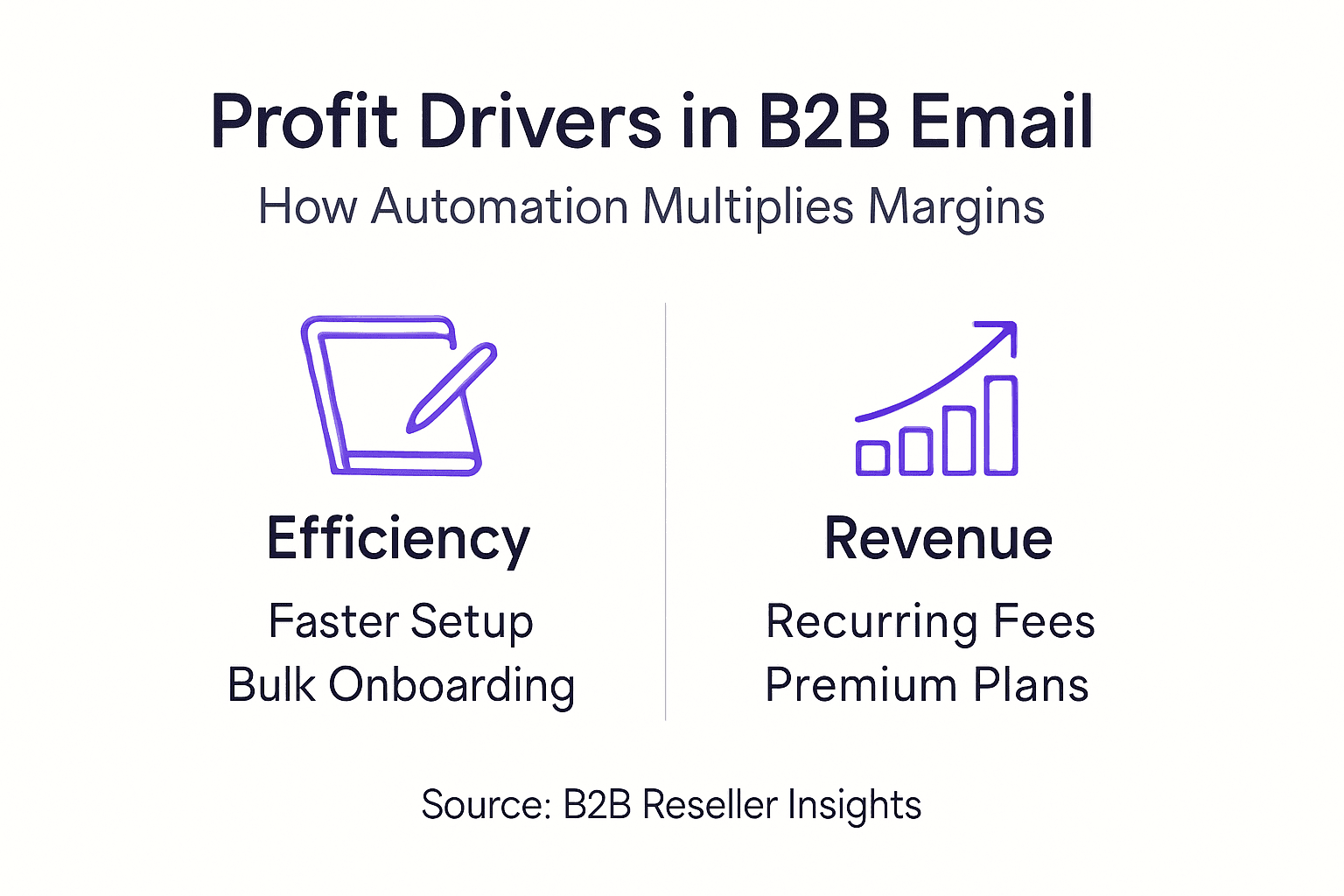
This is the lever that separates profitable resellers from those barely breaking even.
DNS and Domain Management Automation
Manually configuring DNS records for every customer kills margins fast. You lose hours to support tickets, configuration errors, and customer frustration.
Automated DNS management handles this seamlessly:
- MX record setup happens automatically when customers add a domain
- SPF, DKIM, and DMARC validation occurs in the background
- Customers see green checkmarks confirming proper setup instantly
- No manual intervention needed from your team
One platform can onboard hundreds of customers yearly without hiring additional staff. That’s pure margin expansion.
Workflow Automation and Lead Nurturing
Your customers benefit when email automation enables scaled personalization and timely engagement. This makes your white-label offering more valuable, justifying higher pricing.
Automated workflows handle:
- Trigger-based emails responding to customer actions
- Lead scoring that identifies hot prospects automatically
- Drip campaigns nurturing prospects over weeks
- Behavioral segmentation without manual list management
When customers see better engagement metrics, they renew happily and upgrade to larger plans.
Predictive Analytics and Segmentation
Manual segmentation doesn’t scale. Automation identifies patterns your team would miss, delivering smarter insights.
Automation capabilities include:
- AI-driven segmentation based on engagement history
- Predictive scoring identifying which leads convert
- Send-time optimization delivering emails when recipients open them
- Content recommendations suggesting what resonates
Customers get professional-grade marketing intelligence without hiring data scientists.
Security and Compliance Automation
Automation that reduces overhead extends to security and compliance, making your platform enterprise-grade.
Automated security features:
- Spam filtering and virus scanning on every message
- GDPR and compliance rule enforcement
- Automatic backup and disaster recovery
- Security threat detection and response
Your customers stay secure while you manage nothing manually. That’s the promise of managed hosting.
Here’s a comparison of key automation features and their business impact for B2B email resellers:
| Automation Feature | Direct Benefit | Impact on Operations |
|---|---|---|
| DNS/Domain Automation | Fast onboarding | Reduces manual support workload |
| Workflow Scheduling | Personalized outreach | Enables lead nurturing at scale |
| Predictive Analytics | Smarter targeting | Improves conversion rates |
| Security Automation | Consistent threat defense | Minimizes compliance risks |
Automation transforms your operation from service provider to strategic partner, enabling customers to scale without scaling their own teams.
Pro tip: Start by automating your highest-touch, most time-consuming customer onboarding steps first—DNS setup and initial mailbox provisioning typically deliver the fastest ROI on automation investment.
Financial Impact and Brand Control Advantages
Here’s the reality: brand control directly translates to profit margins. When customers see your name on their email platform, not a third-party provider’s, they associate quality and reliability with you.
This matters more than most resellers realize.
Higher Profit Margins Through Branding
White-label email reselling commands premium pricing because customers aren’t buying a commodity. They’re buying your brand and your promise of support.
Compare the economics:
- Generic, unbranded email hosting: $2-3 per user monthly (thin margins)
- Your white-labeled platform: $5-8 per user monthly (healthy margins)
- Your white-labeled platform with premium features: $10-15+ per user monthly (strong margins)
The underlying technology might be identical. The price difference comes entirely from brand control and positioning. Brand benefits in B2B reseller relationships include enhanced financial margins and improved customer retention outcomes.
With 1,000 customers at $7 monthly per user, you’re looking at $84,000 annual recurring revenue from brand premium alone.
Customer Retention and Lifetime Value
Customers stay longer when they feel invested in your brand. They see themselves as your clients, not generic users of a white-label product.
Brand loyalty impacts retention metrics:
- Higher renewal rates (customers stick around through price increases)
- Reduced churn from competitive offers
- Increased willingness to upgrade to premium features
- Natural referrals within their professional networks
A customer staying 3 years instead of 1.5 years doubles your lifetime value. That’s pure profit margin expansion.
Independence from Platform Ecosystems
Brand control means freedom. You don’t rely on Google, Microsoft, or any major platform deciding your pricing or feature set.
This independence delivers:
- Control over pricing strategy and margin expansion
- Freedom to add unique features your customers value
- Protection from platform policy changes affecting your business
- Ability to build deeper customer relationships
When Gmail or Outlook changes terms, you adapt. When you own the platform, you set the terms.
Strategic Market Positioning
Your brand becomes your market moat. Competitors can’t easily replicate your specific positioning, customer relationships, or reputation.
This enables:
- Premium pricing justified by your brand promise
- Customer loyalty that survives price competition
- Ability to enter adjacent markets leveraging existing brand trust
- Acquisition appeal if you ever want to sell the business
Brand control transforms email from a cost center into a strategic asset that compounds in value over time.
Pro tip: Document and showcase customer success stories prominently on your website—real examples of how your white-label platform solved specific business problems build brand credibility faster than any marketing claim.
Risks, Compliance, and Comparison to Market Giants
Profit opportunity comes with responsibility. B2B email reselling requires managing compliance risks that can devastate your business if ignored. Understanding these challenges separates successful resellers from those facing legal trouble.
The stakes are real, but manageable.
Data Privacy Compliance Requirements
Email involves customer data. That means you must comply with global privacy regulations. Non-compliance brings fines, reputation damage, and lost revenue.
Key regulations you need to understand:
- GDPR (European Union): Up to €20 million or 4% of annual revenue in penalties
- CCPA (California): Up to $7,500 per violation
- CASL (Canada): Up to $10 million in fines
- Regional laws in Australia, Brazil, and other markets
Complying with data privacy laws in B2B email requires transparent data collection, permission-based lists, and clear opt-out mechanisms. Violations destroy customer trust and trigger expensive legal exposure.
Practical Compliance Steps for Resellers
Compliance doesn’t require hiring lawyers full-time. It requires systematic approach and automation.
Implement these essentials:
- Maintain documented data processing agreements with customers
- Enforce permission-based email list standards in your platform
- Automate unsubscribe and data removal requests
- Conduct quarterly audits of customer data practices
- Provide customer documentation on compliance obligations
- Maintain encryption for data in transit and at rest
Automation handles most compliance burden. Modern email platforms include built-in compliance tools that reduce your manual work.
How You Differ from Market Giants
Google and Microsoft have massive compliance teams and legal resources. You don’t. But you have advantages they lack.
Your advantages:
- Direct customer relationships enable better data governance
- Smaller customer base means manageable compliance scope
- Ability to customize compliance rules per customer
- No conflicting business interests (they sell ads; you don’t)
- Faster response to regulatory changes
Google struggles with unified compliance because they serve billions of users globally. You serve thousands. That’s an advantage.
Risk Management Strategy
Build compliance into your operations from the start, not as an afterthought.
Key risk management areas:
- Partner vetting: Audit your email infrastructure provider’s compliance certifications
- Ongoing monitoring: Track regulatory changes in target markets
- Customer education: Help customers understand their own compliance obligations
- Documentation: Keep records proving you took reasonable compliance steps
- Employee training: Ensure your team understands privacy requirements
Compliance is a competitive advantage, not a burden. Customers increasingly demand proof that their email provider takes data protection seriously.
Pro tip: Start with SOC 2 Type II certification for your platform—it demonstrates to customers that you take compliance seriously and reduces liability concerns when they evaluate your service.
Unlock Higher Profit Margins with Custom-Branded B2B Email Solutions
The article highlights a crucial challenge for B2B email resellers: achieving strong profit margins while maintaining full brand control and simplifying complex technical tasks like DNS management and compliance. Many resellers face inefficiencies from manual onboarding, limited automation, and dependence on large ecosystems that limit their pricing power. AtrioMail directly addresses these pain points by offering a fully managed, white-label platform designed to put you in control of email infrastructure. With features such as automated DNS validation (MX, SPF, DKIM, DMARC), scalable usage-based pricing, and seamless API integration, AtrioMail empowers you to grow your business without increasing your operational overhead.
Experience these key advantages:
- Complete brand ownership so your clients see your name and trust your service
- Automation tools that reduce setup time and support tickets, boosting margins
- Independence from Google and Microsoft ecosystems to set your own pricing
- Enterprise-grade security and compliance baked into every email
For resellers ready to transform email from a commodity product into a strategic asset, AtrioMail provides the technology and support to scale confidently.
Ready to increase your recurring revenue while delivering unparalleled brand control and reliability? Explore how AtrioMail’s white-label platform can amplify your B2B email reselling success. Start your journey today by registering at AtrioMail and see why digital agencies and IT providers trust us to power their email services.
Take control now with AtrioMail’s managed email hosting and give your clients the professional, private email solutions they deserve.
Frequently Asked Questions
What is B2B email reselling?
B2B email reselling involves providing email hosting and management services to businesses under your own brand. This allows clients to use a white-labeled email platform while you handle the technical infrastructure and customer relationship.
How do B2B email resellers generate profits?
B2B email resellers generate profits by offering branded email services, charging customers per mailbox or user. By controlling the pricing and delivering additional value through support, automation, and better branding, resellers can achieve healthy profit margins.
What advantages do automated features offer in B2B email reselling?
Automated features allow B2B email resellers to reduce manual workload, streamline customer onboarding, enhance personalization, and ensure compliance. This efficiency enables resellers to manage more clients with the same resources, thereby increasing profitability.
How can I ensure compliance when reselling email services?
To ensure compliance, resellers should implement data processing agreements, maintain permission-based email lists, automate unsubscribe processes, conduct regular audits, and keep documentation of compliance efforts. Utilizing platforms with built-in compliance tools can also help manage these requirements.