
Most American mid-sized hosting providers struggle to maintain control and branding while managing email infrastructure at scale. With the demand for professional, secure business email rising worldwide, IT decision-makers face mounting pressure to deliver reliability and flexibility. This article breaks down the essentials of managed email hosting, compares solution types, and highlights critical features like white-label opportunities and robust compliance—guiding providers toward smarter offerings and bigger profit margins.
Table of Contents
- Understanding Managed Email Hosting Basics
- Types of Managed Email Hosting Solutions
- How Automation and APIs Simplify Deployment
- Brand Control and White-Label Opportunities
- Security, Compliance, and Privacy in Email Hosting
- Comparing Managed vs. Big-Tech Email Options
Key Takeaways
| Point | Details |
|---|---|
| Managed Email Hosting Benefits | Offers secure, professional communication using custom domains with enhanced control and reliability. |
| Types of Solutions | Includes reseller hosting, white-label platforms, and infrastructure-based services tailored to various business needs. |
| Automation with APIs | Streamlines deployment, reduces complexity, and enhances operational flexibility by integrating advanced email functions. |
| Compliance and Security | Essential to meet international regulations and protect user data through strong encryption and authentication protocols. |
Understanding Managed Email Hosting Basics
Managed email hosting represents a critical infrastructure service that enables businesses to establish professional, secure email communication platforms under their own custom domains. Unlike standard email services, email hosting provides dedicated mail servers to manage business communications with enhanced control and reliability.
At its core, managed email hosting allows organizations to create professional email addresses using their unique domain names, separating business communications from personal email accounts. This approach offers significant advantages including improved security, centralized email management, and brand consistency. Businesses can configure multiple user accounts, implement robust spam filtering, and maintain complete control over their communication infrastructure.
The technical backbone of managed email hosting involves sophisticated server configurations that handle email routing, storage, security, and accessibility. These platforms typically provide advanced features like encrypted communication channels, spam detection mechanisms, multi-device synchronization, and comprehensive backup systems. By outsourcing email infrastructure management, businesses can focus on core operations while ensuring professional, secure communication channels.
Pro tip: When selecting a managed email hosting provider, prioritize solutions offering robust security protocols, scalable infrastructure, and seamless integration with your existing business systems.
Types of Managed Email Hosting Solutions
Managed email hosting solutions encompass a diverse range of platforms designed to meet varying business communication needs. Email hosting providers offer multiple solution types including reseller, infrastructure, and specialized communication platforms, each tailored to specific organizational requirements and scalability objectives.
The primary categories of managed email hosting solutions include reseller hosting, white-label platforms, and infrastructure-based services. Reseller hosting allows businesses to purchase email services in bulk and rebrand them for their own client base, providing a turnkey solution for creating custom email ecosystems. White-label platforms take this concept further by enabling complete brand customization, allowing resellers to present email services as entirely their own product without visible third-party branding.
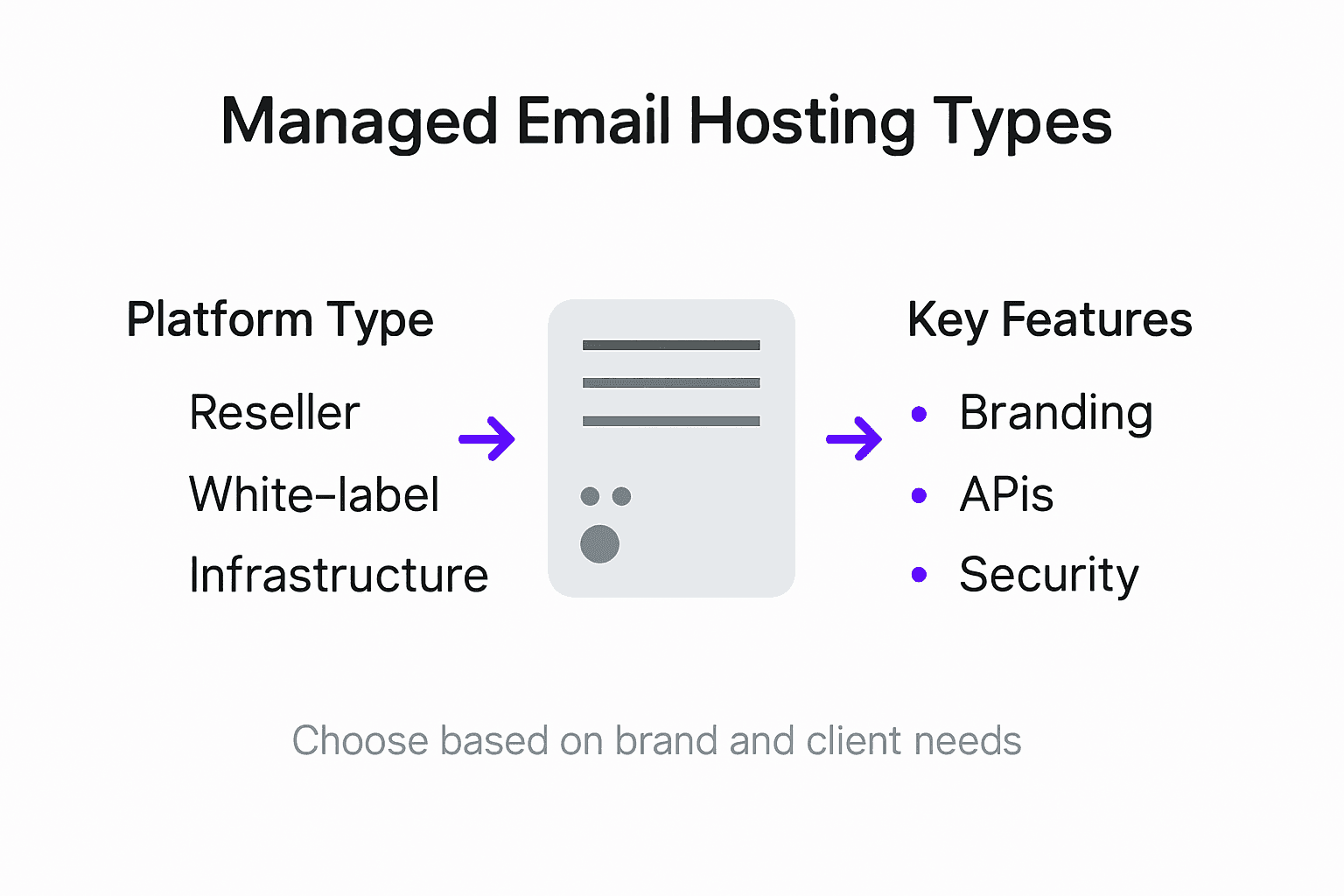
Infrastructure-based email hosting solutions provide comprehensive backend systems that support advanced features like API integration, multi-domain management, and sophisticated security protocols. These platforms typically offer granular control over email routing, authentication mechanisms, and scalable storage options. They cater to organizations requiring complex email architectures, supporting everything from small business communication networks to enterprise-level global messaging systems.
Here’s a concise comparison of managed email hosting types and their typical business use cases:
| Hosting Type | Key Characteristics | Best for |
|---|---|---|
| Reseller | Bulk purchasing, client branding | Agencies, MSPs |
| White-label | Full brand control, custom pricing | SaaS vendors, ISPs |
| Infrastructure-based | API access, advanced customization | Enterprises, Developers |
Pro tip: Evaluate potential email hosting solutions based on their scalability, security features, and customization capabilities to ensure long-term alignment with your business communication strategy.
How Automation and APIs Simplify Deployment
Email APIs enable developers to streamline complex email infrastructure deployment, transforming traditionally manual and time-consuming processes into efficient, scalable solutions. These powerful interfaces allow businesses to integrate sophisticated email functionalities directly into their existing technology ecosystems with minimal custom development effort.
The core advantages of API-driven email hosting deployment include rapid integration, reduced technical complexity, and enhanced operational flexibility. Developers can leverage standardized APIs to automate critical functions such as user provisioning, email routing, authentication mechanisms, and compliance monitoring. By implementing continuous integration and deployment (CI/CD) methodologies, organizations can create repeatable, version-controlled email infrastructure processes that minimize human error and accelerate overall system implementation.
Modern email hosting APIs support multiple communication protocols including SMTP, IMAP, and web-based interfaces, enabling comprehensive management across diverse technological environments. These APIs facilitate advanced features like automated welcome emails, password reset workflows, engagement tracking, and seamless list management. Organizations can now configure complex email systems that adapt dynamically to changing business requirements, dramatically reducing the traditional overhead associated with email infrastructure development and maintenance.
Pro tip: Select email hosting APIs that offer robust documentation, extensive language support, and flexible authentication mechanisms to ensure smooth integration and long-term scalability.
Brand Control and White-Label Opportunities
White-label email solutions empower resellers to offer professional email hosting services under their own brand, creating a powerful strategy for building independent, customizable email ecosystems without managing complex backend infrastructure. This approach allows businesses to present fully branded email services as their own proprietary offering, maintaining complete control over customer experience and brand perception.
The strategic advantages of white-label email hosting extend beyond simple rebranding. Customization options enable resellers to define unique pricing structures, service packages, and support models that differentiate them from traditional email providers. By eliminating third-party branding and controlling the entire customer interaction, resellers can create more cohesive, professional service experiences that strengthen client relationships and increase long-term retention.
Enterprise-level white-label platforms provide comprehensive features that support scalable business growth. These solutions typically include automated user provisioning, seamless domain management, robust security protocols, and flexible integration capabilities. Resellers can now offer enterprise-grade email services that rival major providers, all while maintaining a lean operational model that minimizes technical overhead and maximizes potential revenue streams.
Pro tip: Prioritize white-label email solutions that offer extensive customization options, transparent pricing models, and comprehensive API integration to maximize your brand’s unique value proposition.
Security, Compliance, and Privacy in Email Hosting
Email privacy regulations create a complex landscape of global compliance requirements for SaaS providers, demanding sophisticated strategies to protect user data and maintain legal integrity across different jurisdictions. Resellers must navigate intricate legal frameworks that vary by region, understanding nuanced requirements for data handling, consent management, and user privacy protection.
Comprehensive email hosting security encompasses multiple critical layers of protection. Authentication protocols such as SPF, DKIM, and DMARC play crucial roles in preventing email spoofing and phishing attempts. Encryption technologies like Transport Layer Security (TLS) ensure message confidentiality during transmission, while robust access controls limit potential unauthorized system interactions. These technical safeguards work in concert to create resilient email infrastructure that meets stringent security standards.

Compliance with international regulations demands proactive management of user data and communication preferences. Key legislative frameworks like the General Data Protection Regulation (GDPR) in Europe, CAN-SPAM in the United States, and CASL in Canada impose strict requirements on email communication. Successful email hosting providers must implement transparent consent mechanisms, provide clear opt-out options, and maintain meticulous records of user permissions to avoid substantial financial penalties and maintain sender reputation.
Below is a summary of major compliance regulations and their core requirements for email hosting:
| Regulation | Main Focus | Typical Requirements |
|---|---|---|
| GDPR | Data protection (EU) | Explicit consent, data access |
| CAN-SPAM | Anti-spam (US) | Unsubscribe option, honesty |
| CASL | Anti-spam (Canada) | Express consent, identification |
Pro tip: Develop a comprehensive compliance checklist that maps your email hosting practices against major international privacy regulations to ensure consistent, legally sound data management strategies.
Comparing Managed vs. Big-Tech Email Options
The landscape of business email services reveals significant differences between big-tech platforms and specialized managed email hosting solutions, each offering distinct advantages for organizations with unique operational requirements. Large technology providers like Google and Microsoft dominate the market with integrated productivity tools, while managed email hosting emphasizes customization, privacy, and granular control.
Big-tech email platforms excel in broad collaboration features, providing seamless integration across productivity suites and extensive cloud infrastructure. However, managed email hosting emerges as a compelling alternative for businesses prioritizing data sovereignty, compliance, and brand-specific customization. These specialized solutions offer enhanced security protocols, dedicated infrastructure, and the ability to maintain complete control over email communication environments without relying on generic, one-size-fits-all approaches.
The fundamental trade-offs between big-tech and managed email hosting become apparent when examining specific organizational needs. Enterprises requiring strict regulatory compliance, advanced security configurations, or unique branding opportunities will find managed email hosting significantly more aligned with their strategic objectives. Unlike standardized big-tech solutions, managed platforms enable resellers to create fully customized email ecosystems that reflect their specific operational requirements, technical constraints, and client expectations.
Pro tip: Conduct a comprehensive audit of your organization’s email communication needs, focusing on security requirements, compliance mandates, and customization potential before selecting between big-tech and managed email hosting solutions.
Empower Your Reseller Business with White-Label Managed Email Hosting
The article highlights the critical challenges resellers face in managing complex email infrastructure while striving for full brand control, security, and scalability. If you are seeking a solution that eliminates the technical headaches of email deployment and offers complete white-label branding, automated DNS validation (MX, SPF, DKIM, DMARC), and flexible, usage-based pricing, AtrioMail is designed specifically for your needs. By partnering with AtrioMail, resellers, hosting providers, and IT agencies gain independence from big ecosystems like Google and Microsoft—enabling you to enhance your profit margins without compromising on enterprise-grade email security or compliance.
With seamless API integration, streamlined client management tools, and powerful domain control, AtrioMail allows you to deliver a fully branded email experience that scales as your business grows. Stop juggling complex backend systems and focus on what matters most: strengthening customer relationships and expanding your service portfolio.
Start transforming your email service offering today by registering with AtrioMail and experience firsthand how our managed email hosting platform simplifies your deployment and operations while maximizing your brand’s unique value.
Boost your reseller business now with AtrioMail. Visit AtrioMail registration to get started and take control of your email hosting future.
Frequently Asked Questions
What is managed email hosting for resellers?
Managed email hosting for resellers is a service that allows businesses to purchase email services in bulk and rebrand them for their own clients, enabling customized email ecosystems without the burden of managing complex backend infrastructures.
What are the benefits of using white-label email hosting solutions?
White-label email hosting solutions provide complete brand control, allowing resellers to customize pricing structures, service packages, and customer support without the presence of third-party branding, enhancing the overall customer experience.
How does API integration simplify the deployment of email hosting services?
API integration simplifies deployment by allowing developers to automate essential functions like user provisioning, email routing, and compliance monitoring, thus reducing technical complexity and accelerating deployment time.
What are the key security regulations to consider when choosing a managed email hosting provider?
When selecting a managed email hosting provider, it is crucial to consider compliance with regulations such as GDPR, CAN-SPAM, and CASL, as they dictate requirements for data handling, consent management, and user privacy protection.
Recommended
- Your Brand, Your Rules: Profiting from Fully Managed Email Services – Atriomail
- Empower Your Brand: Boost Revenue by Owning Email Services – Atriomail
- Email Marketing Explained: Understanding Its Importance
- Wat Is E-mailmarketing? Complete Uitleg Voor Webshops
- Understanding Email Security: Protecting Your Business – IT Start